Limestone Mining Lease Revocation Lifted to Support Small MSMEs
Source:business-standard ↗
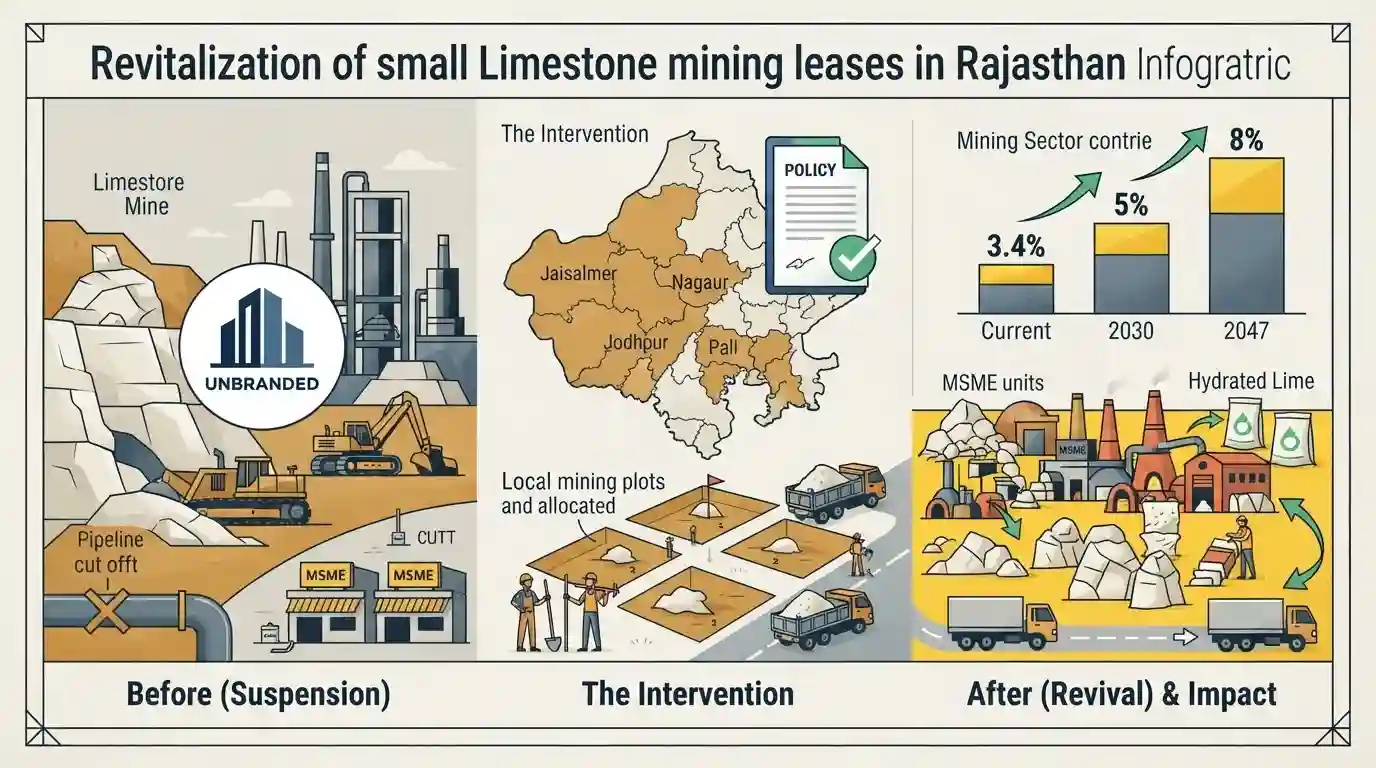
Why It Matters
The article provides exact data points for the Rajasthan Mineral Policy 2024 (GDP targets of 3.4% to 5% and 8%), which was directly tested in the RPSC RAS Prelims 2025. It also highlights the geographical distribution of a crucial industrial mineral (Limestone) across major Rajasthan districts.
Summary
Rajasthan is set to revive the allocation of small limestone mining leases, a practice suspended nearly a decade ago after the central government classified limestone as a major mineral. This suspension forced the auctioning of massive mineral blocks, which overwhelmingly favoured large cement corporations and caused an acute raw material shortage for over 2,000 MSMEs producing quicklime and hydrated lime. By reintroducing smaller leases in key limestone-rich districts like Jaisalmer, Nagaur, Jodhpur, and Pali, the state aims to support local industries and boost employment. This initiative is a critical step under the Rajasthan Mineral Policy 2024, which seeks to elevate the mining sector's contribution to the state's Gross State Domestic Product (GSDP) from 3.4% to 5% by 2030, and eventually up to 8% by 2047.
Key Points
- The Rajasthan government is lifting a nearly 10-year suspension on the allocation of small limestone mining leases.
- The halt was triggered by the Ministry of Mines classifying limestone as a 'major mineral', leading to auctions of large 10-sq-km blocks that favoured large cement companies and neglected small miners.
- This policy shift created severe raw material shortages for over 2,000 small and medium units producing quicklime and hydrated lime.
- About 85-90% of India's high-quality chemical-grade limestone (which constitutes only 1% of total reserves) is concentrated in Rajasthan districts like Jaisalmer, Nagaur, Jodhpur, and Pali.
- The move aligns with the Rajasthan Mineral Policy 2024, which targets increasing the mining sector's contribution to state GDP from 3.4% currently to 5% by FY30 and 8% by FY47.
Important Terms
Rajasthan Mineral Policy 2024

A state framework aiming to increase mining's GSDP contribution to 8% by 2047. It focuses on sustainable, zero-waste extraction, curbing illegal mining, and supporting local MSMEs through tailored lease allocations.
UPSC context
Important for GS Paper 3 (Economy). Tests knowledge of state-level resource mobilization, sustainable development, and industrial policy.
Major Minerals
A legal classification under the MMDR Act, 1957, regulated primarily by the Central government. Designating minerals like limestone as "major" mandates large-block auctioning, strongly influencing raw material access for smaller industries.
UPSC context
Highly relevant for GS Paper 1 (Geography) and GS 2 (Federalism), focusing on Center-State jurisdiction over natural resources.
Ministry of Mines
The central government body responsible for administering the MMDR Act, 1957. It dictates national mining frameworks and determines the classification of minerals (major vs. minor), directly impacting state-level leasing procedures.
UPSC context
Relevant to GS Paper 2 (Governance). Tests understanding of federal resource allocation and the statutory bodies governing extraction.
MSME Sector
Micro, Small, and Medium Enterprises form the backbone of local industrial ecosystems. In mineral-rich regions, MSMEs rely heavily on small mining leases to source raw materials, remaining highly vulnerable to policy shifts.
UPSC context
Crucial for GS Paper 3 (Economy), examining industrial growth, supply chain bottlenecks, and employment generation policies.
Prelims Trap
The Central Government conducts auctions and grants mining leases for major minerals like limestone.
State governments auction and grant mining leases for both major and minor minerals. The Centre only provides the regulatory framework for major minerals under the MMDR Act.
Static Concepts Connected
What is the regulatory distinction between Major and Minor minerals?
- Classification: The Centre notifies 'major' minerals (e.g., iron ore, limestone). State governments declare 'minor' minerals (e.g., building stones, sand, gravel).
- Regulation: The Centre frames the overarching rules for major minerals; States frame rules for minor minerals, retaining rule-making autonomy.
- Leasing powers: State governments conduct auctions and grant leases for both major and minor minerals (except atomic/offshore), collecting the royalty.
How do different grades of limestone serve distinct industrial sectors?
- Cement grade: Requires ~44% calcium oxide and is bulk-mined for clinker production, primarily utilized by large-scale cement manufacturing plants.
- Chemical grade: High-purity limestone, primarily found in Rajasthan, is heated to make quicklime for glass, agriculture, and chemical MSMEs.
- SMS grade: Steel Melting Shop (SMS) grade, largely sourced from Jaisalmer, acts as a crucial flux in steelmaking to remove impurities.
Cross-Topic Patterns
Mineral monopolies & MSME stress
Standardizing mineral classifications (like bulk limestone auctions) often inadvertently creates raw-material monopolies for large corporations, strangling localized MSME supply chains.
Western Rajasthan's geological wealth
The same western arid sedimentary basins hosting oil/gas reserves (Barmer) and immense solar potential also contain India's rarest high-purity chemical and SMS grade limestone.

Prelims 2026 will likely test the MMDR Act, specifically state vs. central powers in auctioning major vs. minor minerals like limestone.
Linked PYQs · 4
Linked PYQs · 4
- 2025RPSC_PRELIMSGS1
Consider the following statements with reference to the goals of the Rajasthan Mineral Policy – 2024: A. To provide employment to 1 crore direct and indirect persons by 2046-47 and 50 lakh persons by 2029-30. B. To increase the contribution of the mineral sector to the state’s Gross State Domestic Product from 3.4 percent in 2023-24 to 5 percent by 2029-30 and 8 percent by 2046-47. C. To increase the number of minerals covered under mining to 70 from 58 by 2047. Which of the statements are correct?
- 2013RPSC_PRELIMSGS1
Which of the following statements is/are correct? 1. Rajasthan has a very rich mineral base and accounts for about 22 percent of the country's industrial mineral production. 2. The contribution of mining to Rajasthan's GDP is approximately 5 percent. 3. There are sufficient reserves of lignite in western Rajasthan.
- 2025RPSC_PRELIMSGS1
Where are the most important resources of lignite located in Rajasthan?
- 2018RPSC_PRELIMSGS1
Which of the following minerals is Rajasthan almost the sole producing state for? (a) Lead and Zinc Ores (b) Copper Ore (c) Wollastonite (d) Selenite Code:
