Rajasthan announces statewide campaign to destroy seized narcotics
Source:lokmattimes ↗
Why It Matters
Highlighting the state's proactive measures in tackling drug trafficking, this development illustrates the practical application of the NDPS Act and coordination mechanisms like NCORD. It is relevant for questions on state administration, internal security challenges, and public health policies in Rajasthan.
Summary
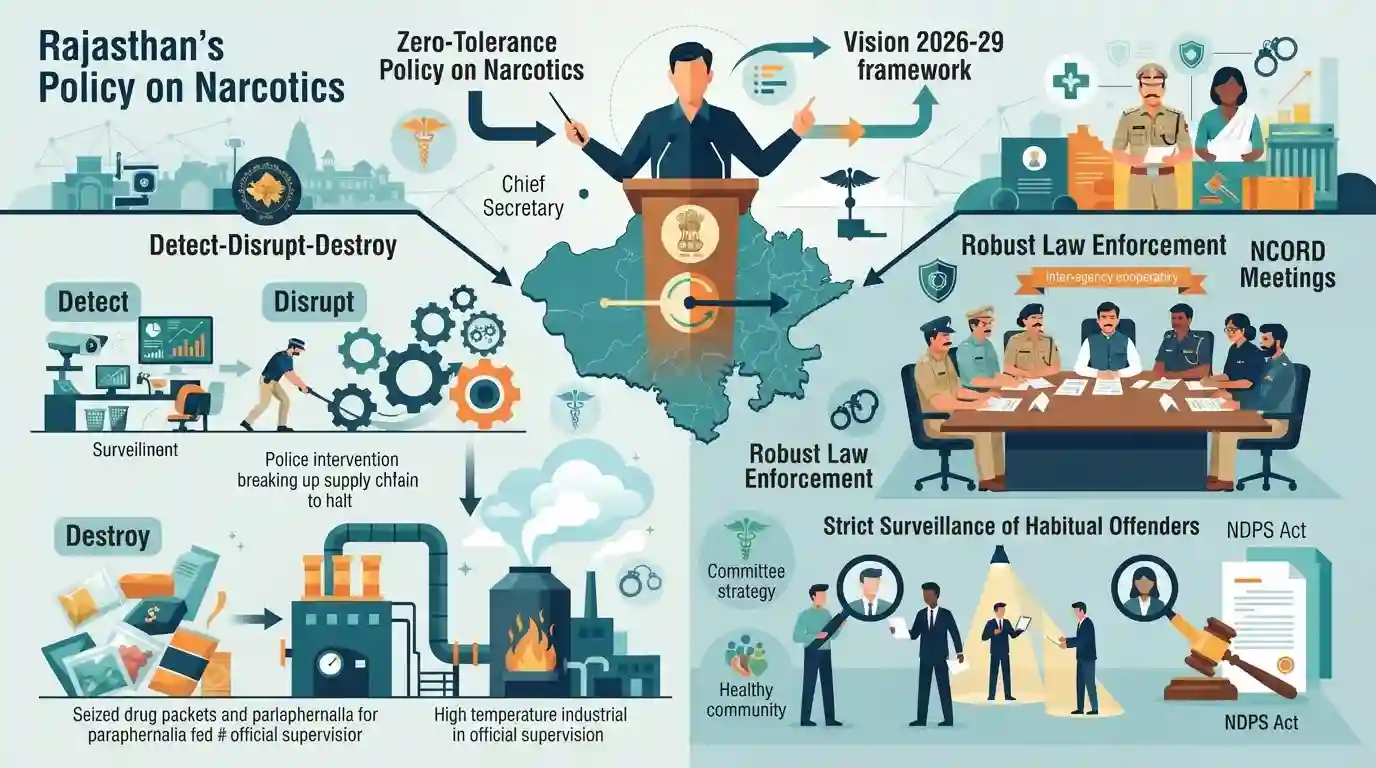
Rajasthan has announced a comprehensive statewide drive to destroy seized narcotics as part of its intensified efforts against drug mafias. Under the leadership of Chief Secretary V. Srinivas, the state is formulating a 'Zero-Tolerance Policy on Narcotics' aligned with its Vision 2026-29 framework and the central government's 'Detect-Disrupt-Destroy' strategy. The initiative emphasizes robust law enforcement, regular NCORD meetings, and strict surveillance of habitual offenders under the NDPS Act to curb drug trafficking and substance abuse across the state.
Key Points
- The Rajasthan government is initiating a simultaneous statewide campaign to destroy seized narcotics and prohibited substances to intensify its crackdown on drug syndicates.
- Chief Secretary V. Srinivas directed the implementation of the state's Vision 2026-29 framework to establish a 'Zero-Tolerance Policy on Narcotics'.
- The state's approach mirrors the central government's 'Detect-Disrupt-Destroy' strategy to dismantle drug networks and curb substance abuse.
- Strict surveillance and enforcement measures will be applied to habitual offenders previously charged under the NDPS Act.
Important Terms
Narcotic Drugs and Psychotropic Substances (NDPS) Act, 1985

An Act of Parliament that prohibits the manufacture, sale, possession, and consumption of narcotic drugs and psychotropic substances except for medical purposes, prescribing severe penalties, seizure of assets, and the death penalty for repeat offenders.
UPSC context
GS Paper III (Internal Security) and GS Paper II (Social Justice) — tests legal mechanisms combatting drug trafficking and rehabilitation frameworks.
Narco Coordination Centre (NCORD)
A four-tier institutional mechanism under the Ministry of Home Affairs established to enhance communication, intelligence sharing, and coordination between state and central law enforcement agencies fighting the drug menace.
UPSC context
GS Paper II (Governance) and GS Paper III (Internal Security) — tests inter-agency coordination, center-state relations, and security management.
Narcotics Control Vision Document (2026–2029)
A national roadmap issued by the Ministry of Home Affairs to systematically dismantle drug syndicates, enforce strict law enforcement, and support the rehabilitation of addicted youth by 2029.
UPSC context
GS Paper III (Internal Security) and GS Paper II (Social Justice) — tests strategic national policies, anti-drug roadmaps, and state-level policy alignment.
'Detect-Disrupt-Destroy' Strategy
The core operational doctrine of the national drug control vision, designed to detect trafficking networks, disrupt illicit financial conduits, and permanently destroy narcotics cartels.
UPSC context
GS Paper III (Internal Security) — tests state responses to organized crime, cross-border narco-terrorism, and supply-chain disruption strategies.
Prelims Trap
The Narcotics Control Bureau (NCB) holds exclusive jurisdiction over the enforcement of the NDPS Act across all Indian states.
The NDPS Act empowers both central agencies (like NCB and DRI) and state governments (State Police, Excise) to enforce its provisions and make seizures.
Static Concepts Connected
What is the four-tier structure of the Narco Coordination Centre (NCORD)?
- Apex Level: Headed by the Union Home Secretary to facilitate national policy formation and inter-agency coordination.
- Executive Level: Headed by the Special Secretary (Internal Security), MHA, handling operational coordination at the center.
- State Level: Headed by the Chief Secretary of the state to ensure statewide policy implementation.
- District Level: Headed by the District Magistrate (DM) to monitor localized law enforcement and awareness campaigns.
How does India's geography exacerbate its vulnerability to drug trafficking?
- Golden Crescent: India's western border is wedged next to the illicit opium production hubs of Iran, Afghanistan, and Pakistan.
- Golden Triangle: The porous eastern border faces heavy drug trafficking and smuggling from Myanmar, Laos, and Thailand.
- Narco-Terrorism Nexus: Drug syndicates exploit these borders to fund insurgencies, intertwining narcotics trafficking with terror financing and arms smuggling.
Cross-Topic Patterns
Supply vs Demand Reduction Policies
While MHA handles supply reduction via the NDPS Act and NCORD, the Ministry of Social Justice and Empowerment focuses on demand reduction and rehabilitation via the Nasha Mukt Bharat Abhiyaan.
Federalism in Internal Security
The prominent role of the Chief Secretary in state-level NCORD meetings illustrates cooperative federalism, where state administrative machinery acts as the linchpin for central 'Detect-Disrupt-Destroy' security mandates.

Expect a multi-statement question on NDPS enforcement spanning MHA's NCORD tiers, state jurisdiction, and Nasha Mukt Bharat Abhiyaan.
Linked PYQs · 2
Linked PYQs · 2
- 2023RPSC_PRELIMSGS1
Which of the following is a narcotic analgesic drug?
- 2021RPSC_PRELIMSGS1
Who is authorized to appoint the Chairman of the Rajasthan State Human Rights Commission?
