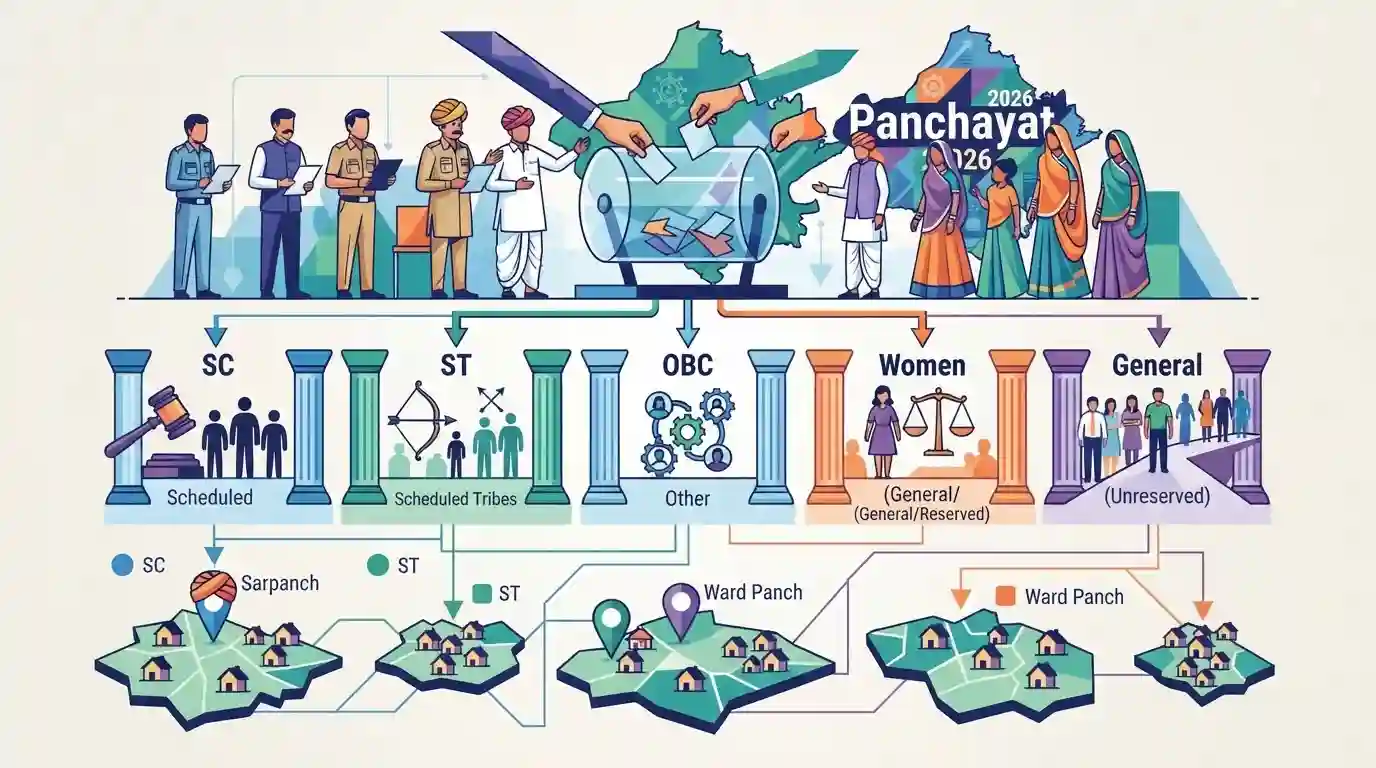
Rajasthan Panchayat Polls conduct reservation lottery for local seats
Source:plutusias ↗
Why It Matters
Crucial for understanding grassroots democracy, local governance administration, and reservation policies under the Panchayati Raj framework in Rajasthan.
Summary
The article discusses the reservation lottery process for Sarpanch and Ward Panch seats ahead of the Rajasthan Panchayat Polls 2026, highlighting the administrative steps for seat allocation across various reservation categories.
Key Points
- Reservation lottery for Sarpanch and Ward Panch seats conducted for Rajasthan Panchayat Polls 2026.
- The process involves determining reservations for Scheduled Castes (SC), Scheduled Tribes (ST), Other Backward Classes (OBC), and Women in local self-government institutions.
- Local administrative bodies oversee the transparent draw of lots at district or block headquarters as per statutory rules.
Important Terms
Rajasthan Panchayati Raj Act 1994

Legislation enacted in 1994 to establish a three-tier Panchayati Raj system in Rajasthan, detailing structures, powers, devolution of finances, and reservation of seats for marginalized groups and women in local bodies.
UPSC context
RPSC RAS Prelims/Mains (Rajasthan Polity - Local Self Government): Tests statutory provisions, administrative framework, and reservation rules for rural local governance in Rajasthan.
73rd Constitutional Amendment Act
A landmark constitutional reform adding Part IX to the Constitution, mandating regular elections, reservation for women, SC, and ST, and empowering Panchayati Raj institutions across India.
UPSC context
RPSC RAS Prelims/Mains (Indian Polity - Decentralization): Tests constitutional provisions, democratic decentralization, and mandatory institutional structures of rural local governance.
State Election Commission Rajasthan
An autonomous constitutional body responsible for superintending, directing, and conducting free and fair elections to urban local bodies and Panchayati Raj institutions in Rajasthan under Articles 243K and 243ZA.
UPSC context
RPSC RAS Prelims/Mains (Constitutional Bodies/Rajasthan Polity): Tests the jurisdiction, powers, and role of the election commission in conducting local body elections.
Prelims Trap
Women reservation in Rajasthan Panchayati Raj is restricted to 33 percent of the total seats.
Aspirants often confuse the 33% minimum reservation mandated by the 73rd Constitutional Amendment with the 50% reservation specifically adopted by Rajasthan for women in Panchayati Raj institutions.
Static Concepts Connected
What are the key constitutional provisions and institutional structures governing Panchayati Raj institutions in Rajasthan?
- Rajasthan Act 1994: Enacted in 1994 following the 73rd Constitutional Amendment Act, 1992, establishing a three-tier structure (Gram Panchayat, Panchayat Samiti, Zilla Parishad).
- Women Reservation: Mandatory 50% reservation for women across all categories (SC, ST, OBC, General) in Panchayati Raj institutions in Rajasthan.
- State Election Comm.: Conducted under the superintendence, direction, and control of the State Election Commission as per Article 243K.
Cross-Topic Patterns
Panchayati Raj history + 73rd Constitutional Amendment
Rajasthan was the pioneer of Panchayati Raj in 1959, linking grassroots administration directly with democratic decentralization under Article 40 and the 73rd Amendment.

Expect statement-based questions on percentage of women's reservation, tribal district exemptions, and constitutional backing in Rajasthan.
Linked PYQs · 2
Linked PYQs · 2
- 2023RPSC_PRELIMSGS1
By which amendment Act was 'Gram Sevak' replaced by 'Gram Vikas Adhikari'?
- 2018RPSC_PRELIMSGS1
Which of the following Act/Rule provides for joint meetings of Gram Sabhas in Rajasthan?
