Rajasthan OBC Demographic Survey for Local Body Reservations
Source:socialnews-xyz ↗
Why It Matters
This article provides a real-world illustration of the legal, constitutional, and administrative complexities surrounding local body elections and reservation quotas in India. For RPSC RAS and UPSC aspirants, it highlights the intersection of Article 243 (Panchayats and Municipalities), the role of the State Election Commission, the judicial enforceability of the Supreme Court's 'triple test' criteria, and the administrative challenges of conducting state-level demographic surveys.
Summary
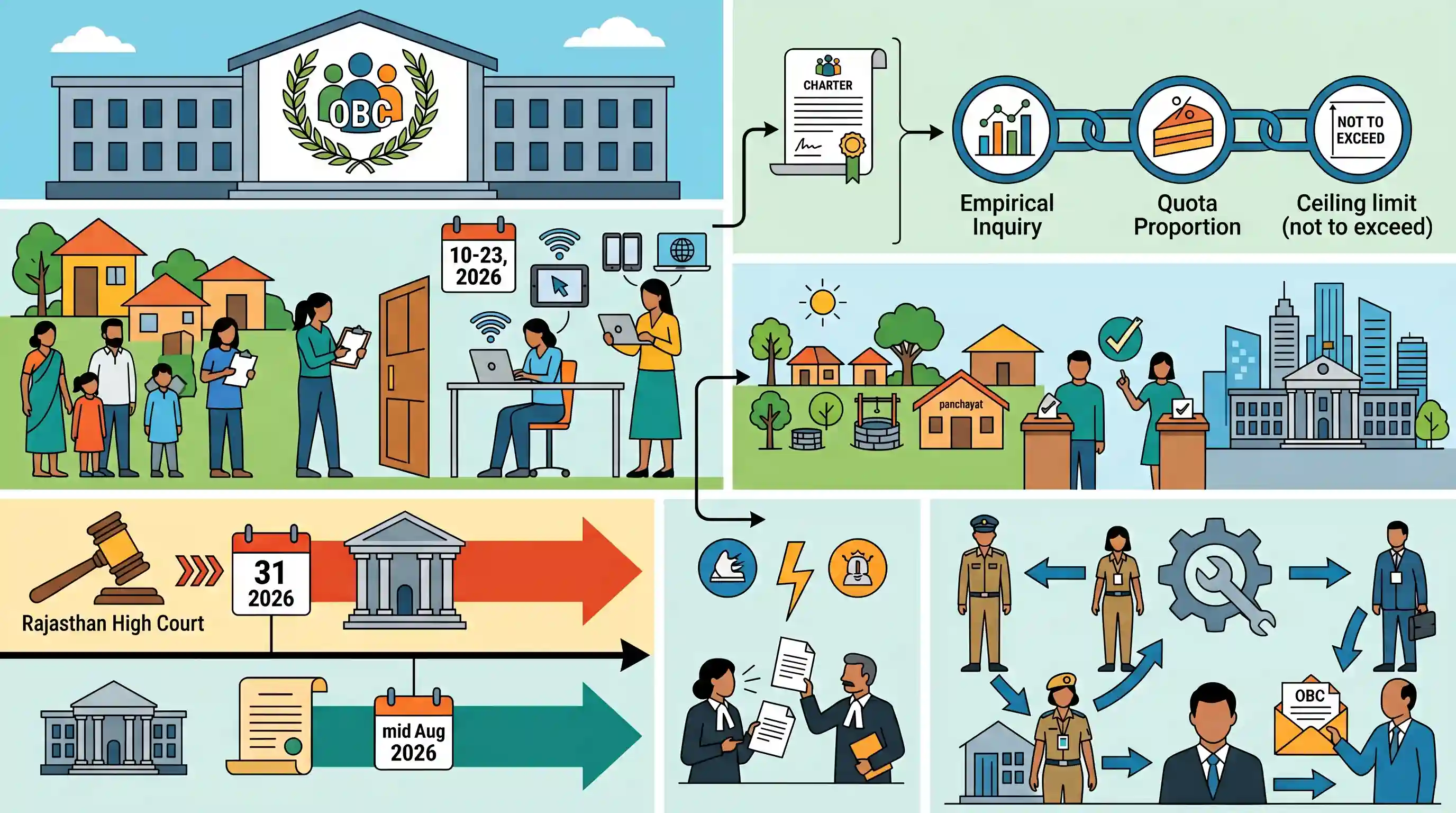
The Rajasthan OBC Commission is launching a statewide door-to-door and online demographic survey of Other Backward Class (OBC) households from July 10 to July 23, 2026. Designed to fulfill the Supreme Court's mandated 'triple test' criteria, the survey will determine OBC reservation quotas for upcoming Panchayati Raj and Urban Local Body (ULB) elections in Rajasthan. While the Rajasthan High Court had set a deadline of July 31, 2026, for conducting these local elections, the state government maintains that the polls can only proceed after the commission submits its empirical report in mid-August. This clash has led to legal challenges, including a contempt petition and caveat filed by Congress leader Sanyam Lodha. Meanwhile, the OBC Commission has urged the Chief Secretary to manage the transition of government personnel smoothly, as ongoing employee transfers threaten to disrupt the survey process.
Key Points
- The Rajasthan OBC Commission is conducting a statewide door-to-door and online survey of OBC families from July 10 to July 23, 2026, to assess reservation needs for local body elections.
- This survey is being executed to comply with the Supreme Court's 'triple test' criteria, which requires a rigorous empirical inquiry by a dedicated commission before reserving seats for OBCs in local bodies.
- The Rajasthan High Court had previously directed the state government to conduct the Panchayati Raj and Urban Local Body (ULB) elections by July 31, 2026. However, the state argues elections cannot occur until the OBC quotas are finalized.
- Congress leader Sanyam Lodha has filed a contempt petition in the High Court over the delay in holding the elections and has filed a caveat to ensure he is heard prior to any extension granted to the government.
- The OBC Commission has warned that the state government's ongoing transfer of government employees (extended till July 10, 2026) could disrupt the work of nodal officers and enumerators, delaying the report scheduled for mid-August.
Important Terms
Triple Test Formula (Supreme Court Mandate)

A three-step judicial framework mandated by the Supreme Court to provide OBC reservations in local body polls, requiring a dedicated empirical commission, local-body-wise quota specification, and a 50% aggregate reservation cap.
UPSC context
GS Paper II (Polity & Governance): Essential for questions on local self-government, federalism, judicial safeguards, and backward classes reservation.
Rajasthan OBC Commission
The statutory body (officially Rajasthan State Backward Classes Commission) constituted to examine and make recommendations on inclusion, exclusion, and empirical backwardness of classes in Rajasthan's OBC list.
UPSC context
GS Paper II (Constitutional & Statutory Bodies): Tests understanding of state-level commissions for vulnerable sections and their functional role.
State Election Commission of Rajasthan
An autonomous, single-member constitutional body established under Articles 243K and 243ZA to superintend, direct, and control the preparation of electoral rolls and conduct elections for state local bodies.
UPSC context
GS Paper II (Polity): Tests decentralized governance, Articles 243K/243ZA, and the structural independence of local electoral machinery.
Rajasthan High Court
The highest judicial organ in the state of Rajasthan, established under Article 214 of the Constitution, possessing original, appellate, and writ jurisdiction to uphold constitutional mandates and oversee local body elections.
UPSC context
GS Paper II (Judiciary): Evaluates structure, powers, writ jurisdiction (Article 226), and judicial review over state actions and local timelines.
Supreme Court of India
The apex judicial body of India under Article 124 of the Constitution, serving as the final interpreter of the Constitution, guarantor of fundamental rights, and creator of binding precedents like the triple-test mandate.
UPSC context
GS Paper II (Judiciary): Crucial for studying judicial activism, landmark judgments on reservation, and the separation of powers.
Prelims Trap
Reservation for backward classes (OBCs) is constitutionally mandatory in local bodies under Article 243, matching SC/ST provisions.
Under Articles 243D(6) and 243T(6), reserving seats for backward classes (OBCs) is entirely discretionary for state legislatures, unlike the mandatory, population-linked reservations for SCs and STs.
Static Concepts Connected
What constitutes the Supreme Court's 'Triple Test' formula for local body reservations?
- Dedicated Commission: A dedicated State Commission must conduct a contemporaneous, empirical inquiry into the nature and implications of backwardness in local bodies.
- Proportionate Quota: The specific proportion of reservation must be determined local body-wise based on the commission's detailed recommendations.
- 50% Ceiling: The total reservation (SC + ST + OBC) must not exceed 50% of the total seats in any local body.
How does political backwardness differ from social/educational backwardness in reservation jurisprudence?
- Social & Educational: Relates to barriers in accessing public employment and higher education, governed under Articles 15(4) and 16(4).
- Political Backwardness: Relates to lack of political representation and governance voice in local bodies, under Articles 243D(6) and 243T(6).
- Judicial Distinction: The Supreme Court (K. Krishna Murthy case) ruled these two are distinct; thus, job-reservation lists cannot be applied blindly to local bodies.
Cross-Topic Patterns
Local Election Timelines vs. State Autonomy
State governments often postpone local body elections citing pending demographic surveys, bringing the mandate of Article 243K/243ZA into conflict with state political narratives.
Federal Census Debates & State Surveys
State-led caste and empirical surveys reflect growing federal divergence over caste-based data collection, bypassing the stalled Union-led decennial census.

Distinctions between mandatory SC/ST local reservations and discretionary OBC reservations under Article 243 are prime 2026 Prelims targets.
Linked PYQs · 2
Linked PYQs · 2
- 2013RPSC_PRELIMSGS1
Consider the following statements regarding the State Election Commission of Rajasthan – (i) It was formed under Article 243k of the Indian Constitution in July 1994. (ii) It is a multi-member commission with the State Election Commissioner as its head. (iii) It has a Secretary who is also the State Registrar of Voters. (iv) It prepares voter lists for Panchayati Raj institutions and urban bodies and conducts elections. Select the correct answer using the code given below
- 2016RPSC_PRELIMSGS1
How many times have elections been held for the Panchayati Raj institutions in Rajasthan until 2015?
