Severe Sandstorms Disrupt Visibility Across Western Desert Districts
Source:ndtv ↗
Why It Matters
Dust storms (Andhi) and the geography of the Thar Desert are recurring themes in the RPSC RAS Prelims. Candidates must understand the atmospheric mechanics (convective currents) behind these storms and the structural factors contributing to desertification in Rajasthan.
Summary
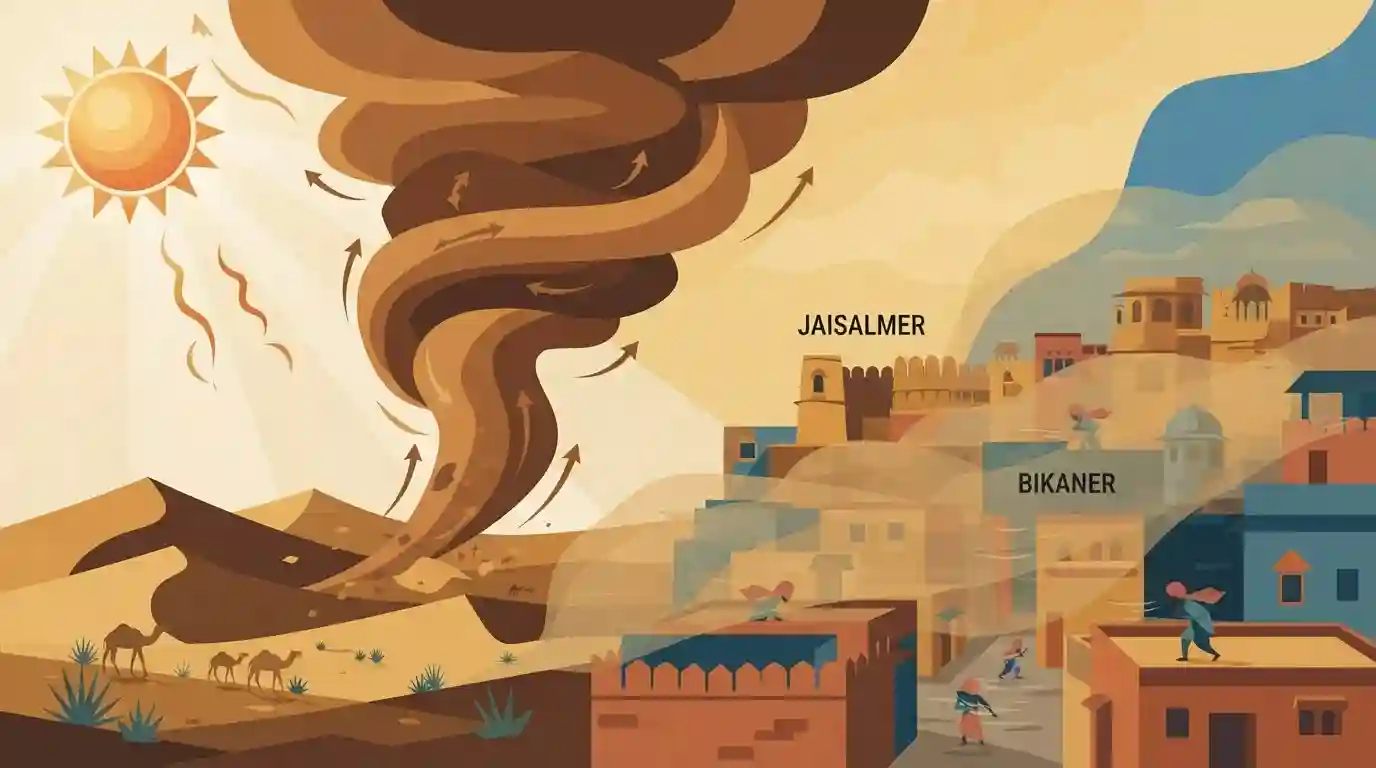
A massive sandstorm swept through Jaisalmer and Bikaner in western Rajasthan, significantly reducing visibility and covering the cities in dust. Such severe dust storms, known locally as 'Andhi', are a characteristic climatic feature of the Thar Desert region. They are primarily caused by intense surface heating during the summer, generating strong convective currents that lift loose sand. The event underscores the region's harsh arid climate and the broader geographical challenges of wind erosion and desertification in Rajasthan.
Key Points
- A severe sandstorm recently blanketed Jaisalmer and Bikaner in western Rajasthan, causing a sharp drop in visibility and disrupting daily life.
- Dust storms, locally known as 'Andhi', are a common geographical phenomenon in Rajasthan, typically occurring during the peak summer months of May and June.
- These storms are primarily driven by intense localized heating of the arid land surface, which leads to the formation of strong vertical convective currents that lift loose sand and dust into the atmosphere.
- The Thar Desert covers approximately 60% of Rajasthan's geographical area, making the region highly vulnerable to wind erosion, shifting sand dunes, and ongoing desertification.
Prelims Trap
"Dust storms ('Andhi') in Rajasthan are primarily driven by the influx of Western Disturbances during the peak summer months."
'Andhi' storms are driven by intense localized surface heating creating strong vertical convective currents, not by Western Disturbances which typically bring winter rain.
Static Concepts Connected
What are the primary mechanisms of desertification in western India?
- Aeolian processes: Wind erosion is the dominant physical driver of land degradation in western Rajasthan, far surpassing water erosion or soil salinity in arid districts.
- Geomorphological barrier: The Aravalli Range acts as a crucial geomorphological barrier that restricts the eastward expansion of shifting sand dunes into the fertile Indo-Gangetic plains.
- Dune stabilization: Institutions like CAZRI (Jodhpur) develop technologies like shelterbelts and micro-windbreaks to stabilize sand dunes and control wind erosion.
How do 'Andhi' and 'Loo' differ in northwestern India's summer climatology?
- Andhi (Dust storms): Pre-monsoon dust storms driven by strong convective currents from intense local heating. They drastically reduce visibility and can temporarily drop temperatures.
- Loo (Dry winds): Hot, dry, and oppressive winds blowing persistently during the day. Unlike Andhi, the Loo significantly raises ambient temperatures and lacks the intense dust-lifting convective columns.
Cross-Topic Patterns
Desertification and UNCCD land degradation targets
Local wind erosion events highlight India's broader struggle with land degradation, directly tying into commitments under the UN Convention to Combat Desertification (UNCCD) to restore 26 million hectares by 2030.
Aravalli mining bridging the desertification shield
The degradation of the Aravalli range through illegal mining threatens its role as a natural windbreak, accelerating the risk of the Thar Desert's eastward expansion into the NCR region.

Expect a multi-statement question contrasting local winds ('Andhi', 'Loo') and the role of the Aravallis in checking desertification.
Linked PYQs · 3
Linked PYQs · 3
- 2018RPSC_PRELIMSGS1
The dust storms occurring in Rajasthan during May-June months are responsible for: (a) Origin of convective currents at some places (b) Aravalli hills are parallel to the southwest winds. (c) Origin of very intense easterly winds
- 2016RPSC_PRELIMSGS1
What percentage of the Thar Desert is in Rajasthan?
- 2012RPSC_PRELIMSGS1
Which of the following is NOT a cause of desertification in Rajasthan?
