Rajasthan Signs Pacts With Institutions To Promote Organic Farming
Source:The Hindu ↗
Why It Matters
This initiative highlights Rajasthan's drive towards sustainable agriculture and resource optimization. Understanding state programs like 'Khet Bachao Abhiyan' and collaborations with agritech and CSOs is highly critical for RPSC RAS Prelims and Mains (Economy of Rajasthan / Agriculture).
Summary
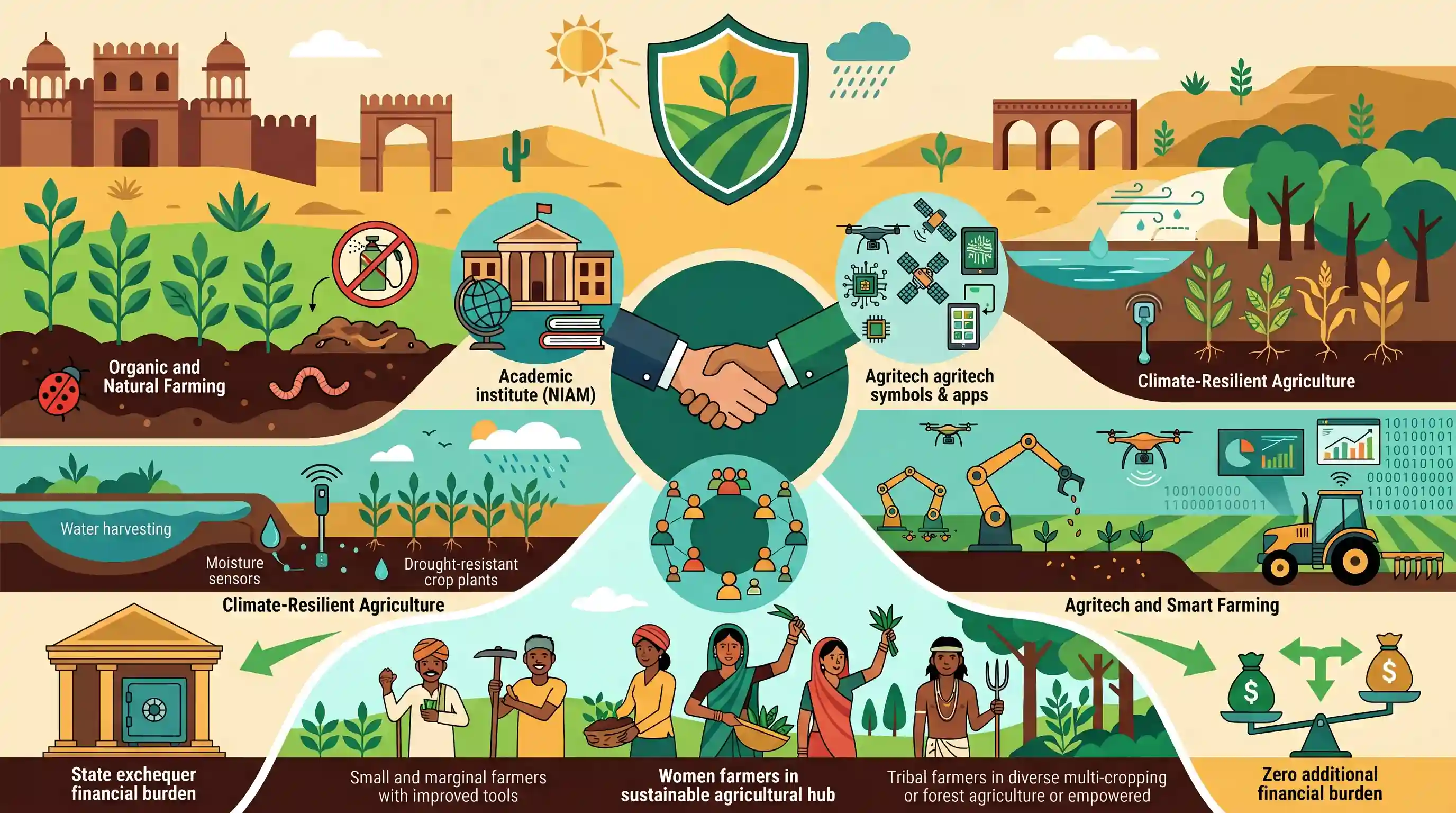
The Rajasthan Agriculture Department has signed non-financial MoUs with 32 institutions, including the National Institute of Agricultural Marketing (NIAM), 10 agritech startups, and 20 civil society organisations, to boost natural and organic farming, climate-resilient agriculture, and digital innovation. This step aligns with the 'Khet Bachao Abhiyan' to transform Rajasthan into a sustainable agricultural hub, focusing on small, marginal, women, and tribal farmers without putting any additional financial burden on the state exchequer.
Key Points
- The Department of Agriculture, Government of Rajasthan, signed non-financial MoUs with 32 institutions to promote natural farming, climate-resilient agriculture, and modern agricultural innovations in the state.
- The 32 institutions comprise the Jaipur-based National Institute of Agricultural Marketing (NIAM), 10 agritech startups, and 20 civil society organisations (CSOs).
- The initiative works in tandem with the state's ongoing 'Khet Bachao Abhiyan' (Save the Farm Campaign) to establish Rajasthan as a leading hub for organic and natural farming.
- The MoUs impose zero financial burden on the state exchequer, focusing on the optimum utilization of available resources and schemes.
- Collaboration areas include water conservation, community resource management, carbon credits, organic certification, value addition, marketing, and tribal agricultural development.
- Agritech startups will provide digital technologies and smart farming solutions, while CSOs will lead grassroots training, awareness campaigns, and the formation of farmer groups.
Important Terms
Khet Bachao Abhiyan

A nationwide, month-long campaign launched in June 2026 by the Ministry of Agriculture to combat soil degradation, promote soil testing, advocate balanced fertilizer use, and encourage sustainable agricultural practices across Indian farmlands.
UPSC context
GS Paper III (Agriculture & Environment); crucial for questions on soil health, fertilizer subsidy, sustainable farming, and land degradation neutrality.
Chaudhary Charan Singh National Institute of Agricultural Marketing (CCS NIAM)
An autonomous national-level organization established in 1988 in Jaipur, Rajasthan under the Ministry of Agriculture and Farmers Welfare, providing specialized training, research, education, and consultancy in agricultural marketing systems.
UPSC context
GS Paper III (Agriculture Marketing & Infrastructure); tests agricultural reforms, value chains, capacity building, and institutions enhancing farmers' income.
Natural Farming
A chemical-free, low-cost ecological farming approach relying on locally available bio-inputs (like cow dung and urine) and natural processes to restore soil health, minimize production costs, and enhance biodiversity.
UPSC context
GS Paper III (Sustainable Agriculture & Ecology); relevant for questions on organic farming, Zero Budget Natural Farming (ZBNF), and soil fertility.
Climate-Resilient Agriculture (CRA)
An agricultural methodology designed to adapt to, withstand, and recover from climate variability and extreme weather shocks while sustaining productivity, food security, and agricultural livelihoods.
UPSC context
GS Paper III (Agriculture, Climate Change & Environment); tests adaptation strategies, crop diversification, water conservation, and sustainable development goals.
Prelims Trap
The 'Khet Bachao Abhiyan' is a state-specific scheme conceptualized and funded solely by the Government of Rajasthan.
Though implemented aggressively in Rajasthan, Khet Bachao Abhiyan is a nationwide awareness campaign under the Union Ministry of Agriculture and Farmers Welfare.
Static Concepts Connected
How do Natural Farming and Organic Farming differ under Indian policy?
- Input sourcing: Organic farming allows external organic manures and biofertilizers, whereas natural farming strictly mandates on-farm indigenous formulations like Jeevamrit.
- Tilling practices: Natural farming discourages plowing and tilling to preserve soil biology, whereas organic farming permits conventional conservation tillage methods.
- Cost structure: Natural farming aims for extremely low-cost, zero-input cycles, while organic farming often incurs high organic certification and external input costs.
What is the mandate and structure of CCS NIAM?
- Status and location: Established in 1988 in Jaipur as an autonomous body under the Union Ministry of Agriculture and Farmers Welfare.
- Leadership: The Union Minister for Agriculture serves as the ex-officio President of its General Body.
- Primary mandate: Provides specialized training, research, consultancy, and education to reform agricultural marketing and post-harvest management.
Cross-Topic Patterns
Arid geography as organic asset
Historically low agrochemical use in Rajasthan's drylands allows rapid organic conversion, turning ecological vulnerability into a distinct agricultural advantage.
State-facilitated public-private-NGO governance
Utilizing non-financial MoUs with startups and CSOs reflects a modern governance shift toward resource optimization over direct capital-heavy public spending.

UPSC 2026 may test natural vs organic farming inputs alongside central schemes like BPKP and the newly launched Khet Bachao Abhiyan.
Linked PYQs · 1
Linked PYQs · 1
- 2013RPSC_PRELIMSGS1
The Rajasthan Agricultural Competitiveness Project was started in the year 2012-13. This project mainly emphasizes
