Rajasthan Legislative Assembly 75th Anniversary Celebrations
Source:socialnews ↗
Why It Matters
The legislative achievements and historical evolution of the Rajasthan Legislative Assembly, including its landmark acts on land reforms, Lokayukta, Panchayati Raj, and RTI, are central topics in the RPSC RAS Prelims and Mains (Polity, Governance, and Economy of Rajasthan).
Summary
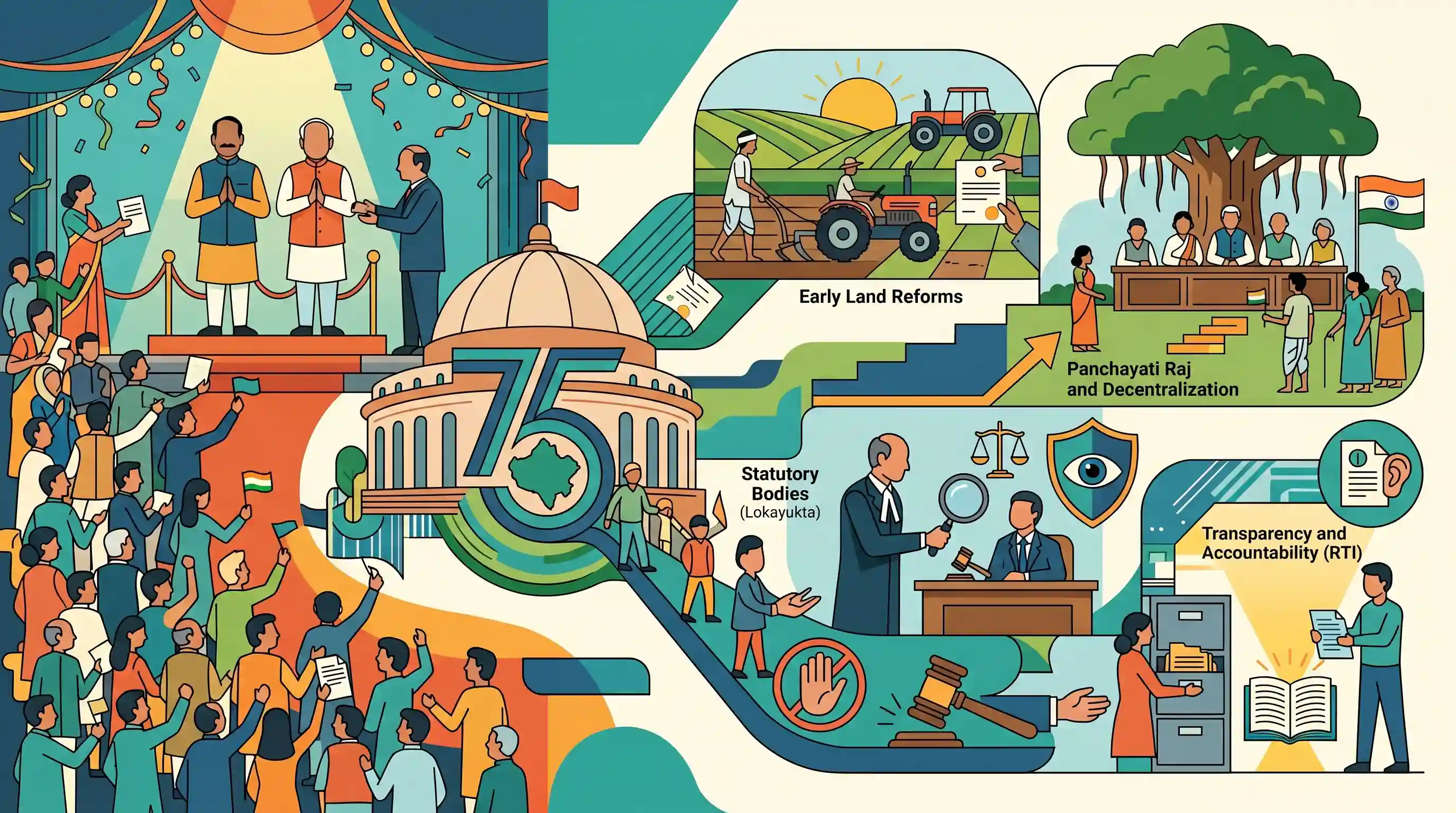
The Rajasthan Legislative Assembly is organizing a historic three-day celebration to commemorate its 75-year legislative journey. The event, chaired by Speaker Vasudev Devnani, will bring together former and current MLAs from the 1st to the 16th Assemblies. It will feature Lok Sabha Speaker Om Birla and Vice-President C.P. Radhakrishnan as chief guests. The celebration honors previous legislative leaders and highlights landmark legislations, including early land reforms, the introduction of Panchayati Raj, the establishment of the Lokayukta, and pioneering transparency laws in the state.
Key Points
- The Rajasthan Legislative Assembly is celebrating the 75th anniversary of its legislative journey (Amrit Mahotsav) with a three-day event uniting past and present MLAs from the 1st to the 16th Assemblies.
- Assembly Speaker Vasudev Devnani will chair the event, with Lok Sabha Speaker Om Birla as the Chief Guest for the inaugural session, and Vice-President & Rajya Sabha Chairman C.P. Radhakrishnan as the Chief Guest for the concluding ceremony.
- Rajasthan Governor Haribhau Bagde and Chief Minister Bhajan Lal Sharma will attend as guests of honour.
- Former Assembly Speakers (Shantilal Chaplot, Sumitra Singh, Dipendra Singh Shekhawat, Kailash Chand Meghwal, and Dr. C.P. Joshi) and Deputy Speakers (Tara Bhandari, Ramnarayan Meena, and Rao Rajendra Singh) will be formally honored.
- The celebration highlights landmark and path-breaking legislations passed by the Rajasthan Assembly over the last 75 years, including early land reform acts, the pioneering Panchayati Raj Act of 1959, the Lokayukta Act of 1973, and the state-level RTI Act of 2001.
Important Terms
Rajasthan Legislative Assembly

The unicameral legislature of Rajasthan, formed in 1952 with 160 members (now 200), responsible for enacting laws, passing the state budget, and ensuring executive accountability.
UPSC context
GS Paper II: State Legislature — Structure, functioning, and conduct of business.
Rajasthan Land Reforms and Resumption of Jagirs Act, 1952
A pioneering post-independence land reform legislation in Rajasthan aimed at eliminating the feudal 'jagir' system, resuming jagir lands, and establishing direct relations between the state and cultivators.
UPSC context
GS Paper III: Land Reforms in India; post-independence agricultural reforms.
Rajasthan Zamindari and Biswedari Abolition Act, 1959
An agrarian reform law enacted to abolish the intermediary systems of 'Zamindari' and 'Biswedari' in Rajasthan, facilitating direct tenancy rights and equitable land distribution.
UPSC context
GS Paper III: Land Reforms; abolition of intermediaries in agriculture.
Rajasthan Panchayat Samiti and Zila Parishad Act, 1959
A historic act implementing the three-tier democratic decentralization pattern recommended by the Balwant Rai Mehta Committee, making Rajasthan a pioneer of Panchayati Raj.
UPSC context
GS Paper II: Local Self-Government and Panchayati Raj decentralization.
Rajasthan Lokayukta and Up-Lokayukta Act, 1973
A statutory framework establishing the anti-corruption ombudsman (Lokayukta) in Rajasthan to investigate allegations of corruption, abuse of office, and maladministration against public servants.
UPSC context
GS Paper II: Statutory Bodies, anti-corruption institutions, and accountability.
Rajasthan Right to Information Act, 2001
A pioneering state legislation (passed in 2000, implemented in 2001) that granted citizens access to public documents, catalyzed by the grassroot MKSS movement.
UPSC context
GS Paper II: Transparency, citizen participation, and the RTI movement.
Rajasthan Guaranteed Delivery of Public Services Act, 2011
An accountability law guaranteeing time-bound delivery of notified public services in Rajasthan, featuring penalty provisions on public servants for delays or denials.
UPSC context
GS Paper II: Citizen's charters, public service delivery, and governance reforms.
Prelims Trap
The Rajasthan Lokayukta has statutory jurisdiction to investigate corruption allegations against all state public servants, including the Chief Minister and MLAs.
Under the Rajasthan Lokayukta Act, 1973, the CM, MLAs, and RPSC members are explicitly excluded from the Lokayukta's investigative ambit, unlike in states like Karnataka.
Static Concepts Connected
How did the post of Governor replace Rajpramukh in India's federal structure?
- 7th Amendment 1956: Abolished the category-based classification of states (Part A, B, C, D) and replaced the Rajpramukh with the Governor.
- States Reorganisation: Implemented Fazl Ali Commission recommendations to establish uniform executive heads across reorganised states.
- Dual Charge Provision: Amended Article 153 to permit the appointment of the same person as Governor for multiple states.
What are the structural limitations of State Lokayuktas?
- Lack of Uniformity: Created by individual state legislative acts, leading to highly uneven powers and jurisdictions across India.
- Jurisdictional Gaps: In several states, the Chief Minister, MLAs, and State Public Service Commissions are entirely excluded from jurisdiction.
- Advisory Powers: Their findings are mostly recommendatory, leaving the final disciplinary action to the state executive.
Cross-Topic Patterns
Decentralization: Nagaur to 73rd Amendment
Traces how local self-governance transitioned from Rajasthan's 1959 statutory experiment to a rigid, uniform constitutional mandate under the 73rd Constitutional Amendment Act in 1992.
Asymmetric Accountability: Lokayukta vs Lokpal
Examines how state-level anti-corruption ombudsmen (Lokayuktas) vary wildly in jurisdiction, illustrating the friction between federal diversity and uniform anti-corruption benchmarks.

The 75-year milestone of state assemblies likely prompts questions on the Rajpramukh-Governor transition and Lokayukta exclusions.
Linked PYQs · 3
Linked PYQs · 3
- 2024RPSC_PRELIMSGS1
According to the Rajasthan Lokayukta and Deputy Lokayukta Act, 1973, the Lokayukta in Rajasthan can investigate allegations against ministers and public servants in certain cases. Which of the following subject is included in such cases? (i) Involves grievance/any suffering caused by public servant. (ii) Used his position as a public servant to obtain, for himself or for any other person, any valuable thing or financial benefit. (iii) Sexual harassment of woman, cause injury to any person. (iv) Can be related to being guilty of corruption of the trust reposed in him as a public servant.
- 2025RPSC_PRELIMSGS1
Under Section 7 of the Rajasthan Lokayukta and Upa-Lokayukta Act, 1973, the Lokayukta has the power to investigate charges against ministers and public servants in certain cases. Which of the following is not part of those investigations?
- 2021RPSC_PRELIMSGS1
Which of the following statements regarding Lokayukta in Rajasthan is correct?
