Alwar Sanitation Workers Recruitment Delay and Ministerial Protest
Source:daily-pioneer ↗
Why It Matters
It illustrates the practical dynamics and occasional friction between elected political representatives (Ministers) and the district administration/bureaucracy (District Collector, Municipal Commissioner) in executing civic responsibilities and court orders at the grassroots level.
Summary
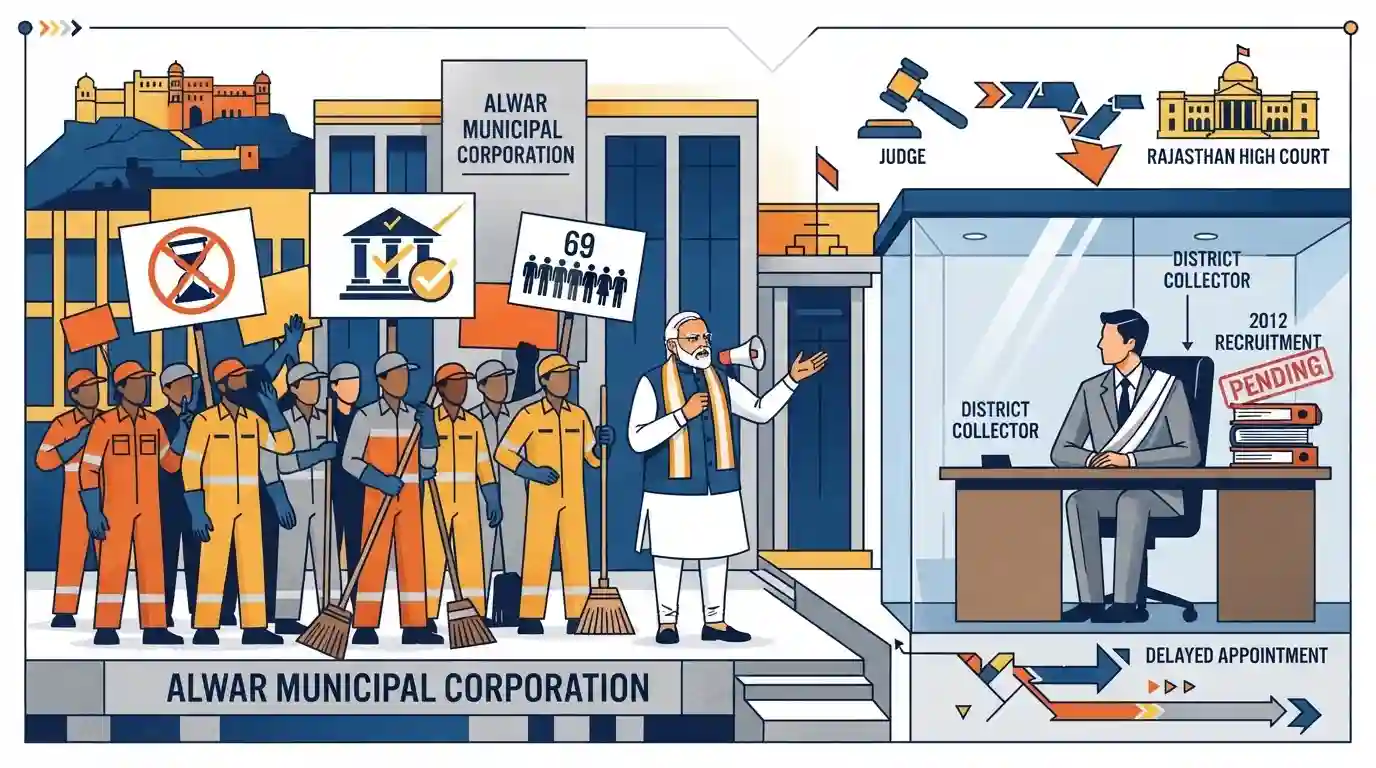
Rajasthan Minister of State Sanjay Sharma staged a protest alongside Valmiki community sanitation workers at the Alwar Municipal Corporation. The demonstration targeted the district administration, particularly the Alwar collector, for delaying the appointment of 69 candidates from a 2012 recruitment drive despite directives from the Rajasthan High Court.
Key Points
- Rajasthan Minister of State for Forests Sanjay Sharma joined a strike by sanitation workers at the Alwar Municipal Corporation.
- The workers, belonging to the Valmiki community, are protesting the delay in the appointment of 69 candidates from a 2012 recruitment drive.
- Sharma openly criticized Alwar District Collector Artika Shukla and the municipal commissioner for failing to implement the appointments despite clear directives from the Rajasthan High Court.
- The incident highlights administrative friction between the state's political executive and the district bureaucracy concerning local self-government matters.
Important Terms
Alwar Municipal Corporation

The local civic body responsible for municipal administration, sanitation, and public health in the city of Alwar, Rajasthan. It is governed by state municipal acts.
UPSC context
Tests local self-government (Paper II), urban governance issues, and the executive accountability of municipal commissioners to elected representatives.
Rajasthan High Court
The apex judicial body in the state of Rajasthan, exercising jurisdiction over all subordinate courts and tribunals in the state. It issues directives enforcing statutory rights and recruitment rules.
UPSC context
Important for understanding judicial review, executive compliance with court orders, and administrative law in GS Paper II.
Valmiki Community
A marginalized Scheduled Caste community in India historically assigned sanitation work. They frequently protest against proxy hiring and demand priority in civic sanitation recruitment drives.
UPSC context
Relevant for GS Paper I (Indian Society) and GS Paper II (Social Justice/Vulnerable Sections) regarding caste dynamics, manual scavenging, and affirmative action.
Prelims Trap
"The National Commission for Safai Karamcharis (NCSK) is a statutory body under the Ministry of Social Justice."
The NCSK was established under a 1993 Act, but its statutory status lapsed in 2004. It now operates as a non-statutory body under the Ministry of Social Justice.
Static Concepts Connected
What is the mandate and status of the NCSK?
- Current Status: It is currently a non-statutory body functioning under the Ministry of Social Justice and Empowerment since 2004.
- Core Mandate: It monitors the implementation of the Prohibition of Employment as Manual Scavengers and their Rehabilitation Act, 2013.
- Historical Origin: It was originally established as a statutory body in 1993, but its parent legislation lapsed.
What is the District Collector's role in local self-governance?
- DPC Member: Serves as an ex-officio member of the District Planning Committee (Article 243ZD), which is chaired by the elected Zila Pramukh.
- State Representative: Exercises delegated authority to monitor municipalities and can suspend execution of unlawful resolutions by local bodies.
- Electoral Role: Often designated as the District Election Officer to assist the State Election Commission in conducting local polls.
Cross-Topic Patterns
Bureaucracy vs. Political Executive friction
Protests by a Minister against their own district administration highlight friction between civil service neutrality, bureaucratic delays, and political executive accountability, a frequent theme in GS-2 and GS-4.
Judicial Directives vs. Executive Apathy
The delay in appointing workers despite High Court directives showcases the tension between judicial mandates and bureaucratic execution, illustrating issues of executive apathy often explored in GS-2 Mains.

Expect questions testing the dual subordination of the District Collector to the State Executive and local bodies under Article 243.
Linked PYQs · 2
Linked PYQs · 2
- 2021RPSC_PRELIMSGS1
According to the provisions of the Rajasthan Municipal Act, 2009, what is the maximum number of persons that the State Government can nominate in a Municipal Council?
- 2021RPSC_PRELIMSGS1
In which of the following years were Rajasthan Administrative Service officers first posted as District Collectors?
