Rajasthan pitched as living lab for agritech innovations
Source:The Hindu ↗
Why It Matters
The article highlights the practical integration of emerging technologies (AI, drones) and infrastructure (cold chains, micro-irrigation) into agriculture, directly addressing GS3 themes of e-technology for farmers and food processing. It provides a state-specific case study (Rajasthan) that can be cited in Mains answers regarding agricultural modernization and water management.
Summary
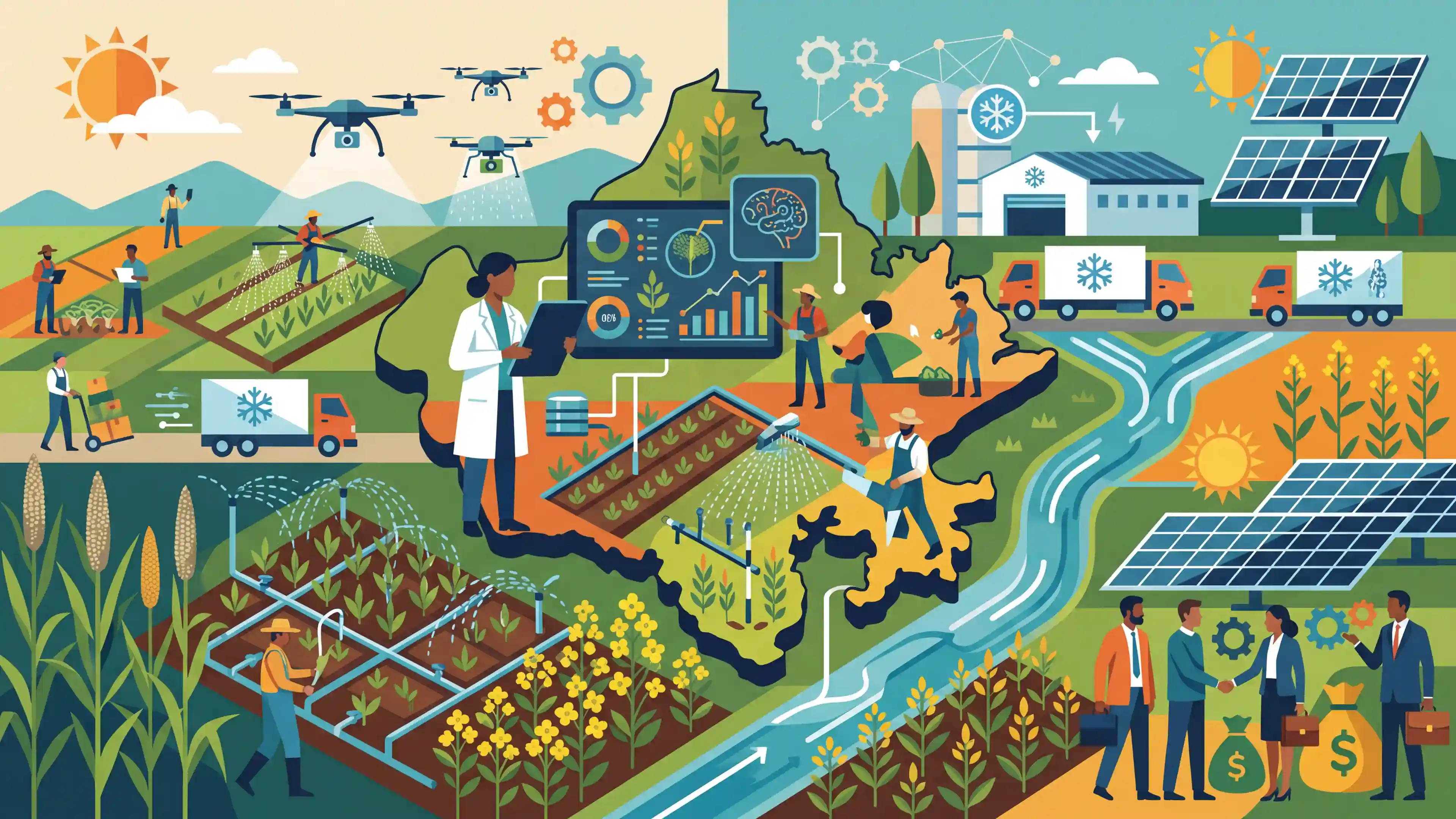
Rajasthan is positioning itself as an innovation hub for agriculture technology, with Chief Minister Bhajan Lal Sharma inviting agritech firms to use the state as a 'living lab'. Ahead of the Global Rajasthan Agritech Meet (GRAM)-2026, the government is highlighting massive investment potential in modern farming practices, including AI crop assessment, drone agriculture, cold chains, and micro-irrigation. Leveraging its leading production of bajra, mustard, and oilseeds, along with infrastructural advancements like the Yamuna Water Agreement and solar power initiatives, Rajasthan aims to modernize its agricultural sector and boost farmer incomes.
Key Points
- Rajasthan CM Bhajan Lal Sharma pitched the state as a 'living lab' for agritech companies ahead of the Global Rajasthan Agritech Meet (GRAM)-2026.
- The state offers vast investment opportunities in food processing, cold chains, modern irrigation, drone-based agriculture, and AI-driven crop assessment.
- Rajasthan leads India in the production of crops like bajra, mustard, oilseeds, barley, guar, psyllium, and cumin, providing a diverse agricultural base.
- Recent infrastructure boosts include the Yamuna Water Agreement for better irrigation and increased integration of solar power for farmers.
Important Terms
Yamuna Water Agreement

A 1994 multi-state pact updated by a 2024 MOU between Rajasthan and Haryana to deliver Rajasthan's water share from Hathnikund Barrage via underground pipelines to arid northern districts.
UPSC context
GS Paper 2 (Inter-state relations/water disputes) and GS Paper 3 (Irrigation systems). Relevant for federalism and water security topics.
Global Rajasthan Agritech Meet (GRAM)-2026
A flagship international event (scheduled for May 2026 in Jaipur) designed to showcase modern agricultural technologies, attract investments, and connect farmers with global innovation.
UPSC context
GS Paper 3 (E-technology in the aid of farmers; Agriculture marketing). Tests knowledge of state-led agri-modernization initiatives.
Living Lab
A policy concept positioning a real-life environment (like Rajasthan's diverse farms) as a research hub for agritech firms to test and refine innovations like AI and drones.
UPSC context
GS Paper 3 (Science and Technology; Innovation in Agriculture). Relevant for technology adoption and public-private partnerships in farming.
Micro-irrigation
Water-saving irrigation techniques, such as drip or sprinkler systems, that provide precise water application to roots, crucial for agricultural productivity in water-scarce regions.
UPSC context
GS Paper 3 (Irrigation systems; Water management). A recurring theme in discussions on sustainable agriculture and climate resilience.
E-technology in Agriculture
The integration of digital tools, including AI, drones, and GIS, into farming to assist in crop assessment, soil health monitoring, and precision agriculture.
UPSC context
GS Paper 3 (E-technology in the aid of farmers). Directly addresses a specific component of the Mains syllabus.
Prelims Trap
The PM-KUSUM scheme exclusively provides standalone off-grid solar pumps to farmers.
UPSC often uses 'exclusively' to trap candidates. PM-KUSUM also solarizes existing grid-connected agricultural pumps (Component C) and enables selling surplus power.
Static Concepts Connected
How does drone technology (Kisan Drones) aid precision agriculture?
- Input optimization: Allows targeted spraying of fertilizers and pesticides, significantly reducing chemical waste and environmental runoff.
- Crop monitoring: Utilizes multispectral imaging for early disease detection, yield estimation, and localized moisture analysis.
- Health & safety: Minimizes direct human exposure to hazardous agricultural chemicals during application.
What are the backward and forward linkages in food processing?
- Backward linkages: Connecting processors to primary agriculture via contract farming, cold chains, and raw material sourcing.
- Forward linkages: Connecting processors to end markets via distribution networks, retail chains, and export logistics.
Cross-Topic Patterns
Agritech + Climate Adaptation
Rajasthan's push for AI crop assessment and micro-irrigation directly ties to the National Mission for Sustainable Agriculture (NMSA) and climate resilience goals.
Water-Energy-Agriculture Nexus
Solarizing pumps (PM-KUSUM) paired with state-led micro-irrigation attempts to solve the groundwater-energy nexus, a frequent GS-3 Mains theme.

Expect a GS-3 or Prelims 2026 question linking AI/drones in agriculture, PM-KUSUM, and state-specific arid cropping patterns.
Linked PYQs · 5
Linked PYQs · 5
- 2023MainsGS3
How does e-Technology help farmers in production and marketing of agricultural produce? Explain it.
- 2025MainsGS3
Examine the scope of the food processing industries in India. Elaborate the measures taken by the government in the food processing industries for generating employment opportunities.
- 2016MainsGS3
What is water-use efficiency? Describe the role of micro-irrigation in increasing the water-use efficiency.
- 2021MainsGS3
How and to what extent would micro-irrigation help in solving India's water crisis?
- 2024MainsGS3
What are the major challenges faced by Indian irrigation system in recent times? State the measures taken by the government for efficient irrigation management.
