Statewide Pregnancy Screening Drive Launched in Rajasthan
Source:indiatoday ↗
Why It Matters
Maternal healthcare and e-governance systems in public health are highly relevant for the RPSC RAS Prelims. The exam frequently asks about state-specific digital portals (like the PCTS portal, similar to previous questions on the Nidan software) and government health policies/indicators. Understanding state interventions to reduce Maternal Mortality Rate (MMR) and manage High-Risk Pregnancies is crucial for aspirants studying Rajasthan's socio-economic development.
Summary
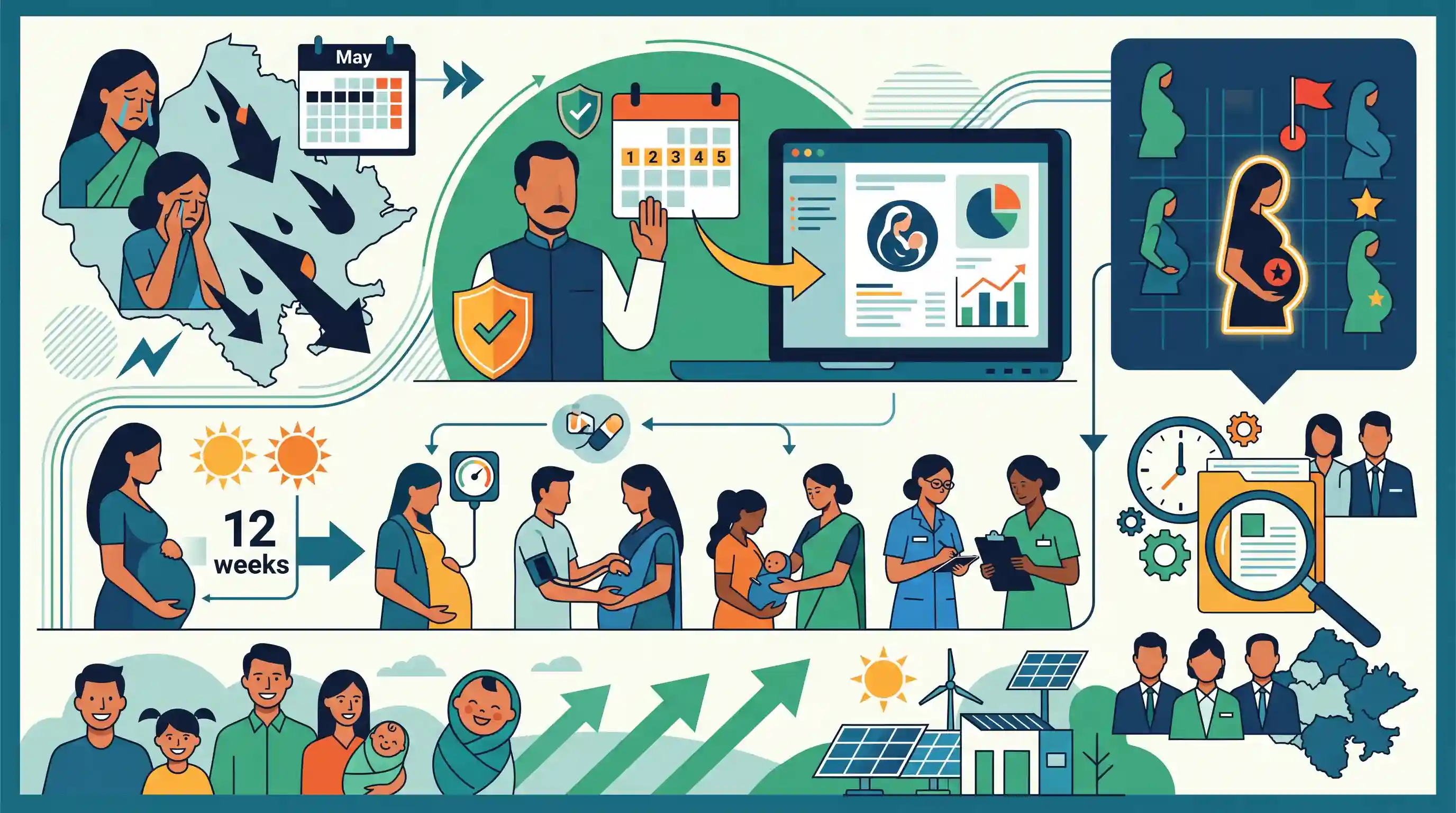
Following 18 maternal deaths in Rajasthan since May 2026, the state government has announced a 5-day comprehensive health screening campaign for all pregnant women starting July 15, 2026. Directed by Principal Secretary Gayatri Rathore, the drive mandates registration within the first 12 weeks of pregnancy, updating information on the Pregnancy and Child Tracking System (PCTS) portal, and completing at least 4 Antenatal Care (ANC) check-ups. Special tracking is being set up for High-Risk Pregnancies (HRPs), and districts are required to review any maternal death within 24 hours. The initiative follows public outcry and allegations of negligence and infection risks, particularly in Bhilwara, where infrastructure shortages in sterilization were highlighted.
Key Points
- Maternal Death Crisis: Rajasthan reported 18 maternal deaths following childbirth since May 2026, including a spike of nine deaths in Bhilwara and Banswara districts between July 5 and July 10, prompting urgent government action.
- Statewide Screening Drive: The Rajasthan government has launched a 5-day statewide screening campaign starting July 15, 2026, aimed at comprehensive health check-ups and monitoring of pregnant women.
- Pregnancy Monitoring Protocols: Guidelines mandate that all pregnant women must be registered within the first 12 weeks of pregnancy. Their health records must be updated on the state's online Pregnancy and Child Tracking System (PCTS) portal.
- Antenatal Care (ANC) Standards: Every pregnant woman must undergo a minimum of 4 ANC check-ups, including diagnostic tests for blood pressure, haemoglobin levels, weight, urine, and blood sugar.
- High-Risk Pregnancies (HRP) Tracking: Separate name-wise tracking lists for HRPs (complications such as anaemia, hypertension, diabetes, previous caesarean deliveries, twin pregnancies, or excessive bleeding) must be maintained from sub-health centre to district levels.
- Administrative Accountability & Death Audits: Field-level health workers (ASHA, ANMs, and CHOs) will be held accountable for any screening lapses. Furthermore, an initial review of every maternal death must be conducted within 24 hours, followed by a formal Maternal Death Review.
- Infrastructure Challenges: Concerns were raised about critical infrastructure shortages at the Bhilwara facility, where 30 to 40 daily C-sections are performed with only eight surgical instrument sets, heightening potential sterilization and infection risks.
Important Terms
Pregnancy and Child Tracking System (PCTS) portal

An online e-governance software platform developed by Rajasthan to track, report, and monitor health services provided to pregnant women, infants, and children to reduce maternal and infant mortality.
UPSC context
GS Paper II: E-governance, digital public infrastructure in health, and maternal/child social sector schemes.
Antenatal Care (ANC) guidelines
Standard medical protocols and routine clinical check-ups recommended for pregnant women to monitor fetal-maternal health, ensure early detection of complications, and guarantee safe delivery.
UPSC context
GS Paper II: Social sector issues related to Health, healthcare indicators, and public welfare policies.
Maternal Death Review protocol
A structured administrative and clinical surveillance process (often called MDSR) to identify, notify, and analyze maternal deaths to correct system lapses and prevent future preventable deaths.
UPSC context
GS Paper II: Health accountability, administrative governance, and strategies to lower the Maternal Mortality Ratio.
Medical and Health Department, Rajasthan
The state-level administrative authority in Rajasthan responsible for executing public health policies, managing healthcare infrastructure, and implementing welfare programs like the National Health Mission.
UPSC context
GS Paper II: State health governance, public health administration, and implementation of welfare schemes.
Prelims Trap
The Maternal Mortality Ratio (MMR) is calculated as the number of maternal deaths per 1,000 live births.
MMR is calculated per 100,000 live births, unlike Infant Mortality Rate (IMR) or Child Mortality Rate, which use 1,000 live births as the denominator.
Static Concepts Connected
How do Maternal Mortality Ratio and Maternal Mortality Rate differ?
- Ratio denominator: Measures maternal deaths per 100,000 live births, indicating the obstetric risk associated with pregnancy.
- Rate denominator: Measures maternal deaths per 100,000 women of reproductive age (15-49), reflecting both fertility and obstetric risk.
- SDG 3.1 Target: Mandates reducing the global Maternal Mortality Ratio to less than 70 per 100,000 live births by 2030.
What are the structural differences between ASHAs and ANMs?
- Cadre status: ASHA is an incentivized community volunteer; ANM is a salaried, trained professional paramedic based at Sub-Health Centres.
- Clinical authority: ANM is trained to perform basic clinical diagnostics, vaccinations, and distribute drugs; ASHA primarily facilitates referrals and community mobilization.
- Accountability bridge: ASHA works closely with the community, reporting health outcomes and identifying high-risk cases to the ANM for clinical validation.
Cross-Topic Patterns
Digital Governance + Health Equity
Digital tracking portals like PCTS require ground-level data entry, showing how digital health success depends directly on the digital literacy of frontline workers.
SDG 3 + Local Infrastructure
While administrative tracking and audits identify gaps, meeting maternal mortality targets ultimately hinges on solving supply-side issues like inadequate surgical sterilization equipment.

UPSC may frame a 2026 question comparing MMR and Maternal Mortality Rate, testing SDG 3.1 targets and digital intervention tools like e-PMSMA.
Linked PYQs · 2
Linked PYQs · 2
- 2018RPSC_PRELIMSGS1
The Rajasthan government has released a new software to monitor trends in seasonal and non-communicable diseases, as well as diseases found in specific areas. What is the name of this software?
- 2021RPSC_PRELIMSGS1
Under the Ayushman Bharat Mahatma Gandhi Rajasthan Health Insurance Scheme, the amount provided per family per year in the event of a critical illness health insurance is
