Rajasthan Maternal Deaths Prompt NHRC Notice to Chief Secretary
Source:zee-news ↗
Why It Matters
Illustrates the active intervention of statutory bodies like the NHRC in holding the state administration accountable for public health failures. It emphasizes critical governance challenges surrounding maternal mortality, hospital infrastructure, and the health status (e.g., anemia) of women in Rajasthan.
Summary
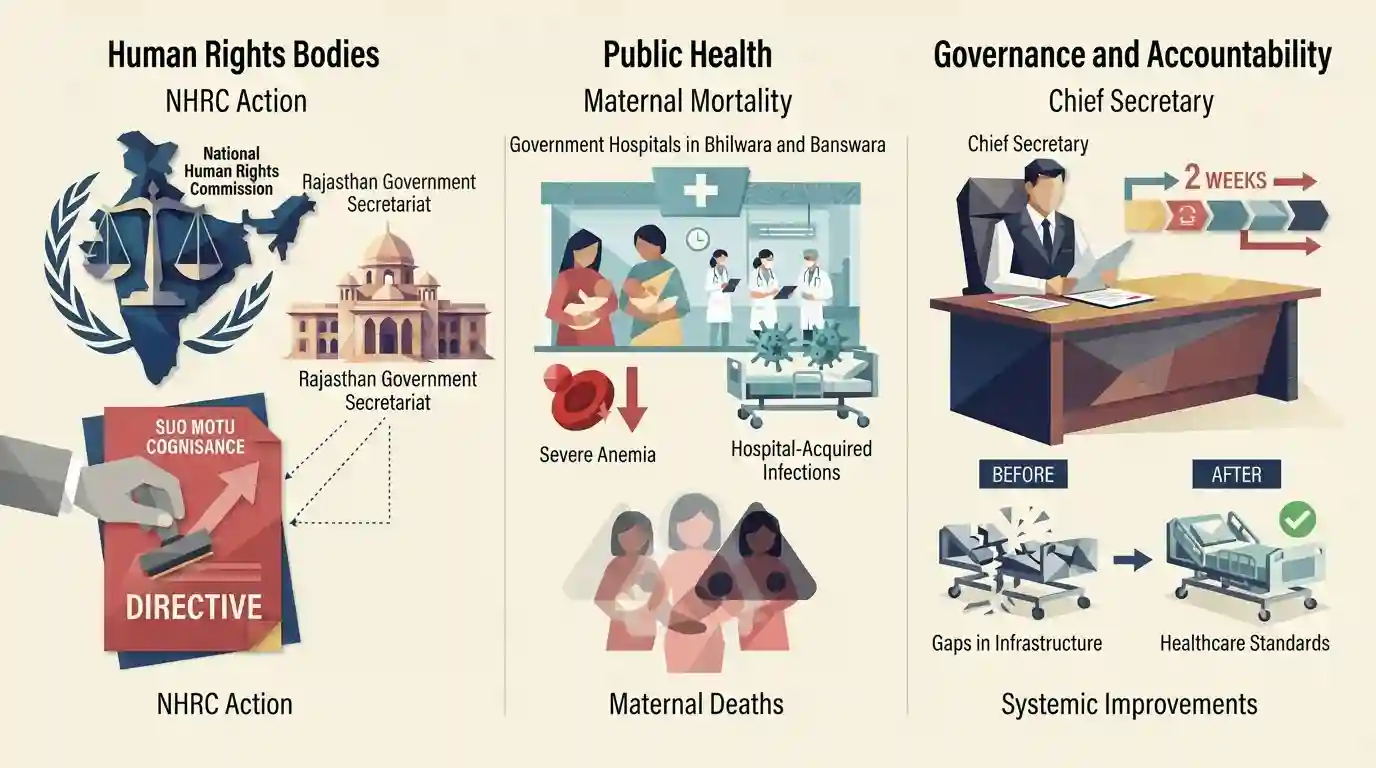
The National Human Rights Commission (NHRC) has sought a detailed report from the Rajasthan government concerning the recent maternal deaths following childbirth in government hospitals in Bhilwara and Banswara districts. Taking suo motu cognisance, the rights body directed the state's Chief Secretary to respond within two weeks regarding maternal healthcare standards, accountability of medical staff, and systemic improvements. The deaths have been preliminarily linked to severe anemia in patients and hospital-acquired infections, pointing to significant negligence and gaps in the state's public healthcare infrastructure.
Key Points
- The National Human Rights Commission (NHRC) took suo motu cognisance of multiple maternal deaths following childbirth in government hospitals in Bhilwara and Banswara districts of Rajasthan.
- NHRC issued a notice to the state Chief Secretary, demanding a detailed report within two weeks regarding the state of maternal health, actions taken, and the status of healthcare infrastructure.
- Preliminary reports revealed that severe anemia and potential medical negligence contributed to the deaths, alongside hospital-acquired infections, as one operation theatre tested positive for contamination.
- The incident highlights structural gaps in public healthcare delivery, maternal mortality management, and hospital hygiene protocols within Rajasthan.
Important Terms
National Human Rights Commission (NHRC)

A statutory public body established under the Protection of Human Rights Act, 1993, responsible for the protection and promotion of human rights in India.
UPSC context
GS Paper II: Statutory, regulatory and quasi-judicial bodies; tests understanding of NHRC's structure, powers, and role in human rights protection.
Suo Motu Cognisance
A legal power meaning "on its own motion," allowing courts or quasi-judicial bodies to initiate legal proceedings independently, without receiving a formal petition or complaint.
UPSC context
GS Paper II: Judiciary and Governance; tests knowledge of judicial activism, epistolary jurisdiction, and administrative accountability.
Maternal Mortality Ratio (MMR)
The annual number of female deaths per 100,000 live births from any cause related to or aggravated by pregnancy or its management.
UPSC context
GS Paper II: Social Sector and Health; tests knowledge of maternal health indicators, public health policies, and SDG Goal 3.1.
Public Healthcare Infrastructure
The foundational network of government-run medical facilities—from primary health centers to district hospitals—providing accessible and equitable healthcare services to citizens.
UPSC context
GS Paper II: Issues relating to Health and Governance; tests understanding of public health service delivery and healthcare challenges.
Prelims Trap
NHRC recommendations for compensation or penal action against negligent medical staff are binding on the state.
NHRC is a statutory body with purely recommendatory powers. Its directions are not legally binding on governments, although authorities must submit action-taken reports.
Static Concepts Connected
What are the investigative powers and limitations of the NHRC?
- Suo Motu Cognisance: Can initiate inquiries on its own into human rights violations or negligence by public servants without requiring a formal petition.
- Civil Court Powers: Can summon witnesses, receive evidence on affidavits, and requisition public records, possessing the powers of a civil court.
- Time Limitation: Barred from inquiring into any human rights violation matter after the expiry of one year from the date of the alleged incident.
What defines Maternal Mortality Ratio (MMR) and what are the global targets?
- MMR Definition: Calculated as the number of maternal deaths during a given time period per 100,000 live births. India's current MMR is 93/lakh (SRS 2019-21).
- SDG Target 3.1: Aims to reduce the global Maternal Mortality Ratio to less than 70 per 100,000 live births by the year 2030.
- Underlying Causes: Severe anaemia, postpartum haemorrhage, and hospital-acquired infections are leading underlying causes of maternal mortality in India.
Cross-Topic Patterns
Right to Health Act vs Reality
Rajasthan passed a landmark Right to Health Act in 2023. These tragic deaths highlight the implementation gap between statutory health guarantees and the ground reality of public healthcare infrastructure.
Anaemia Mukt Bharat & MMR linkages
Over 52% of pregnant women in India are anaemic (NFHS-5). Interventions under Anaemia Mukt Bharat (6x6x6 strategy) directly target this underlying non-obstetric cause of maternal mortality.

NHRC’s suo motu mandate and limitations, paired with India's MMR trajectory and SDG 3.1 targets, is prime for a 2026 multi-statement MCQ.
Linked PYQs · 3
Linked PYQs · 3
- 2023RPSC_PRELIMSGS1
Consider the following statements regarding the Rajasthan State Human Rights Commission: (i) According to the provisions of the Human Rights Protection (Amendment) Act, 2006, the Commission has one Chairman and four members. (ii) Currently, Justice Gopal Krishna Vyas is the Chairman.
- 2021RPSC_PRELIMSGS1
Which characteristic of the Chief Minister Chiranjeevi Health Insurance Scheme is incorrect?
- 2021RPSC_PRELIMSGS1
Under the Ayushman Bharat Mahatma Gandhi Rajasthan Health Insurance Scheme, the amount provided per family per year in the event of a critical illness health insurance is
