Rajasthan Mandates Tree Plantation for Renewable Energy Projects
Source:energetica-india ↗
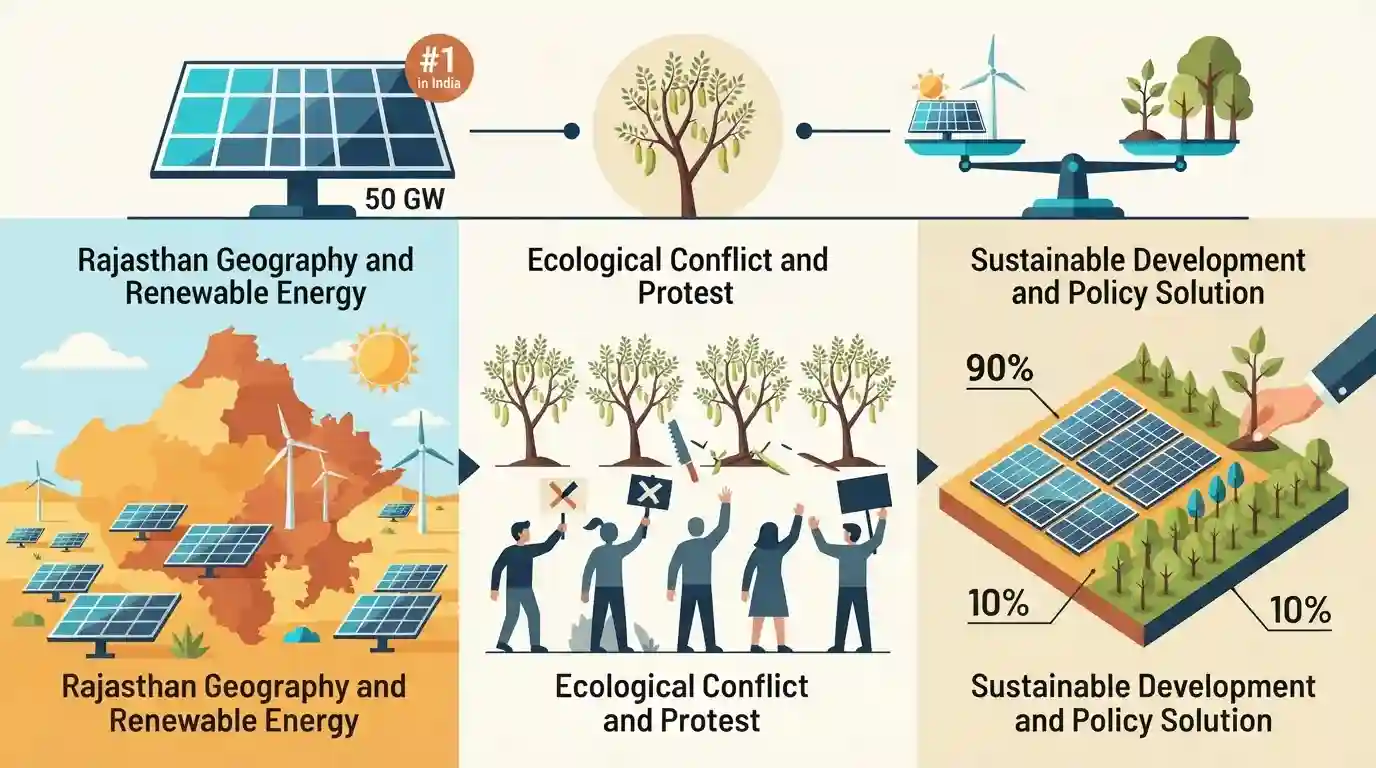
Why It Matters
Rajasthan is the leading state in India for renewable energy capacity. However, land-intensive solar and wind projects often conflict with local desert ecology and cultural symbols like the Khejri tree. This policy intervention is crucial for ensuring that the state's clean energy transition remains ecologically sustainable.
Summary
The Rajasthan Government has amended its land allocation rules to make it mandatory for renewable energy developers to allocate 10% of their allotted land for tree plantation. This environmental safeguard was introduced following local protests against the cutting of Khejri trees (the state tree of Rajasthan) for green energy projects in western Rajasthan. The move represents a significant policy shift aimed at balancing ecological conservation with the rapid expansion of renewable energy in the state, which currently leads India with over 50 GW of installed capacity, predominantly from solar power.
Key Points
- The Rajasthan Government has mandated renewable energy developers to reserve 10% of their allotted land for tree plantation.
- This mandate was executed by amending the Rajasthan Land Revenue (Allotment of Land for Setting up Power Plants Based on Renewable Energy Sources) Rules, 2007.
- The decision was heavily influenced by protests from local communities in western Rajasthan against the felling of the Khejri tree (the state tree) for solar and wind projects.
- Rajasthan leads India in renewable energy with an installed capacity of over 50,000 MW, of which 44,135 MW is solar energy.
- Under the rules, 2 hectares of land per MW is allotted for solar and wind projects, while 2.5 hectares per MW is allotted for hybrid projects.
Important Terms
Rajasthan Land Revenue (Allotment of Land for Setting up Power Plants Based on Renewable Energy Sources) Rules, 2007

A policy governing green energy land allocation. Recently amended, it mandates renewable developers in Rajasthan to allocate 10% of project land for tree plantation, mitigating the ecological impact of large solar parks.
UPSC context
GS-3 (Environment); tests policy frameworks that balance rapid renewable energy infrastructure growth with environmental conservation.
Khejri Tree (Prosopis cineraria)
The state tree of Rajasthan, ecologically vital for the Thar desert and culturally revered by the Bishnoi community. Its large-scale felling for solar projects recently sparked widespread protests and a state-wide ban.
UPSC context
GS-1 (Art & Culture) & GS-3 (Biodiversity); essential for flora adaptation, desert ecology, and indigenous conservation movements.
Renewable Energy Expansion in Rajasthan
Rajasthan leads India in renewable energy, targeting 90 GW by 2030. However, the rapid expansion of utility-scale solar parks in the Thar desert has caused ecological friction, prompting mandatory tree plantation rules.
UPSC context
GS-3 (Energy); tests India's clean energy transition, spatial distribution of solar potential, and sustainable land-use challenges.
Prelims Trap
"The Centre mandates 10% land reservation for tree plantations in all renewable energy projects nationwide."
This is a state-specific mandate by Rajasthan, not a nationwide MNRE policy. Also, do not confuse the protected Khejri (Prosopis cineraria) with the invasive Vilayati Babul (Prosopis juliflora).
Static Concepts Connected
What is the ecological significance of the Khejri tree (Prosopis cineraria)?
- Nitrogen fixation: As a leguminous tree, it enhances soil fertility in arid regions, supporting the fragile Thar Desert ecosystem.
- Drought resilience: An extensive deep root system allows it to survive extreme arid conditions and stabilize sand dunes.
- Socio-cultural value: It is the State Tree of Rajasthan, historically and strictly protected by the Bishnoi community (Khejarli movement).
What is the "Green vs. Green" policy dilemma?
- Definition: Conflicts where large-scale climate change mitigation efforts (like renewable energy infrastructure) inadvertently destroy local biodiversity and habitats.
- UPSC Examples: Wind turbines affecting avian migration, hydro-dams submerging pristine forests, and solar parks displacing desert flora/fauna.
Cross-Topic Patterns
RE Expansion vs. Great Indian Bustard
The Khejri tree conflict mirrors the Supreme Court battle over undergrounding solar transmission lines to protect the critically endangered Great Indian Bustard in the Thar desert.
Wasteland Classification Debates
Solar parks often target government-classified 'wastelands' (arid ecosystems), ignoring that these regions support highly specialized biodiversity and traditional pastoralist communities.

"Green vs Green" conflicts (Khejri/GIB vs Solar parks) will likely drive GS3 Mains questions on the ecological costs of India's 500GW target.
Linked PYQs · 5
Linked PYQs · 5
- 2021RPSC_PRELIMSGS1
In which year was the Rajasthan Solar Energy Policy announced?
- 2023RPSC_PRELIMSGS1
Which agency has been given the responsibility of implementing the PM-KUSUM scheme (Component A) in Rajasthan, which involves the establishment of solar power plants with a capacity of 0.5 MW to 2 MW?
- 2012RPSC_PRELIMSGS1
The first solar energy policy was announced by the Government of Rajasthan in -
- 2023RPSC_PRELIMSGS1
According to the India State Forest Report 2021, the forest area, in terms of forest cover, is 16,654 sq km, which is ___ percent of Rajasthan's geographical area.
- 2021RPSC_PRELIMSGS1
The state flower of Rajasthan is
