Rajasthan Litigation Policy 2026 for reducing court pendency
Source:sanskritiias ↗
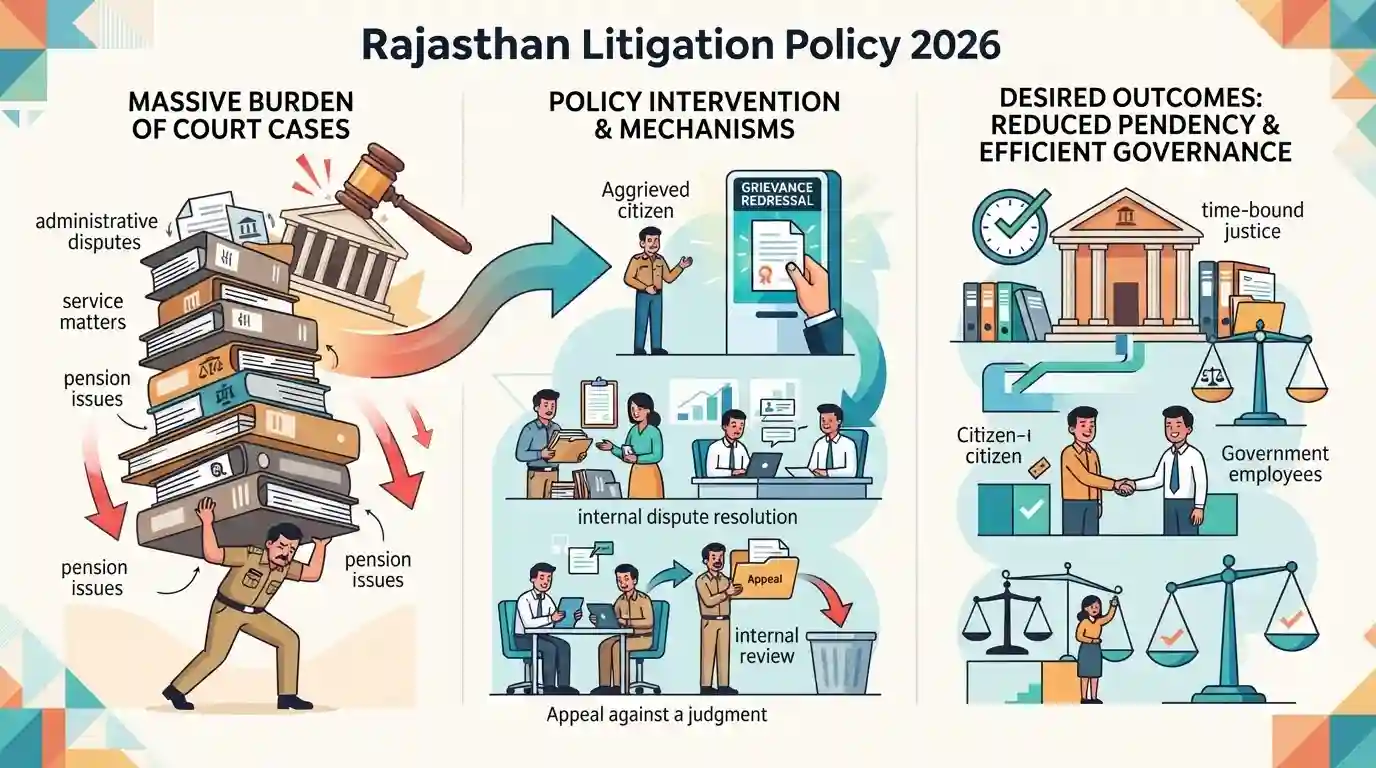
Why It Matters
Crucial for understanding administrative reforms, judicial backlog reduction strategies, and state-level governance policies relevant to Rajasthan public administration and polity.
Summary
The Rajasthan government is rolling out the Rajasthan Litigation Policy 2026 to tackle the massive burden of court cases arising from administrative, service, and pension disputes. By institutionalizing internal grievance redressal mechanisms and discouraging unnecessary government appeals, the policy seeks to reduce judicial pendency, promote efficient public administration, and ensure time-bound justice.
Key Points
- The Rajasthan Litigation Policy 2026 aims to curb government-related litigation, especially service and pension disputes involving employees and pensioners.
- Government bodies are among the largest litigants, contributing heavily to judicial pendency and court backlog.
- The policy promotes internal departmental grievance redressal mechanisms, treating litigation as a last resort to enhance administrative accountability and cut down public costs.
Important Terms
Rajasthan Litigation Policy 2026

A strategic policy framework by the Rajasthan government designed to curb excessive litigation, reduce court pendency, and resolve administrative and service-related disputes internally through a structured three-tier grievance redressal system.
UPSC context
RPSC RAS Mains (Paper II/III - Public Administration & Governance): Tests knowledge of state-level policy interventions, administrative reforms, and reducing judicial burden.
Government of Rajasthan
The executive body of the state of Rajasthan responsible for formulating administrative policies, maintaining law and order, and implementing welfare and governance initiatives across districts.
UPSC context
RPSC RAS Prelims/Mains: Core entity for questions related to state administration, governance structures, welfare schemes, and policy implementation in Rajasthan.
Prelims Trap
tackle the massive burden of court cases arising from administrative, service, and pension disputes
Aspirants might assume the policy covers all civil and criminal disputes involving private citizens, whereas its primary focus is on administrative, service, and pension disputes involving government employees.
Static Concepts Connected
What are the key institutional mechanisms recommended to reduce government litigation in India?
- Grievance Redressal: Empowering internal departmental grievance committees to resolve service and pension disputes before they reach courts.
- Nodal Officers: Appointing dedicated nodal officers at state and district levels to monitor and review pending litigation periodically.
- Appellate Restraint: Discouraging routine and mechanical appeals by government departments against adverse judicial rulings.
Cross-Topic Patterns
State Litigation Policy + Judicial Pendency
The state litigation policy connects administrative governance with the recommendations of various Law Commission reports on reducing government litigation.
Service Disputes + Article 226 Writs
Service and pension disputes form a major chunk of writ petitions under Article 226, linking civil service accountability with constitutional remedies.

Rajasthan Litigation Policy 2026's timelines (7-day action, 30-day recommendation) and nodal officer roles may be framed in RPSC Mains/Prelims.
Linked PYQs · 2
Linked PYQs · 2
- 2021RPSC_PRELIMSGS1
The Vishakha vs. State of Rajasthan and others case relates to
- 2024RPSC_PRELIMSGS1
According to the Rajasthan Lokayukta and Deputy Lokayukta Act, 1973, the Lokayukta in Rajasthan can investigate allegations against ministers and public servants in certain cases. Which of the following subject is included in such cases? (i) Involves grievance/any suffering caused by public servant. (ii) Used his position as a public servant to obtain, for himself or for any other person, any valuable thing or financial benefit. (iii) Sexual harassment of woman, cause injury to any person. (iv) Can be related to being guilty of corruption of the trust reposed in him as a public servant.
