Rajasthan Secures Top Rank in PM-KUSUM Solar Capacity
Source:socialnews-xyz ↗
Why It Matters
Highly relevant for RPSC RAS Prelims questions concerning Rajasthan's economic development, premier ranking in national renewable energy schemes, and key state nodal agencies like RRECL.
Summary
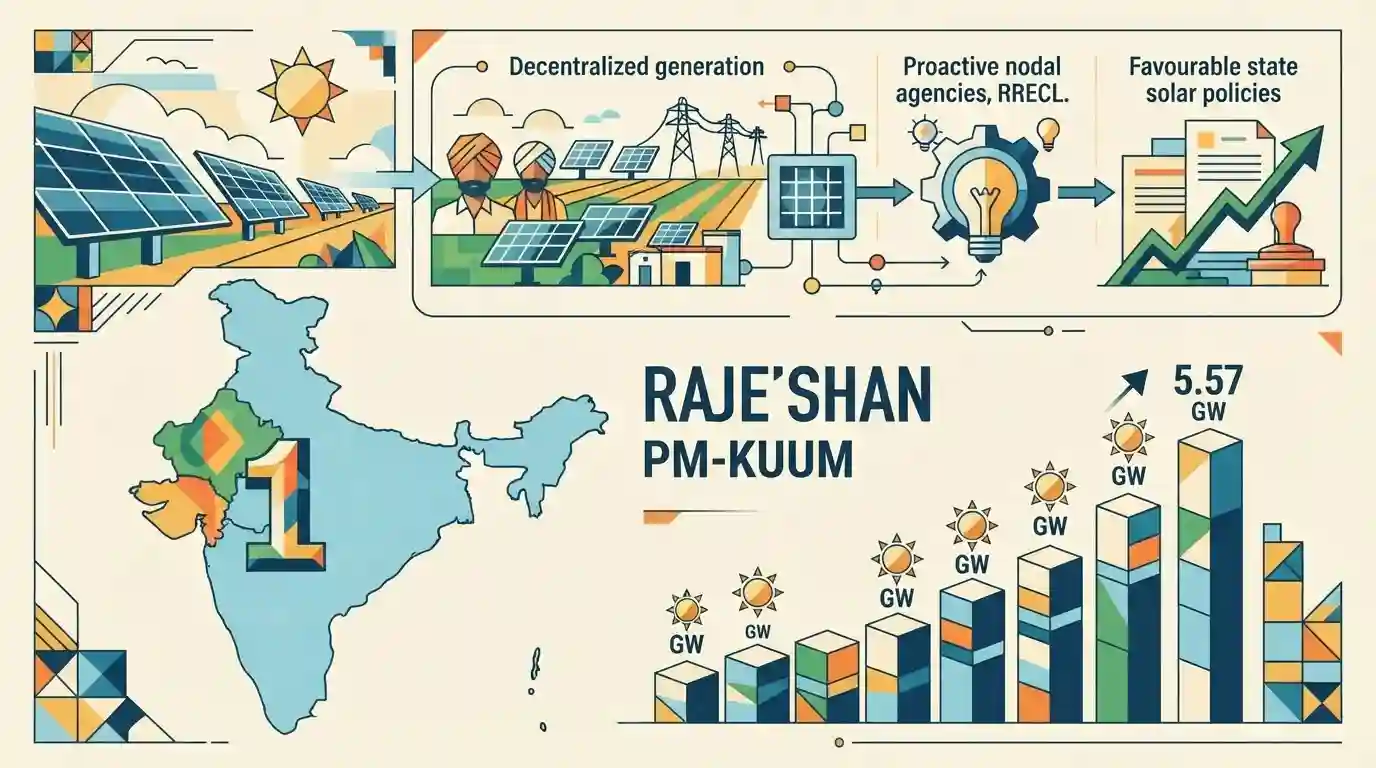
Rajasthan has secured the top position nationwide under the PM-KUSUM scheme, achieving a solar capacity of 5.57 GW. The state continues to excel in decentralized solar generation, supported by proactive nodal agencies like RRECL and favourable state solar policies.
Key Points
- Rajasthan leads nationwide in the implementation of the PM-KUSUM (Pradhan Mantri Kisan Urja Suraksha evam Utthaan Mahabhiyan) scheme, reaching 5.57 GW of solar capacity.
- The Rajasthan Renewable Energy Corporation Limited (RRECL) serves as the primary state nodal agency for executing renewable energy and decentralized solar projects.
- Rajasthan previously achieved milestones such as establishing India's first agriculture-based solar power plant under PM-KUSUM Component-A in Bhaloji village (Kotputli, Jaipur).
Important Terms
PM-KUSUM scheme

A flagship central scheme aimed at providing financial security to farmers by promoting decentralized solar power generation, installing standalone solar pumps, and solarizing grid-connected agricultural pumps.
UPSC context
Important for RPSC/UPSC Prelims and Mains (Economy & Renewable Energy); tests knowledge of farmer-centric green energy initiatives.
Rajasthan Renewable Energy Corporation Limited (RRECL)
State nodal agency responsible for promoting, facilitating, and implementing renewable energy projects, including solar and wind power, across Rajasthan.
UPSC context
Crucial for RPSC exams regarding state-level institutional frameworks for executing renewable energy policies.
Rajasthan Solar Energy Policy
Comprehensive state policy framework guiding solar sector growth, targets, land allotments, and financial incentives to establish Rajasthan as a leading hub for clean energy.
UPSC context
Essential for Rajasthan Economy and Geography papers, focusing on industrial growth and sustainable development strategies.
Static Concepts Connected
What are the three core components of the central PM-KUSUM scheme?
- Component A: Component-A establishes up to 10,000 MW of decentralized grid-connected renewable power plants (500 kW to 2 MW) on barren or cultivable land by farmers.
- Component B: Component-B installs 17.5 lakh standalone solar agriculture pumps for farmers in areas where grid connectivity is not feasible.
- Component C: Component-C solarizes 20 lakh grid-connected agricultural pumps to enable farmers to use solar energy and sell excess power to DISCOMs.
Cross-Topic Patterns
PM-KUSUM and State Power Distribution Reforms
The integration of PM-KUSUM with DISCOM loss-reduction strategies links renewable energy generation directly with state power sector fiscal management.
Solar Pumps and Groundwater Extraction in Arid Zones
Decentralized solar installations intersect with water resource management through solar pump adoption, impacting groundwater extraction patterns in arid districts like western Rajasthan.

Expect a multi-statement RPSC question on PM-KUSUM components (A, B, C) combined with Rajasthan specific implementation stats and RRECL role.
Linked PYQs · 3
Linked PYQs · 3
- 2023RPSC_PRELIMSGS1
Which agency has been given the responsibility of implementing the PM-KUSUM scheme (Component A) in Rajasthan, which involves the establishment of solar power plants with a capacity of 0.5 MW to 2 MW?
- 2021RPSC_PRELIMSGS1
In which village of Rajasthan was India's first agriculture-based “KUSUM” solar energy plant project launched?
- 2021RPSC_PRELIMSGS1
In which year was the Rajasthan Solar Energy Policy announced?
