Rajasthan Peyjal Samvad Initiative For Rural Water Governance
Source:eGov Magazine ↗
Why It Matters
The article is highly relevant for the RPSC RAS Prelims as it deals with a flagship state implementation of a central scheme (Jal Jeevan Mission) and highlights crucial state-specific geographical data regarding water resources. The emphasis on Panchayati Raj Institutions (VWSCs, Sarpanches) aligns with the RPSC's focus on local governance and decentralized administration in Rajasthan.
Summary
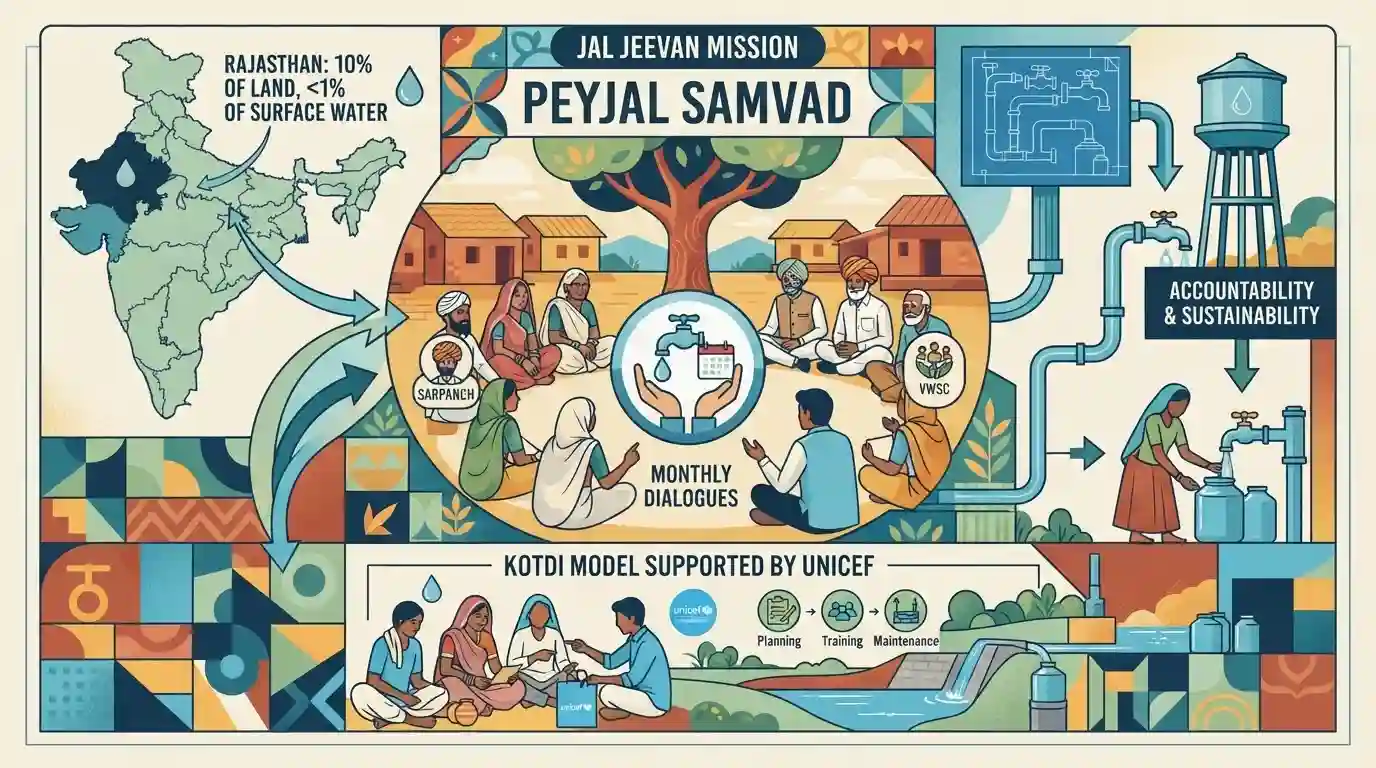
Rajasthan has launched 'Peyjal Samvad', a strategic initiative under the Jal Jeevan Mission, aimed at strengthening rural water governance through active community participation. The program mandates monthly dialogues with local Sarpanches and Village Water and Sanitation Committees (VWSCs) to ensure accountability and sustainability in drinking water supply. Highlighting the Kotdi Gram Panchayat model backed by UNICEF, the state aims to address its severe geographical challenge of possessing over 10% of India's landmass but barely 1% of its surface water resources.
Key Points
- Rajasthan launched 'Peyjal Samvad' under the Jal Jeevan Mission to enhance rural drinking water governance.
- The initiative entails monthly dialogues with Sarpanches and Village Water and Sanitation Committees (VWSCs) to shift focus from mere infrastructure creation to sustainable, community-driven service delivery.
- The Kotdi Gram Panchayat model, supported by UNICEF, was highlighted as a successful example of community participation for efficient rural water supply.
- Rajasthan holds more than 10% of India's geographical area but only about 1% of the country's surface water resources, making sustainable water management crucial.
- Under JJM, Rajasthan has fully covered 13,850 villages, with 6,172 achieving Har Ghar Jal certification, and has received ₹537.70 crore under JJM 2.0.
Important Terms
Jal Jeevan Mission (JJM)

A flagship Central Government scheme launched in 2019 to provide safe and adequate drinking water through Functional Household Tap Connections (FHTCs) to all rural households, emphasizing community-driven, decentralized governance.
UPSC context
GS-2 (Government Policies) and GS-3 (Infrastructure). Tests knowledge of rural development targets and decentralized water management frameworks.
Peyjal Samvad
A reform-linked rural water governance initiative by Rajasthan under JJM 2.0. It institutes monthly dialogues with local communities and village committees to foster feedback, transparency, and sustainable drinking water delivery.
UPSC context
GS-2 (State Governance, Citizen Charters). Highlights mechanisms for participatory policymaking, citizen feedback loops, and local accountability.
Village Water and Sanitation Committees (VWSCs)
Standing committees of Gram Panchayats tasked with the planning, implementation, operation, and financial management (like user fee collection) of local drinking water security and infrastructure under the Jal Jeevan Mission.
UPSC context
GS-2 (Local Self-Government). Crucial for understanding community-led operation, maintenance, and grassroots resource management of public utilities.
Gram Panchayat
The grassroots institution of local self-government in India. In rural water governance, they are empowered to lead community-driven service delivery and ensure the long-term sustainability of local water supply assets.
UPSC context
GS-2 (Panchayati Raj). Tests foundational knowledge of the 73rd Constitutional Amendment and grassroots democratic decentralization.
UNICEF
A UN agency responsible for providing humanitarian and developmental aid. In Rajasthan, it acts as a technical partner for rural water governance pilots (like Kotdi village), enhancing environmental sustainability and capacity-building.
UPSC context
GS-2 (International Organizations). Highlights the role of global multilateral agencies in supporting state-level grassroots development and resilience projects.
Prelims Trap
"Har Ghar Jal certification is granted by the Ministry of Jal Shakti once tap infrastructure is built."
Certification is a decentralized, community-led process. A village receives 'Har Ghar Jal' status only after its Gram Sabha passes a formal resolution confirming functional tap connections.
Static Concepts Connected
What is the mandate and composition of Village Water and Sanitation Committees (VWSCs)?
- Panchayat Sub-committee: Functions as a dedicated standing committee or sub-committee of the local Gram Panchayat to manage water resources.
- Mandatory Representation: Must legally comprise at least 50% women and 25% representation from weaker sections (SC/ST).
- Core Function: Responsible for planning, implementing, operating, and maintaining the in-village water supply infrastructure under JJM.
What are the core service level benchmarks of the Jal Jeevan Mission?
- Supply Benchmark: Aims to provide 55 liters per capita per day (lpcd) of potable drinking water on a regular basis.
- Target Mechanism: Delivered through Functional Household Tap Connections (FHTCs) extending to every rural household.
Cross-Topic Patterns
PRI Devolution + Water Governance
The empowerment of VWSCs maps directly to the 11th Schedule (Article 243G) of the Constitution, which devolves drinking water and sanitation management to Panchayati Raj Institutions.
Geography vs. Resource Scarcity
Rajasthan's geographical mismatch—possessing over 10% of India's landmass but barely 1% of its surface water—makes it a classic GS-1 case study for water stress management.

Expect a multi-statement prelims question testing VWSC composition (50% women) and the Gram Sabha's role in Har Ghar Jal certification.
Linked PYQs · 3
Linked PYQs · 3
- 2023RPSC_PRELIMSGS1
Which of the following statements is/are correct regarding the Atal Bhujal Yojana in Rajasthan? (a) The Atal Bhujal Yojana is being run by the Government of Rajasthan with financial assistance from the Government of India. (b) The focus of this scheme is to improve groundwater management and prevent its declining levels.
- 2023RPSC_PRELIMSGS1
Which of the following is not a part of the Rajasthan Urban Drinking Water, Sewage and Infrastructure Corporation Limited?
- 2021RPSC_PRELIMSGS1
The 'Parwan' multipurpose irrigation project of Rajasthan will provide irrigation facilities to which districts?
