Peyjal Samvaad Initiative Launched to Gather Jal Jeevan Feedback
Source:thebuckstopper ↗
Why It Matters
The 'Peyjal Samvaad' initiative highlights participatory governance and decentralized management in crucial sectors like drinking water. Given Rajasthan's unique geographical constraints and persistent water scarcity, schemes aimed at community-led water conservation and management are highly relevant for RPSC RAS Prelims, often featuring in questions related to state welfare policies and environmental resources.
Summary
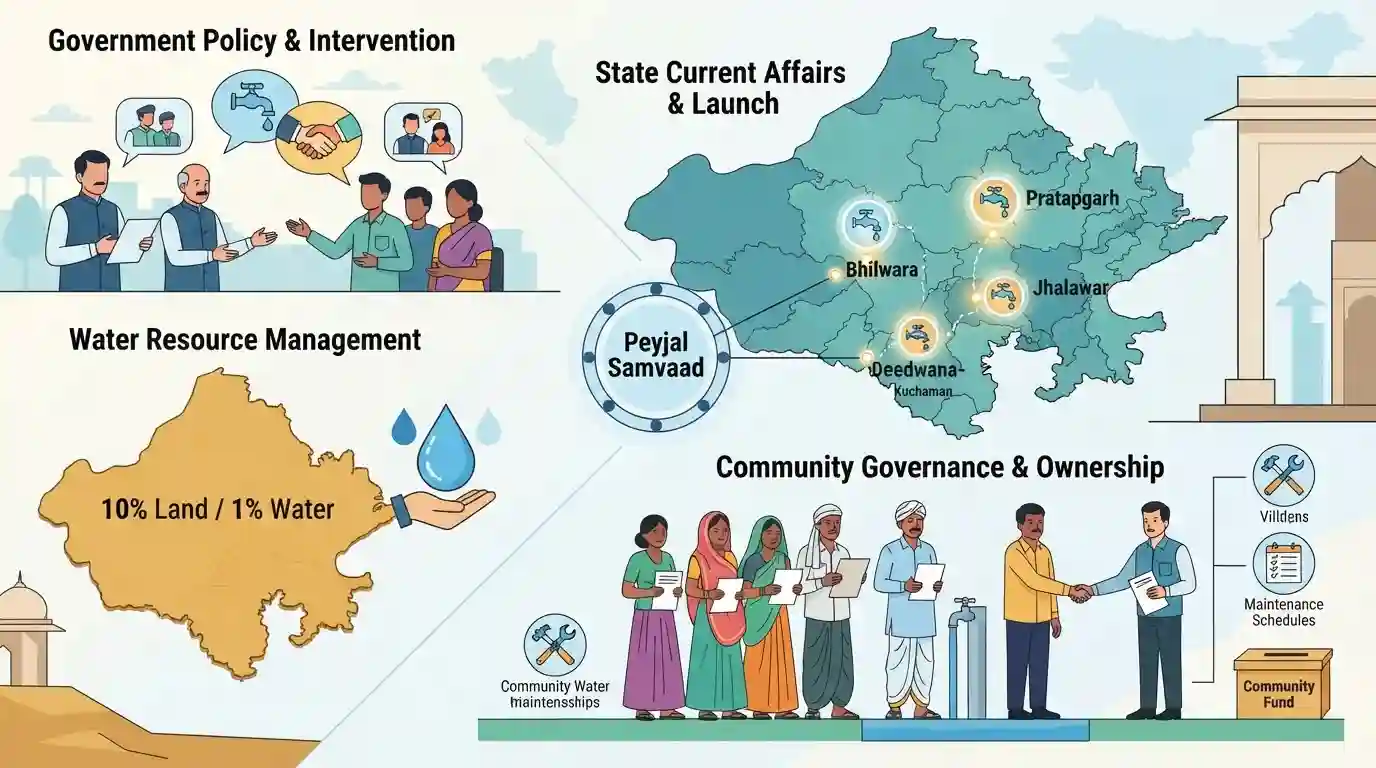
The Government of Rajasthan has initiated 'Peyjal Samvaad' under the Jal Jeevan Mission (JJM) to facilitate direct communication with citizens regarding tap water supply. Designed to assess the on-ground reality of the 'Har Ghar Jal' scheme, the program aims to transfer the ownership and maintenance of drinking water projects to the community level. The launch events took place in multiple districts, including Bhilwara, Pratapgarh, Jhalawar, and Deedwana-Kuchaman. This initiative is particularly crucial given Rajasthan's severe water scarcity, as the state possesses over 10% of India's landmass but merely 1% of its surface water resources.
Key Points
- The Rajasthan government launched 'Peyjal Samvaad' to gather direct community feedback on the Jal Jeevan Mission (JJM).
- The initiative focuses on shifting the ownership of water governance from the government to local communities to ensure the long-term sustainability of water supply schemes.
- Under the Jal Jeevan Mission in Rajasthan, 13,850 villages have achieved 'Har Ghar Jal' status, with 6,172 villages receiving certification.
- The primary goal of the state PHED is to establish continuous and regular public interaction to assess and resolve local issues related to tap water supply.
- Rajasthan faces acute water scarcity, holding over 10% of India's geographical area but only about 1% of its surface water resources.
Important Terms
Jal Jeevan Mission (JJM)

A Centrally Sponsored Scheme launched in 2019 to provide Functional Household Tap Connections (FHTC) to all rural households. It emphasizes community ownership, decentralised management, and water conservation.
UPSC context
GS Paper 2 & 3. Highly relevant for evaluating rural development, water resource management, and community-led infrastructure schemes.
Har Ghar Jal
The central target of the Jal Jeevan Mission, ensuring 55 litres per capita per day of safe and adequate drinking water to every rural household through functional tap connections.
UPSC context
GS Paper 2. Tests knowledge on welfare schemes, basic amenities provision, and milestones in rural governance.
Peyjal Samvaad
A Rajasthan government initiative facilitating direct monthly dialogues with citizens regarding tap water supply. It aims to gather grassroots feedback and transfer maintenance of drinking water projects to local communities.
UPSC context
GS Paper 2. Important case study for citizen-centric governance, participatory policy feedback, and decentralised local administration.
Public Health Engineering Department (PHED)
The state government department responsible for the planning, implementation, and maintenance of water supply projects. In Rajasthan, PHED executes the Jal Jeevan Mission and related rural water initiatives.
UPSC context
GS Paper 2. Relevant for understanding institutional frameworks and state-level execution bodies managing public utilities and sanitation.
Prelims Trap
Pani Samitis under the Jal Jeevan Mission must be composed entirely of women and SC/ST members.
UPSC often uses extreme words like 'entirely'. The statutory mandate for Village Water and Sanitation Committees (VWSCs) is a minimum of 50% women and 25% weaker sections, not 100%.
Static Concepts Connected
How does the 73rd Constitutional Amendment empower Panchayats in water management?
- Eleventh Schedule: Includes 'Drinking water' (Item 11) and 'Minor irrigation, water management and watershed development' (Item 3) as functional items devolved to PRIs.
- Institutional Mechanism: Gram Sabhas are empowered to constitute Village Water and Sanitation Committees (VWSCs) or Pani Samitis as standing committees to manage local water infrastructure.
- Financial Devolution: State Finance Commissions recommend transferring tied grants to PRIs specifically for the operation and maintenance (O&M) of rural drinking water assets.
What drives Rajasthan's extreme water asymmetry compared to its landmass?
- Aravalli Alignment: The Aravalli range lies parallel to the advancing Southwest Monsoon (Arabian Sea branch), causing minimal orographic rainfall and sustaining the arid climate.
- Resource Asymmetry: Rajasthan holds over 10% of India's total geographical area but only about 1% of its surface water and 1.7% of its groundwater resources.
- High Evapotranspiration: The arid climate and high temperatures lead to rapid loss of surface water, compounding the over-exploitation of already stressed groundwater aquifers.
Cross-Topic Patterns
Social Capital in Climate Adaptation
Schemes shifting from 'infrastructure creation' (JJM 1.0) to 'community ownership' (Peyjal Samvaad) mirror broader climate adaptation strategies where local social capital ensures asset sustainability.
Digitalization of Rural Utilities
"Sujalam Bharat" assigning unique IDs to villages parallels land record digitization (SVAMITVA) and agriculture stacks, demonstrating a clear UPSC governance trend toward micro-targeting rural service delivery.

Expect a multi-statement question on JJM 2.0 focusing on decentralized O&M via Pani Samitis and VWSC composition, not just infrastructure targets.
Linked PYQs · 2
Linked PYQs · 2
- 2023RPSC_PRELIMSGS1
Which of the following statements is/are correct regarding the Atal Bhujal Yojana in Rajasthan? (a) The Atal Bhujal Yojana is being run by the Government of Rajasthan with financial assistance from the Government of India. (b) The focus of this scheme is to improve groundwater management and prevent its declining levels.
- 2023RPSC_PRELIMSGS1
Which of the following is not a part of the Rajasthan Urban Drinking Water, Sewage and Infrastructure Corporation Limited?
