Rajasthan Initiates Digital Backward Class Survey For Local Elections
Source:newindianexpress ↗
Why It Matters
This survey represents a significant administrative effort in Rajasthan to satisfy the legal and constitutional requirements ('triple test' guidelines) for reserving seats for OBCs in local self-governments. It showcases how state administration uses mobile applications for massive e-governance data collection to resolve legal and electoral bottlenecks.
Summary
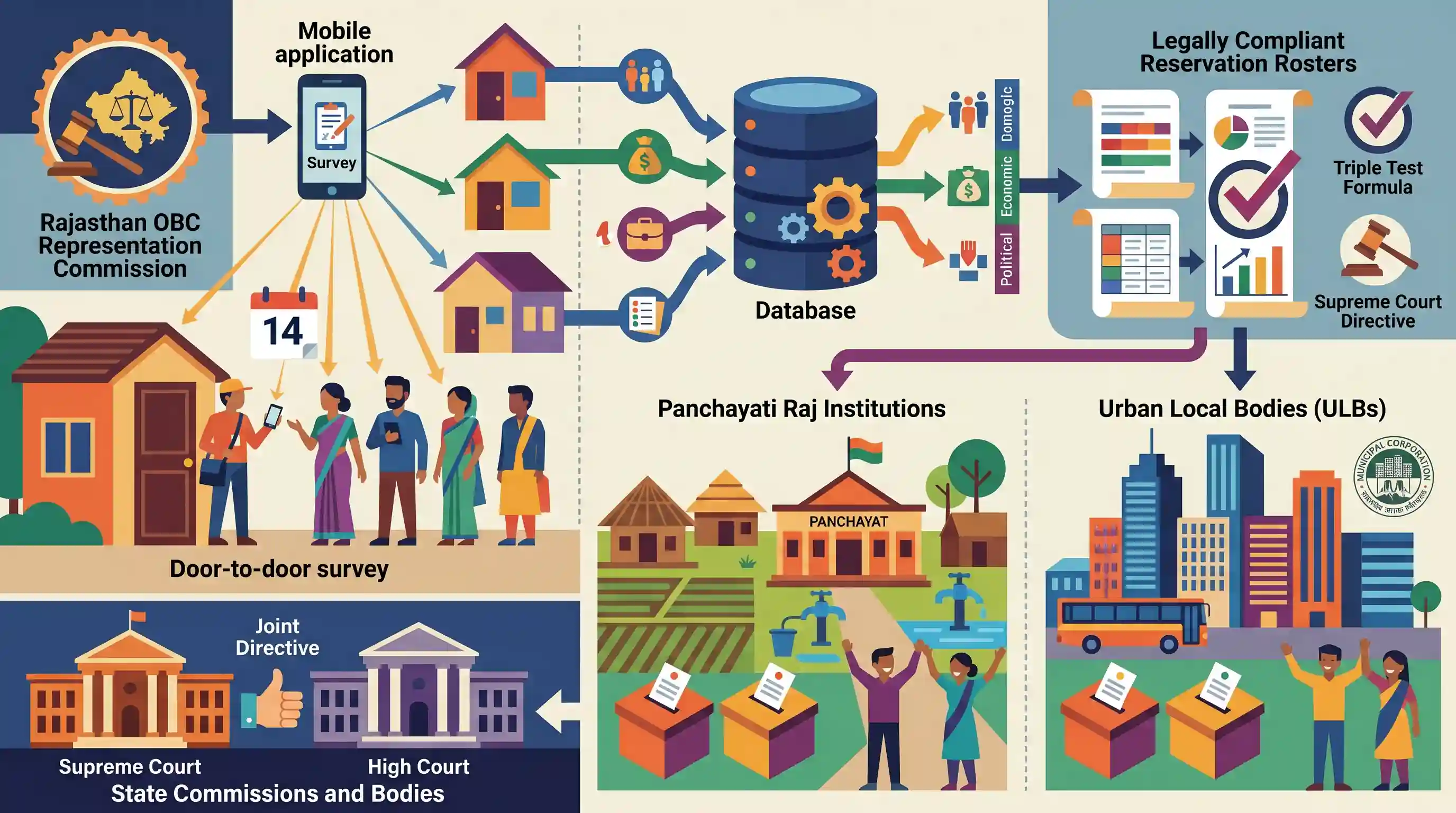
The Rajasthan OBC Representation Commission has launched a 14-day digital door-to-door survey called the 'Rajdhara Survey' to collect comprehensive data on the demographic, economic, and political status of Other Backward Classes (OBCs). Running from July 10 to July 23, 2026, this survey utilizes a dedicated mobile application to gather authentic data. The resulting data will be used to construct legally compliant reservation rosters, thereby clearing the way for long-overdue Panchayati Raj and Urban Local Body (ULB) elections in accordance with Supreme Court and High Court directives.
Key Points
- The Rajasthan OBC Representation Commission has launched the 'Rajdhara Survey' (July 10 to July 23, 2026) to gather authentic data on the demographic, social, educational, economic, and political status of OBC families in the state.
- Over 51,000 personnel have been deployed to execute this digital door-to-door exercise using a dedicated 'Rajdhara Survey' mobile application.
- The survey aims to gather precise empirical data to frame fresh reservation rosters for long-delayed local body (Panchayati Raj and Urban Local Body) elections.
- Ashok Kumar Jain is the Secretary of the Commission, and Additional District Collectors (ADMs) serve as the Chief District Coordinators at the district level.
- The administrative push is driven by judicial pressure, including a High Court-mandated deadline and a contempt petition, alongside the constitutional requirement of the Supreme Court's 'triple test' criteria for OBC reservation.
Important Terms
Rajdhara Survey

A digital door-to-door survey launched by Rajasthan in July 2026, using a mobile app, to collect demographic, socioeconomic, and political representation data on Other Backward Classes (OBCs).
UPSC context
GS Paper II (Governance); tests understanding of digital governance and data-driven reservation frameworks for local body elections.
Jan-Aadhaar
A Rajasthan government scheme based on the 'One Number, One Card, One Identity' model, creating a socio-economic database of resident families to streamline direct benefit transfers and welfare delivery.
UPSC context
GS Paper II (Governance) & GS Paper III (E-technology); tests implementation of welfare administration and citizen data profiles.
Rajasthan OBC Representation Commission
A state body constituted to gather empirical data on the social, economic, educational, and political backwardness of OBCs to recommend legally valid reservation quotas for local body elections.
UPSC context
GS Paper II (Statutory/Regulatory Bodies); tests state-level institutional mechanisms for implementing judicial mandates like the "triple test".
Supreme Court of India
India's apex judicial body, which mandated the "triple test" formulation, requiring empirical data on backwardness before reserving seats for backward classes in local self-governments.
UPSC context
GS Paper II (Polity/Judiciary); tests understanding of constitutional provisions, judicial reviews, and mandates governing local self-government elections.
Rajasthan High Court
The highest judicial organ in Rajasthan, which monitors and enforces constitutional timelines under Articles 243E and 243U to ensure timely conduct of local government elections.
UPSC context
GS Paper II (Judiciary & Local Government); tests understanding of state judiciary's role in enforcing democratic continuity in Panchayats.
Prelims Trap
General state-wide census data on social and educational backwardness is sufficient to justify political reservation for OBCs in local bodies.
The Supreme Court mandates that political backwardness is distinct from social/educational backwardness; hence, general census data is insufficient without a dedicated local body-wise empirical inquiry.
Static Concepts Connected
What are the three criteria under the Supreme Court's 'Triple Test' formula?
- Empirical Inquiry Commission: Establish a dedicated, state-appointed commission to conduct a rigorous, empirical inquiry into the nature and implications of backwardness local-body-wise.
- Proportionality Determination: Specify the proportion of reservation required in light of the commission's findings, ensuring local-body-wise tailoring rather than blanket applications.
- Strict Fifty Percent Cap: Ensure that the aggregate reservation for SCs, STs, and OBCs combined does not exceed 50% of the total seats.
How does constitutional OBC reservation in local bodies differ from education and employment quotas?
- Constitutional Basis: Local body quotas are governed by Articles 243D(6) and 243T(6), whereas reservation in education/employment is governed by Articles 15(4) and 16(4).
- Nature of Backwardness: Local body reservations address 'political backwardness' (under-representation in governance), which the Supreme Court distinguishes from 'social and educational backwardness'.
- Discretionary Power: Unlike SC/ST reservation which is mandatory under the Constitution, political reservation for OBCs is left to the discretion of individual state legislatures.
Cross-Topic Patterns
Local Governance and Judicial Mandates
The clash between constitutional mandates to hold regular local elections (Article 243E/U) and judicial insistence on the 'Triple Test' highlights how the judiciary regulates state legislative actions.
Mobile E-Governance and Data Legality
State deployment of localized mobile applications like the Rajdhara Survey demonstrates the rising utility of targeted digital administrative machinery for fast-tracking constitutional data compliance.

Constitutional distinction between political backwardness (Art 243) and social backwardness (Art 15/16) likely to feature in 2026 Prelims.
Linked PYQs · 3
Linked PYQs · 3
- 2021RPSC_PRELIMSGS1
Rajasthan government has launched an app to provide assistance to college students with digital academic material. What is the name of this app?
- 2023RPSC_PRELIMSGS1
By which amendment Act was 'Gram Sevak' replaced by 'Gram Vikas Adhikari'?
- 2018RPSC_PRELIMSGS1
Which of the following Act/Rule provides for joint meetings of Gram Sabhas in Rajasthan?
