Rajasthan Conducts Survey To Facilitate Local Body Elections
Source:newindianexpress ↗
Why It Matters
This development highlights the intersection of local self-government governance, technology in state administration (the Rajdhara App), and the constitutional and legal frameworks governing political reservation for backward classes in India, which is a frequent theme in RPSC RAS examinations.
Summary
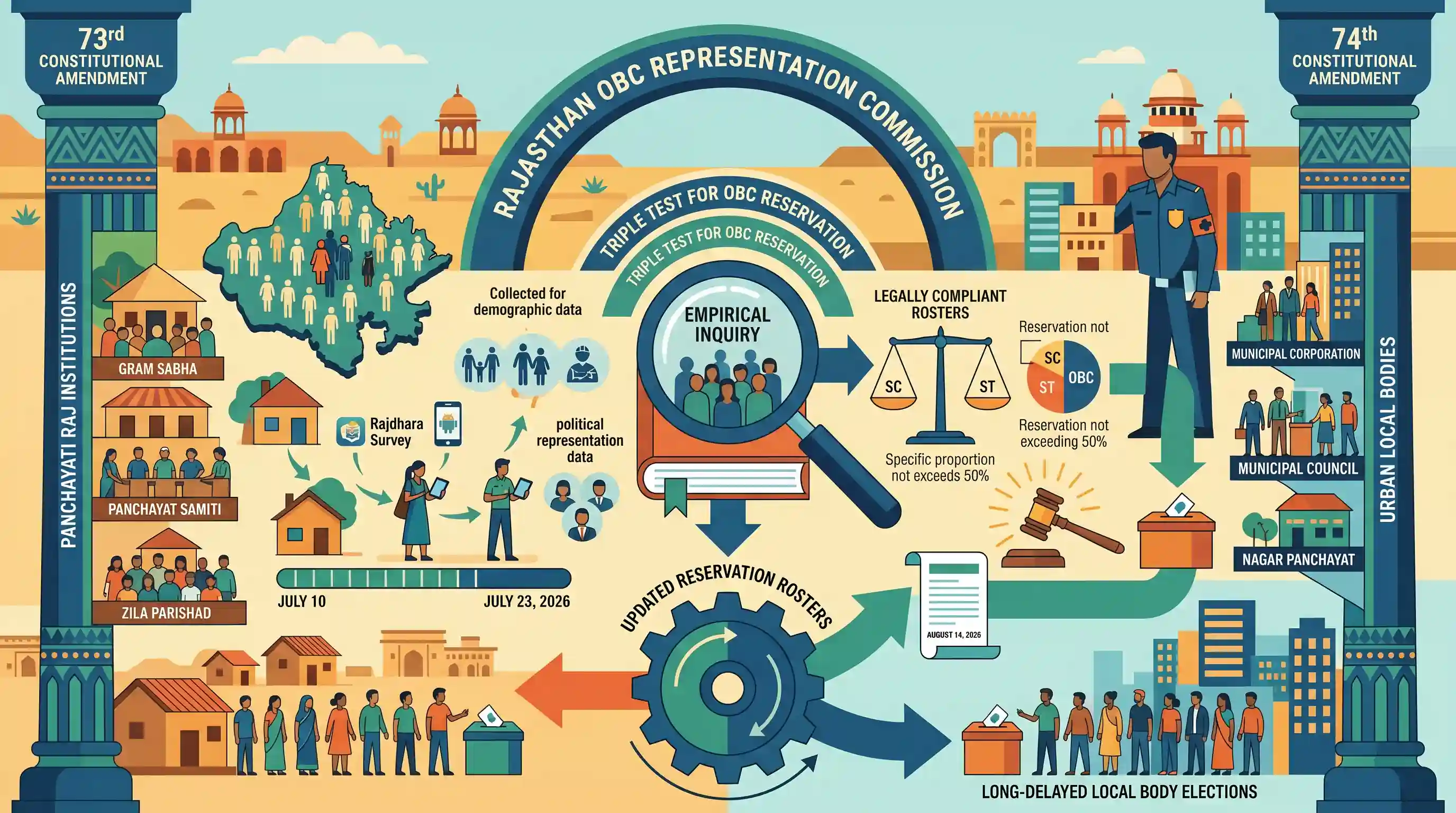
The Rajasthan OBC Representation Commission has initiated a 14-day digital door-to-door 'Rajdhara Survey' to collect demographic and political representation data of OBC families across the state. This empirical exercise aims to prepare updated, legally compliant reservation rosters for the long-delayed Panchayati Raj and Urban Local Body (ULB) elections in Rajasthan, aligning with judicial mandates (including the Supreme Court's 'Triple Test' criteria). The survey, running from July 10 to July 23, 2026, utilizes a dedicated mobile app and is overseen by Additional District Collectors (ADMs) as Chief District Coordinators, with the final report targeted for submission by August 14, 2026.
Key Points
- The Rajasthan OBC Representation Commission has launched a 14-day digital door-to-door survey (July 10 to July 23, 2026) to study the political representation of Other Backward Classes (OBC).
- The survey is powered by the 'Rajdhara Survey' mobile app, designed to digitally collect demographic, social, educational, economic, and political representation status of OBC families across all districts.
- The data collected will be used to formulate fresh, legally compliant reservation rosters for local self-governments (rural Panchayats and urban local bodies) in compliance with Supreme Court and High Court directives (primarily the 'Triple Test' mandate).
- An Additional District Collector (ADM) has been designated as the Chief District Coordinator in every district for administrative and technical support.
- The survey aims to resolve the two-year delay in local body elections, which was held up due to the lack of accurate empirical data required to comply with reservation ceilings (SCs, STs, OBCs, and women). The High Court had set a July 31, 2026 deadline.
- The Commission was constituted on May 9, 2025, and is expected to submit its report by August 14, 2026, despite its tenure being extended until September 30, 2026.
Important Terms
73rd Constitutional Amendment Act

A landmark 1992 constitutional amendment that institutionalized Panchayati Raj Institutions (PRIs) across India, mandating a three-tier governance system, regular elections, and reservation for weaker sections.
UPSC context
GS Paper II: Local Governance. Tests constitutional devolution, democratic decentralization, and rural self-governance.
74th Constitutional Amendment Act
A 1992 constitutional amendment that recognized urban local bodies as institutions of self-government, establishing municipal corporations, councils, and nagar panchayats with structured local powers.
UPSC context
GS Paper II: Urban Local Governance. Evaluates municipal devolution, metropolitan planning, and urban civic administration.
Triple Test Criteria for OBC Reservation
A Supreme Court-mandated three-step framework requiring states to establish a commission, collect empirical data on backwardness, and ensure total reservations do not exceed 50% in local bodies.
UPSC context
GS Paper II: Reservation and Judiciary. Tests landmark Supreme Court judgments, constitutional quotas, and federal limits on reservations.
Rajasthan OBC Representation Commission
A dedicated statutory body appointed to conduct rigorous, empirical, and demographic inquiry into the social and political representation of backward classes in Rajasthan's local bodies.
UPSC context
GS Paper II: Affirmative Action. Tests criteria for political reservation and the implementation of judicial guidelines like the 'Triple Test'.
Rajasthan Panchayati Raj Act, 1994
A state legislative act that established the legal framework for Panchayati Raj Institutions in Rajasthan, aligning state panchayat governance with the 73rd Constitutional Amendment.
UPSC context
GS Paper II: State-level PRIs. Analyzes decentralized legislation, operational structures, and state election mandates.
Rajasthan Municipalities Act, 2009
Comprehensive state legislation consolidating and amending the laws relating to the constitution, administration, taxation, elections, and functions of municipalities in the state of Rajasthan.
UPSC context
GS Paper II: Urban Administration. Examines regional civic frameworks, local municipal laws, and municipal administrative autonomy.
Prelims Trap
Under Articles 243D and 243T, reservation for SCs, STs, and OBCs is constitutionally mandated, while women's reservation is discretionary.
SC and ST reservations are constitutionally mandatory, whereas OBC reservation in local bodies is entirely discretionary and depends on state-specific legislative enactments.
Static Concepts Connected
What is the "Triple Test" formula mandated by the Supreme Court for local body OBC reservations?
- Dedicated Commission: Set up a dedicated commission to conduct a rigorous empirical inquiry into backwardness within local bodies.
- Proportionate Provision: Specify the proportion of reservation needed local body-wise based on empirical findings to avoid over-breadth.
- Fifty percent cap: Ensure that total reservations (SCs, STs, and OBCs combined) do not exceed 50 percent of total seats.
How do Articles 243D and 243T differentiate between reservation categories in local bodies?
- Mandatory Quotas: Seats must be reserved for SCs and STs based on population, and at least one-third of seats for women.
- Discretionary Provisions: State legislatures are permitted, but not constitutionally compelled, to provide reservations for Backward Classes (OBCs).
Cross-Topic Patterns
Local polls & Judicial overwatch
The Supreme Court's enforcement of the Triple Test showcases how judicial review actively regulates state legislative discretion on local self-governance and reservation policies.
State-led surveys vs National Census
Delays in the decadal Census push states to launch localized digital surveys (like Rajdhara) to bypass administrative blocks in local body grants and elections.

Strict application of Supreme Court's local body Triple Test is highly likely to be tested via multi-statement polity questions in 2026.
Linked PYQs · 3
Linked PYQs · 3
- 2023RPSC_PRELIMSGS1
By which amendment Act was 'Gram Sevak' replaced by 'Gram Vikas Adhikari'?
- 2018RPSC_PRELIMSGS1
Which of the following Act/Rule provides for joint meetings of Gram Sabhas in Rajasthan?
- 2021RPSC_PRELIMSGS1
According to the provisions of the Rajasthan Municipal Act, 2009, what is the maximum number of persons that the State Government can nominate in a Municipal Council?
