Rajasthan Industrial Relation Rules and Women Workforce Committees
Source:lexplosion ↗
Why It Matters
This development is highly relevant for RPSC Prelims as it highlights Rajasthan's evolving legal framework concerning labor reforms, industrial dispute resolution, and gender representation. It connects directly to state governance initiatives and ease of doing business parameters.
Summary
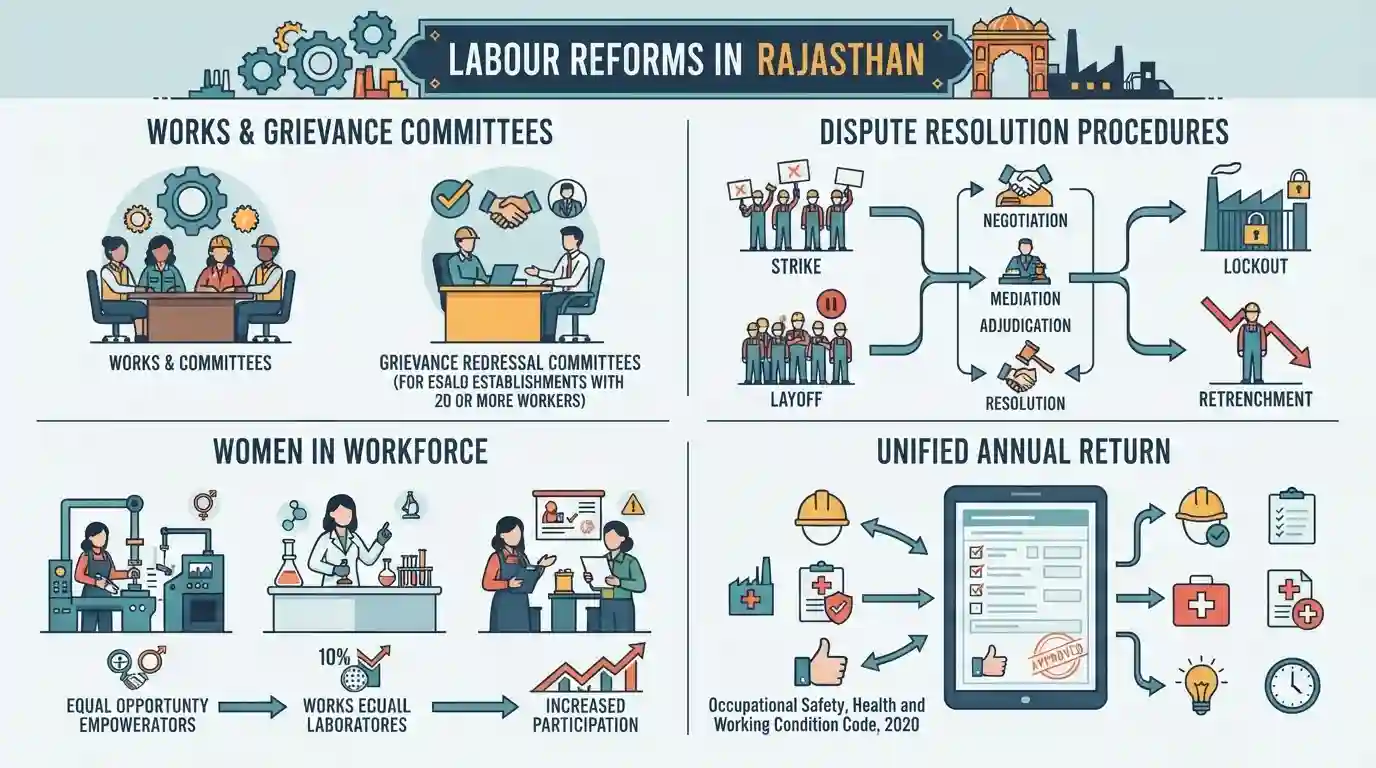
The Rajasthan Labour Department has notified the Rajasthan Industrial Relation Rules, 2026, effective from August 12, 2026. Designed to streamline industrial relations and dispute resolution, the rules mandate the formation of Works Committees with adequate representation of women and Grievance Redressal Committees in establishments with 20 or more workers. Furthermore, they outline standard operating procedures for strikes, lockouts, layoffs, retrenchment, and establishment closures, while introducing a unified annual return framework aligned with the Occupational Safety, Health and Working Condition Code, 2020.
Key Points
- The Rajasthan Labour Department notified the Rajasthan Industrial Relation Rules, 2026, which will come into effect on August 12, 2026.
- The rules mandate the constitution of Works Committees with adequate representation for women workers.
- Establishments employing 20 or more workers must establish a Grievance Redressal Committee.
- The framework requires unified annual returns under the Occupational Safety, Health and Working Condition Code, 2020.
- It lays down clear protocols for written dispute settlement agreements, as well as rules for strikes, lockouts, layoffs, retrenchment, and closure.
Important Terms
Rajasthan Industrial Relation Rules, 2026

State-level regulations effective August 12, 2026, streamlining industrial dispute resolution, strikes, and workforce restructuring. They mandate unified annual returns and formalize Works Committees and Grievance Redressal Committees.
UPSC context
Crucial for RPSC GS Paper 2 and 3 covering state labour reforms, governance, and ease of doing business.
Occupational Safety, Health and Working Condition Code, 2020
A national labour code consolidating 13 prior laws to regulate workplace safety, health, and welfare. Rajasthan's 2026 rules align their unified annual return framework with this national mandate.
UPSC context
Important for RPSC/UPSC GS Paper 2 (Social Justice) and Paper 3 (Economic Reforms) regarding national labour policies.
Works Committee
A bipartite workplace body mandated by Rajasthan's 2026 rules to ensure industrial harmony. It features up to 20 members, maintaining equal worker-employer representation alongside proportional mandatory inclusion of women.
UPSC context
Tests knowledge of democratic workplace governance and women's empowerment policies for RPSC GS Paper 2.
Grievance Redressal Committee
An internal dispute resolution panel required in Rajasthan industrial establishments with 20 or more workers. It is capped at 10 members and guarantees equal representation between employers and workers.
UPSC context
Key concept in industrial harmony and statutory grievance mechanisms, relevant for RPSC GS Paper 2.
Prelims Trap
Grievance Redressal Committees are mandatory for every industrial establishment operating in Rajasthan.
The 2026 Rules strictly mandate Grievance Redressal Committees only for establishments employing 20 or more workers, not universally across all micro or small enterprises.
Static Concepts Connected
What is the constitutional status of labour legislation in India?
- Concurrent List: Labour falls under the Concurrent List of the 7th Schedule (Article 246).
- Entry 22: Covers trade unions, industrial and labour disputes.
- Entry 24: Covers welfare of labour including conditions of work, provident funds, and maternity benefits.
- Shared Jurisdiction: Both Parliament and State Legislatures (like Rajasthan) can enact laws, allowing state-specific rules aligned with Central Acts.
What are the four Central Labour Codes enacted to consolidate India's labour laws?
- Code on Wages (2019): Consolidates acts related to minimum wages, payment of wages, and bonuses.
- Industrial Relations Code (2020): Amalgamates laws relating to trade unions, conditions of employment, and industrial disputes.
- OSHWC Code (2020): Regulates health, safety, leave, and working conditions (to which the new Rajasthan rules align).
- Social Security Code (2020): Consolidates laws on EPF, ESI, maternity benefits, and unorganised workers' welfare.
Cross-Topic Patterns
Labour Reforms & EoDB
Unified returns under the OSHWC Code reduce compliance burdens, linking state-level statutory reforms directly to Rajasthan’s Ease of Doing Business (EoDB) rankings and industrial investment push.
Gender-Inclusive Workplace Governance
Mandating women's representation in Works Committees mirrors Rajasthan's policy shift from mere welfare schemes to structural empowerment and representation in formal sector employment.

Multi-statement questions will likely mix the 20-worker threshold for Grievance Committees with the rules' alignment to the OSHWC Code.
Linked PYQs · 2
Linked PYQs · 2
- 2021RPSC_PRELIMSGS1
The Vishakha vs. State of Rajasthan and others case relates to
- 2025RPSC_PRELIMSGS1
The Ease of Doing Business ranking for states is issued by
