Rajasthan issues India first rare earth elements exploration licence
Source:drishti-ias ↗
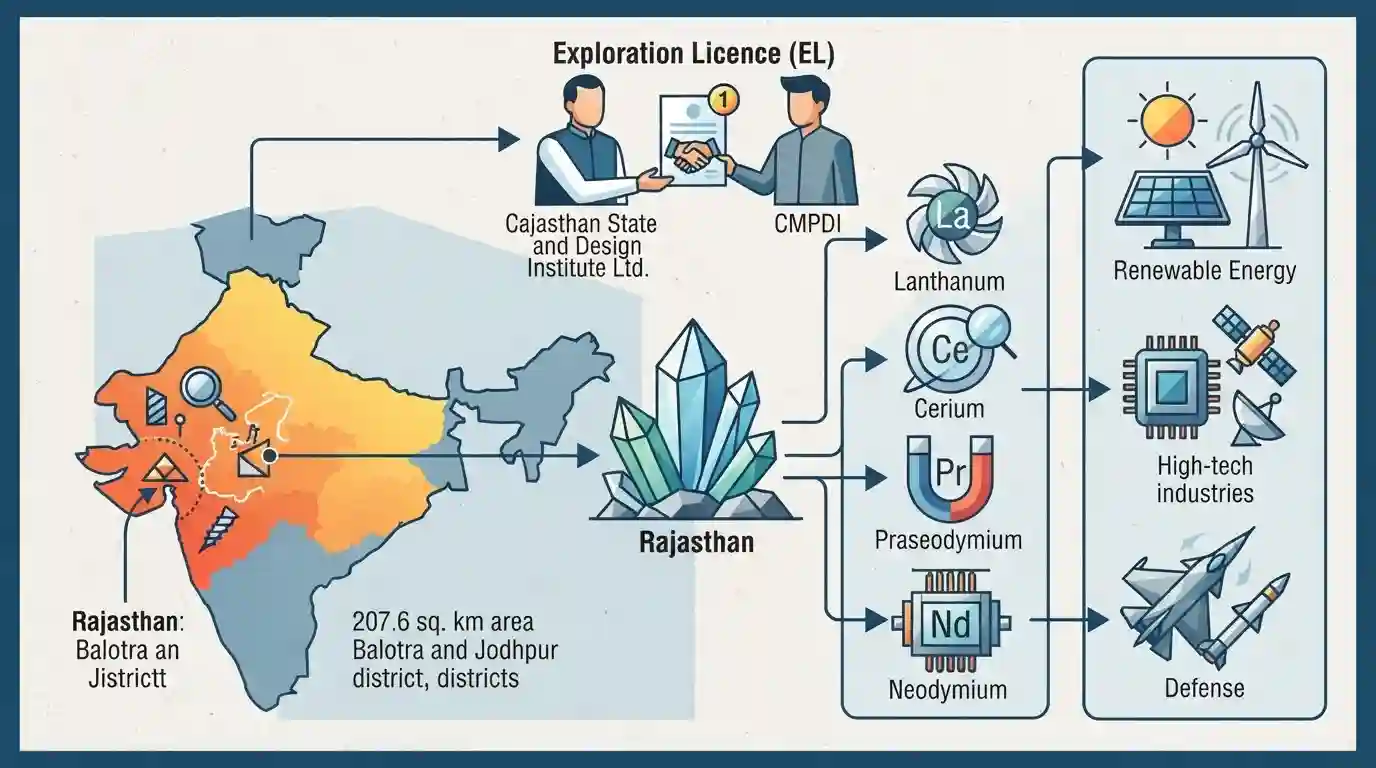
Why It Matters
The discovery and exploration of Rare Earth Elements in Rajasthan are crucial for India's strategic autonomy in high-tech manufacturing, defense, and the transition to clean energy. It highlights Rajasthan's growing importance in India's critical mineral supply chain.
Summary
Rajasthan has marked a significant milestone by becoming the first state in India to issue an Exploration Licence (EL) for Rare Earth Elements (REE). The licence was granted to the Central Mine Planning and Design Institute Ltd. (CMPDI) for a 207.6 sq. km block located in Balotra and Jodhpur districts. This block is known to contain critical minerals like Lanthanum, Cerium, Praseodymium, and Neodymium. The initiative aligns with the Central Government's introduction of the EL framework in 2024, aimed at accelerating the exploration of 29 critical and strategic minerals essential for high-tech industries, renewable energy, and defense sectors.
Key Points
- Rajasthan has become the first Indian state to issue an Exploration Licence (EL) for a Rare Earth Elements (REE) block.
- The exploration block covers 207.6 sq. km across Nawatala Devigarh (Pachpadra, Balotra district) and Shergarh (Jodhpur district).
- The licence was granted to the Central Mine Planning and Design Institute Ltd. (CMPDI), a Public Sector Enterprise.
- The block contains critical minerals such as Lanthanum, Cerium, Praseodymium, and Neodymium.
- The Central Government introduced the EL framework in 2024 for 29 critical and strategic minerals to boost domestic exploration and reduce import dependence.
Important Terms
Exploration Licence (EL) Framework

Introduced via the 2023 MMDR Amendment Act, this framework allows private and public agencies to undertake reconnaissance and prospecting for 29 deep-seated and critical minerals on a revenue-sharing basis, accelerating domestic exploration.
UPSC context
GS Paper 3 (Economy/Resources). Tests understanding of India's updated mineral policy, private participation, and efforts to secure critical minerals.
Central Mine Planning and Design Institute Ltd. (CMPDI)
A public sector enterprise and subsidiary of Coal India Limited. It provides premier technical consultancy for mine planning and exploration, and was recently awarded India's first Exploration Licence for rare earth elements in Rajasthan.
UPSC context
GS Paper 3 (Infrastructure). Highlights the evolving role of PSUs in exploring strategic minerals to build domestic resource self-reliance.
Rare Earth Elements (REEs)
A set of 17 metallic elements—15 lanthanides plus scandium and yttrium. Though moderately abundant in Earth's crust, they rarely form concentrated, easily mineable deposits. They are vital for electronics, renewable energy, and defense.
UPSC context
GS Paper 1 & 3 (Geography/S&T). Crucial for green energy transitions; tests knowledge of resource distribution and global supply monopolies.
Critical and Strategic Minerals
Minerals like lithium, cobalt, and REEs essential for high-tech manufacturing, defense, and clean energy, which face high supply-chain vulnerability. India has officially identified 30 such minerals to prioritize domestic exploration and strategic partnerships.
UPSC context
GS Paper 3 (Economy/Security). Evaluates awareness of India's import dependencies and policies driving the Atmanirbhar Bharat vision in resources.
Light Rare Earth Elements (LREEs)
A subcategory of rare earths with lower atomic numbers (57-63), including Lanthanum, Cerium, Praseodymium, and Neodymium. They are more abundant than heavy rare earths and are prominently found in the newly licensed Rajasthan block.
UPSC context
GS Paper 1 & 3 (Geography/S&T). Tests granular knowledge of REE types, their domestic availability, and specific industrial uses.
Prelims Trap
The Exploration Licence (EL) allows the winning bidder to mine and sell the discovered rare earth elements.
The EL is solely for reconnaissance and prospecting. The licensee does not get mining rights but receives a share of the auction premium when the state eventually auctions the block for mining.
Static Concepts Connected
What are Rare Earth Elements (REEs) and why are they strategically important?
- 17 Metals: A group of 17 metals (15 lanthanides plus scandium and yttrium). They are called 'rare' due to the metallurgical difficulty of extracting them, not absolute scarcity.
- High-Tech Applications: Crucial for modern technology, including permanent magnets (Neodymium, Praseodymium), phosphorescent display screens (Europium), defense systems, and electric vehicle motors.
- India's Status: India holds the 5th largest global reserves (largely as monazite sand) but relies heavily on imports due to a lack of domestic downstream processing capability.
What are the key features of the Exploration Licence (EL) under the MMDR Act?
- Target Minerals: Introduced in 2023, it is specifically for reconnaissance and prospecting of 29 critical and deep-seated minerals listed in the Seventh Schedule.
- Large Block Size: Allows exploration of massive blocks up to 1,000 sq km (compared to 25 sq km for standard prospecting), with a mandate to surrender 75% of the area after 3 years.
- Revenue Model: Awarded via competitive reverse bidding. The licensee earns a percentage share of the premium paid by the future mining lessee once the block is auctioned for extraction.
Cross-Topic Patterns
REEs + MSP & China-Plus-One
Domestic REE mapping connects directly to India's entry into the US-led Minerals Security Partnership (MSP), aiming to secure strategic supply chains and reduce reliance on China's processing monopoly.
Critical Minerals + Panchamrit Targets
Elements like Neodymium are essential for permanent magnets in wind turbines and EV motors. Domestic exploration is a prerequisite for achieving India's 2030 renewable energy targets.

Expect a multi-statement question linking the new MMDR Exploration Licence rules (reverse bidding, area limits) with specific REEs in 2026.
Linked PYQs · 3
Linked PYQs · 3
- 2025RPSC_PRELIMSGS1
Consider the following statements with reference to the goals of the Rajasthan Mineral Policy – 2024: A. To provide employment to 1 crore direct and indirect persons by 2046-47 and 50 lakh persons by 2029-30. B. To increase the contribution of the mineral sector to the state’s Gross State Domestic Product from 3.4 percent in 2023-24 to 5 percent by 2029-30 and 8 percent by 2046-47. C. To increase the number of minerals covered under mining to 70 from 58 by 2047. Which of the statements are correct?
- 2025RPSC_PRELIMSGS1
Where are the most important resources of lignite located in Rajasthan?
- 2023RPSC_PRELIMSGS1
What is the similarity between Jhadol (Udaipur), Kurada (Nagaur), and Sabania (Bikaner)?
