Rajasthan grants maiden rare earth mineral exploration licence
Source:gktoday ↗
Why It Matters
Rajasthan's status as the first state to issue an exploration licence for critical minerals makes it a highly probable current affairs topic for the RPSC RAS Prelims. Questions can target the specific districts involved (Balotra and Jodhpur), the agency granted the licence (CMPDIL), or the specific rare earth elements identified.
Summary
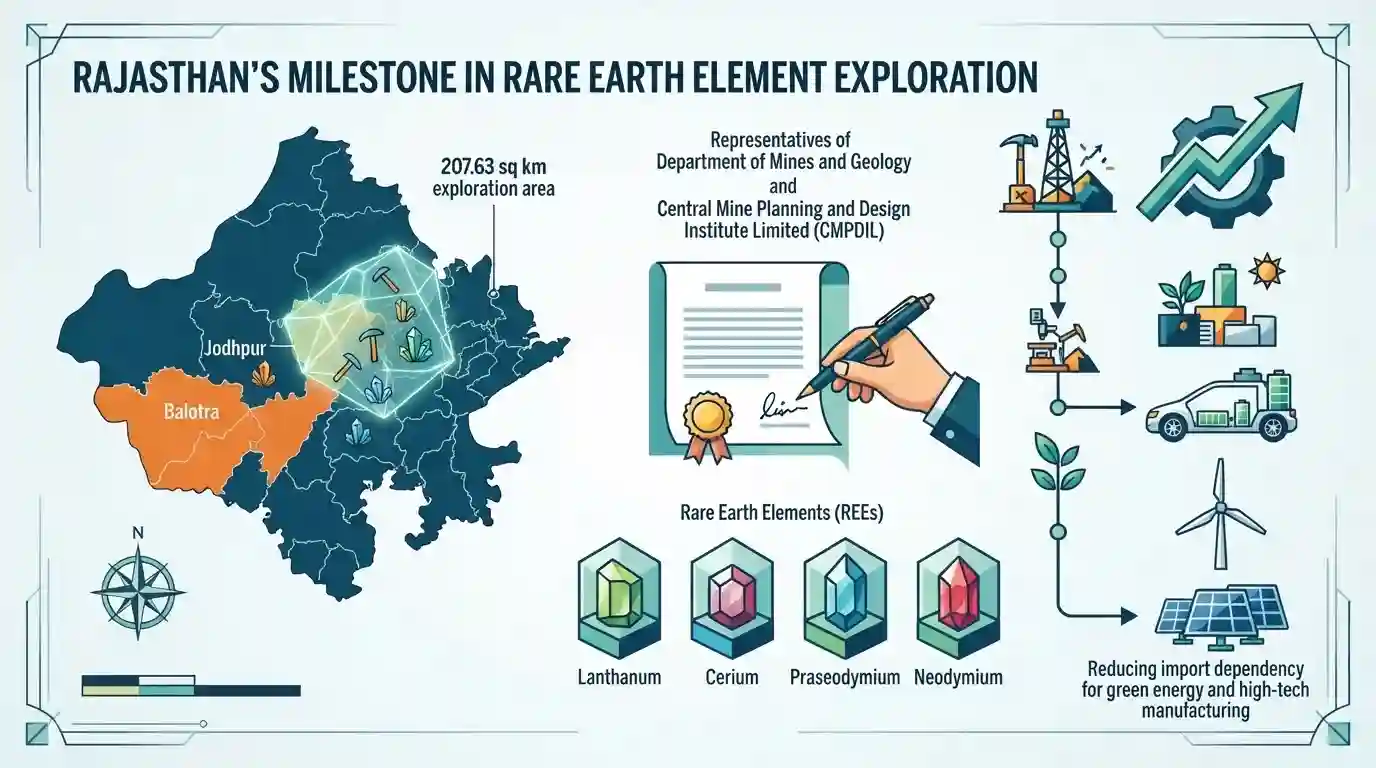
Rajasthan has become the first state in India to issue a rare earth exploration licence, marking a significant milestone in the country's strategic minerals push. The Department of Mines and Geology granted the licence to the Central Mine Planning and Design Institute Limited (CMPDIL) for a 207.63 sq km area spanning Balotra and Jodhpur districts. Initial surveys have identified critical rare earth elements such as lanthanum, cerium, praseodymium, and neodymium. This move is the first execution under India's newly updated critical minerals regulatory regime, aimed at reducing import dependency for high-tech and green energy manufacturing.
Key Points
- Rajasthan is the first state in India to issue a rare earth exploration licence.
- The licence was granted to Central Mine Planning and Design Institute Limited (CMPDIL).
- Exploration will cover 207.63 sq km in Balotra (Navatala-Devigarh in Pachpadra) and Jodhpur (Shergarh tehsil) districts.
- Identified Rare Earth Elements (REEs) in the area include lanthanum, cerium, praseodymium, and neodymium.
- This marks the first agreement signed under India’s updated critical minerals regulatory framework to secure strategic supply chains.
Important Terms
Critical Minerals Regulatory Regime

A framework established via MMDR Act amendments that grants the Central Government exclusive authority to auction exploration and mining licences for specified strategic and critical minerals.
UPSC context
Crucial for GS-2 (Policies) and GS-3 (Economy), focusing on Atmanirbhar Bharat, energy transition, and supply chain security for strategic resources.
Central Mine Planning and Design Institute Limited (CMPDIL)
A Mini Ratna public sector undertaking and Coal India subsidiary providing mine planning, design, and exploration services, now expanding into strategic rare earth mineral exploration.
UPSC context
Relevant for GS-3 (Economy) regarding the evolving mandate of traditional coal PSUs in driving India's critical mineral exploration.
Department of Mines and Geology of Rajasthan
The state nodal agency responsible for surveying mineral resources, enforcing mining regulations, and executing auctioned exploration licences, recently issuing India's first rare earth exploration licence.
UPSC context
Important for GS-1 (Geography) and GS-2 (Federalism), illustrating state-level execution of central mineral auction frameworks.
Rare Earth Elements (REEs)
A group of metallic elements (e.g., lanthanum, neodymium) that are essential for manufacturing high-tech electronics, electric vehicles, defence equipment, and renewable energy technology.
UPSC context
Vital for GS-3 (Science & Tech, Environment) to understand clean energy transitions, technological manufacturing, and import dependency vulnerabilities.
Prelims Trap
All Rare Earth Elements in India are classified as atomic minerals, restricting their exploration exclusively to public sector undertakings.
The MMDR Amendment Act 2023 split REEs: those without Uranium/Thorium are 'Critical and Strategic Minerals' (Part-D), permitting commercial exploration under the new Exploration Licence regime.
Static Concepts Connected
How does the MMDR Amendment Act 2023 classify Rare Earth Elements?
- Regulatory Split: REEs without uranium/thorium are placed under Part-D (Critical Minerals), while radioactive-bearing REEs remain strictly under Part-B (Atomic Minerals).
- Exploration Licence: Allows private or public entities to conduct G3/G2 level prospecting for 29 deep-seated minerals, earning a share of the subsequent mining auction premium.
What is the geological distinction between India's REE reserves?
- Beach Sand Monazite: Heavy mineral sands in coastal regions containing thorium; highly regulated under the Atomic Energy Act due to radioactivity.
- Hard-Rock Deposits: Terrestrial carbonatite and alkaline rock complexes, like Rajasthan's new blocks, which bypass complex atomic clearances as they lack radioactive elements.
Cross-Topic Patterns
Critical Minerals + Indo-Pacific Security
Domestic REE extraction aligns with India's entry into the US-led Minerals Security Partnership (MSP), aiming to build supply chains independent of Chinese monopoly.
Mineral Federalism + Fiscal Autonomy
While the Union government classifies critical minerals and designs auction terms, state governments execute licences and receive royalties, balancing central security with state revenues.

The distinction between Part-B atomic and Part-D critical REEs under the MMDR 2023 Act is highly likely for a 2026 Prelims question.
Linked PYQs · 3
Linked PYQs · 3
- 2025RPSC_PRELIMSGS1
Where are the most important resources of lignite located in Rajasthan?
- 2025RPSC_PRELIMSGS1
Where are the asbestos mines located in Rajasthan at the following sites?
- 2025RPSC_PRELIMSGS1
The correct order of decreasing contribution of different sectors in Rajasthan’s Gross Fixed Capital Formation is
