Rajasthan adopts central renewable consumption obligation framework
Source:mercom-india ↗
Why It Matters
Rajasthan leads India in solar power potential and installed capacity. The transition from Renewable Purchase Obligations (RPO) to the central-aligned Renewable Consumption Obligation (RCO) framework represents a key policy shift that impacts state DISCOMs, commercial open-access users, and captive power plants. Introducing dedicated Distributed Renewable Energy (DRE) targets further accelerates rural micro-grid and agricultural solar development, making it highly relevant to state economic policy and infrastructure-related examinations.
Summary
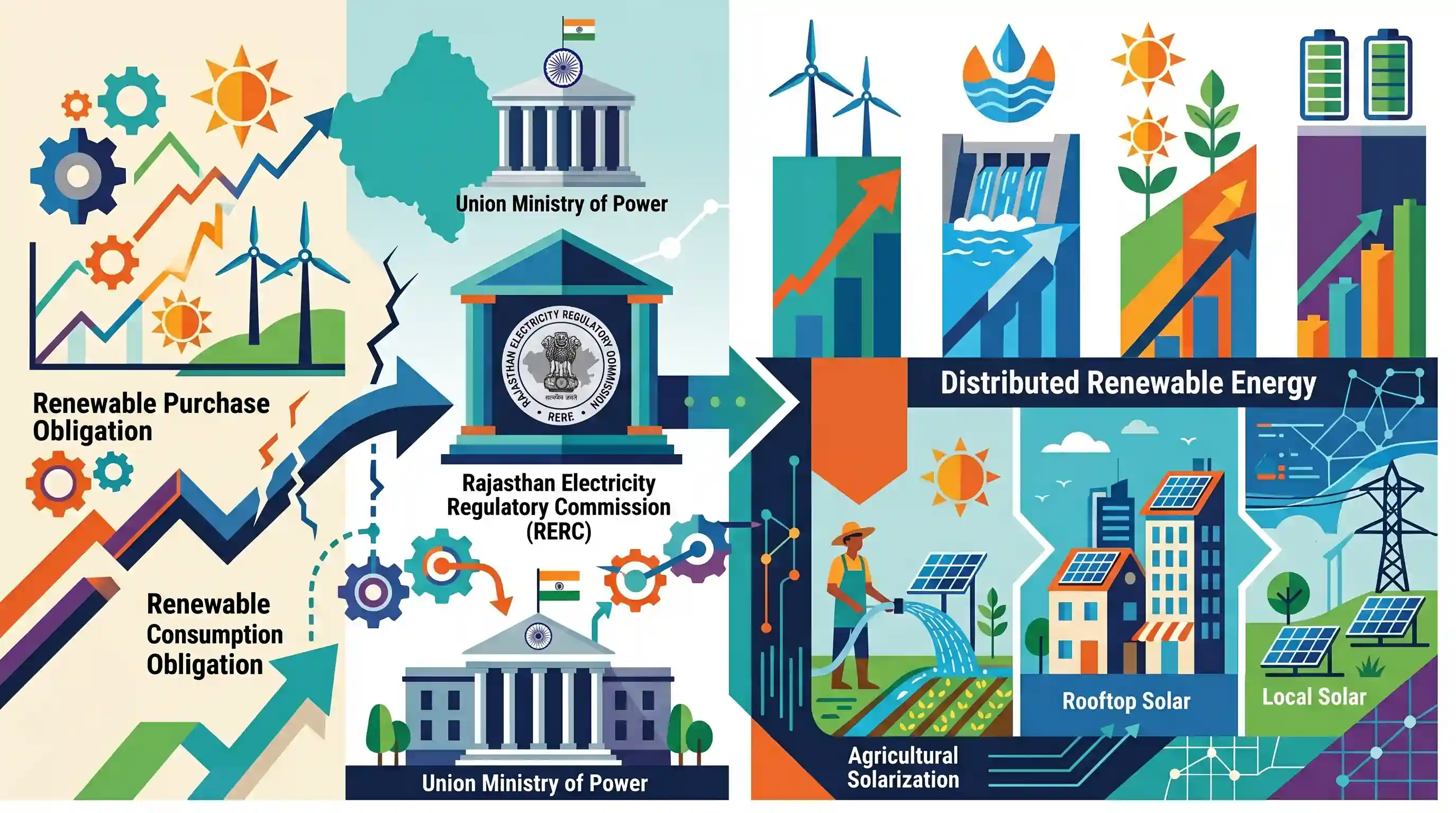
The Rajasthan Electricity Regulatory Commission (RERC) has introduced updated renewable energy compliance rules, effective April 1, 2026. These regulations align the state's power framework with the Union Ministry of Power's Renewable Consumption Obligation (RCO) trajectory, replacing previous RPO structures. The guidelines mandate distinct obligations for wind, hydro, other renewable sources, and energy storage, while establishing dedicated targets for Distributed Renewable Energy (DRE) to encourage local solar systems, agricultural solarization, and rooftop installations across the state.
Key Points
- The Rajasthan Electricity Regulatory Commission (RERC) has notified new renewable energy compliance regulations, which came into effect on April 1, 2026.
- The regulations align Rajasthan's state energy frameworks with the central Ministry of Power's Renewable Consumption Obligation (RCO) trajectory.
- The rules introduce specific Distributed Renewable Energy (DRE) targets to boost decentralized power generation, including rooftop solar and agricultural solar installations under PM-KUSUM.
- The transition from traditional Renewable Purchase Obligations (RPO) to RCO ensures actual green energy consumption tracking across different resource types (wind, hydro, other RE, and energy storage).
- Obligated entities, including state distribution companies (DISCOMs), open-access consumers, and captive power plants, must comply with the new purchase percentages to support Rajasthan's energy transition.
Important Terms
Renewable Consumption Obligation (RCO) framework

A legislative mandate under the Energy Conservation (Amendment) Act, 2022, requiring designated consumers to consume a specified minimum percentage of their electricity from non-fossil/renewable sources.
UPSC context
GS Paper III (Environment & Infrastructure); tests knowledge of legislative shifts from purchase-based (RPO) to consumption-centric renewable targets.
PM-KUSUM Scheme
A central scheme launched in 2019 to promote agricultural solarization by funding decentralized solar plants, standalone solar pumps, and the solarization of grid-connected agricultural pumps.
UPSC context
GS Paper III (Agricultural Policy & Infrastructure); tests understanding of energy-water security, diesel substitution, and farmers' income diversification.
PM Surya Ghar: Muft Bijli Yojana
A flagship central rooftop solar scheme launched in February 2024, providing up to 300 units of free monthly electricity to one crore Indian households through subsidized solar panel installations.
UPSC context
GS Paper III (Infrastructure & Climate Change); tests understanding of decentralized renewable deployment, public subsidies, and domestic solar power generation.
Rajasthan Electricity Regulatory Commission (RERC)
The statutory regulatory body governing the power sector in Rajasthan, responsible for tariff determination, open-access frameworks, and implementing state-level renewable compliance rules.
UPSC context
GS Paper II & III (Statutory Bodies & Infrastructure); tests state-level regulatory implementation and federal alignment of renewable energy policies.
Electricity (Promoting Renewable Energy Through Green Energy Open Access) Rules, 2022
Union Ministry of Power regulations that enable consumers with a contract demand/sanctioned load of 100 kW or more to directly procure clean electricity from third-party renewable energy developers.
UPSC context
GS Paper III (Energy Sector & Infrastructure); tests knowledge of open-access reforms, ease of procuring green energy, and grid-decarbonization efforts.
Prelims Trap
Renewable Consumption Obligations (RCOs) are statutorily mandated and governed under the provisions of the Electricity Act, 2003.
While RPOs were established under the Electricity Act, 2003, the newly introduced RCOs derive their statutory mandate from the Energy Conservation (Amendment) Act, 2022.
Static Concepts Connected
What is the statutory basis and difference between RPOs and RCOs?
- RPO Mandate: Established under Section 86(1)(e) of the Electricity Act, 2003, requiring DISCOMs to purchase minimum renewable power.
- RCO Mandate: Introduced via the Energy Conservation (Amendment) Act, 2022, focusing on physical consumption of non-fossil energy sources.
- Key Shift: Transitions accountability from paper-based procurement contracts to actual physical grid integration and energy absorption.
What are State Electricity Regulatory Commissions (SERCs) and their key functions?
- Statutory Origin: Statutory bodies established under the Electricity Act, 2003 to regulate power sectors at the state level.
- Core Functions: Determining tariffs, regulating electricity purchase, and promoting renewable energy generation within the state.
- Dispute Resolution: Adjudicating disputes between licensees and generating companies, with appeals lying to APTEL.
Cross-Topic Patterns
Federalism and Clean Energy Mandates
Explores how central climate commitments require state regulatory alignment (SERCs), illustrating the cooperative federalism dynamics of India's green transition.
Decentralized Solar and Rural Development
Connects localized DRE targets with schemes like PM-KUSUM, demonstrating how energy reforms directly influence rural climate resilience and farmer incomes.

UPSC may target the statutory shift from RPOs (Electricity Act) to RCOs (Energy Conservation Act) and the non-fungibility of DRE targets.
Linked PYQs · 4
Linked PYQs · 4
- 2021RPSC_PRELIMSGS1
In which year was the Rajasthan Solar Energy Policy announced?
- 2023RPSC_PRELIMSGS1
Which agency has been given the responsibility of implementing the PM-KUSUM scheme (Component A) in Rajasthan, which involves the establishment of solar power plants with a capacity of 0.5 MW to 2 MW?
- 2024RPSC_PRELIMSGS1
Which of the following statements about Rajasthan Multi Bijli Yojana is/are correct? A. Provide plants on one side to provide 100 solar plants. B. Subsidy for setting up rooftop solar panels. C. Provision of loan at book interest.
- 2021RPSC_PRELIMSGS1
'Green Energy Corridor' – Through which of the following districts will it pass in Rajasthan?
