Rajasthan Rolls Out First Electric Buses Under PM e Bus Sewa Scheme
Source:punjabkesari ↗
Why It Matters
This milestone marks the debut of electric buses in Rajasthan's public transport fleet under a major central scheme, integrating urban planning, clean energy transition, public safety, and state-specific environmental policies.
Summary
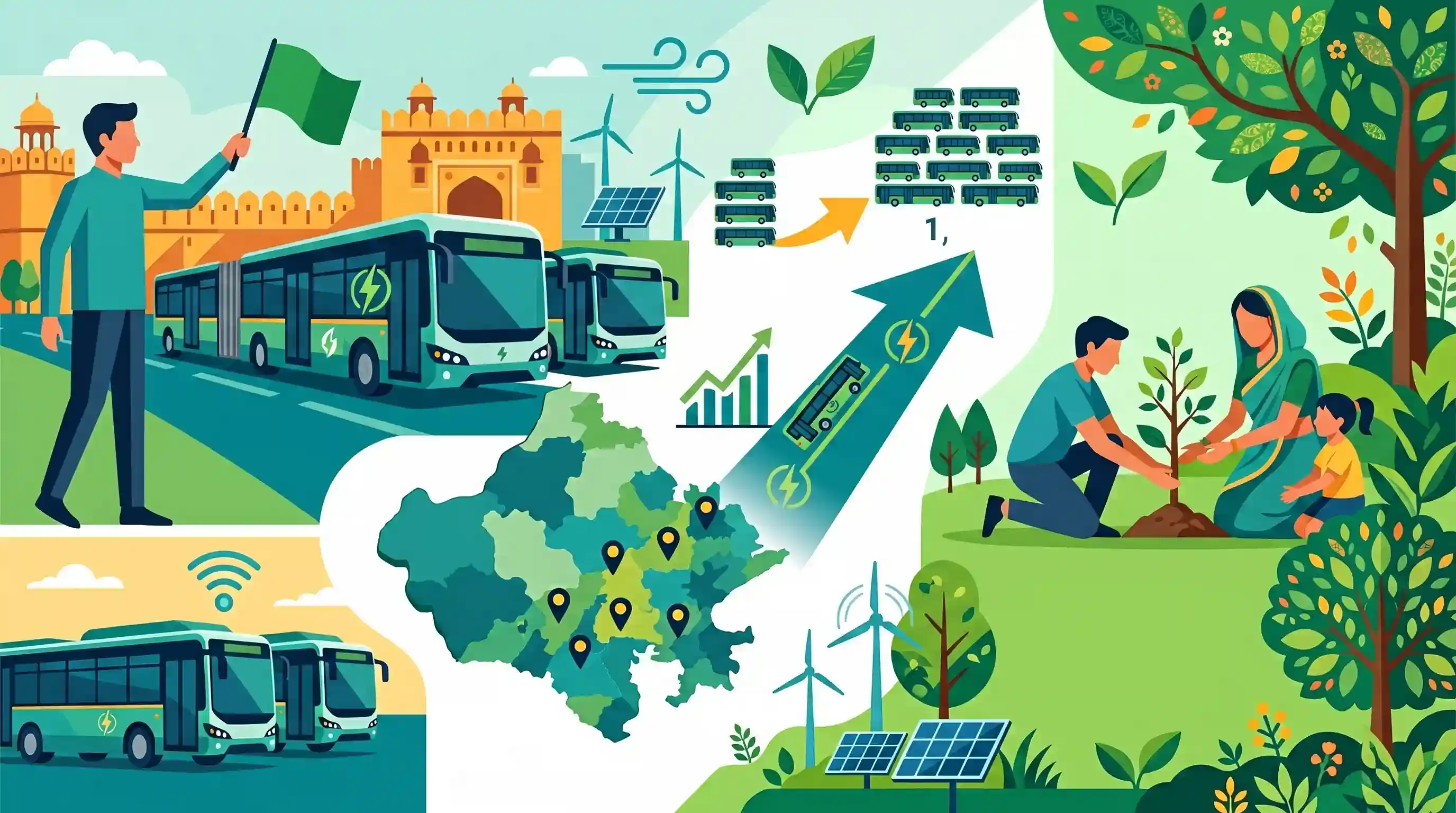
On June 20, 2026, Rajasthan Chief Minister Bhajan Lal Sharma flagged off the state's first-ever electric public transport buses under the PM e-Bus Sewa Scheme. Flagging off 29 state-of-the-art electric buses for Jaipur and virtually inaugurating 18 for Bhilwara, the CM marked a historic step in clean urban mobility. Eight Rajasthan cities have been chosen under the scheme, with the state's total central allocation expanded from 675 to 1,150 electric buses. The rollout is supported by environmental drives like the Hariyalo Rajasthan Campaign and the 'Ek Ped Maa Ke Naam' initiative.
Key Points
- First-Time Initiative: Rajasthan has officially rolled out its first-ever electric bus service to enhance sustainable urban transit and curb pollution.
- PM e-Bus Sewa Scheme: Launched in August 2023 by Prime Minister Narendra Modi, this centrally-sponsored scheme supports depot construction, charging infrastructure, and operations in cities. Eight cities in Rajasthan have been selected under this scheme: Jaipur, Jodhpur, Udaipur, Kota, Bikaner, Bhilwara, Alwar, and Ajmer.
- Bus Allocations: The Central government originally sanctioned 675 electric buses for Rajasthan, with an additional approval of 475 buses, bringing the state's total allocation to 1,150. Chief Minister Bhajan Lal Sharma flagged off the first batch of 29 buses for Jaipur and 18 for Bhilwara, with the remaining 675 of the first batch expected to run by Diwali.
- Amenities & Future Urban Targets: The buses feature air-conditioning, CCTV surveillance, emergency panic buttons, and features customized for safety of women, students, and senior citizens. Separately, Rajasthan plans to deploy 555 electric buses for urban transit and 50 double-decker electric buses for tourism.
- Environmental Campaign Linkages: CM Sharma highlighted concurrent green drives in the state, noting that nearly 20 crore saplings have been planted under the Hariyalo Rajasthan Campaign alongside the 'Ek Ped Maa Ke Naam' initiative.
Important Terms
PM e-Bus Sewa Scheme

A Centrally Sponsored Scheme aimed at deploying 10,000 electric buses on a Public-Private Partnership (PPP) model across Indian cities with populations of 3 lakh and above to promote green urban mobility.
UPSC context
GS Paper 3 (Infrastructure & Conservation); tests knowledge of clean energy transit systems and public-private partnerships in urban development.
Hariyalo Rajasthan Campaign
An environmental initiative by the Rajasthan government aimed at planting 50 crore trees over five years to increase forest cover, prevent land erosion, and restore ecological balance in the state.
UPSC context
GS Paper 3 (Environment) and State PCS; tests knowledge of state-level afforestation, climate resilience, and ecosystem restoration strategies.
Ek Ped Maa Ke Naam Initiative
A nationwide citizen-driven tree plantation campaign launched on World Environment Day 2024 to promote afforestation and ecological preservation by encouraging citizens to plant saplings in honor of their mothers.
UPSC context
GS Paper 3 (Environment and Climate Change); tests awareness of participatory climate actions, afforestation goals, and carbon-sink targets.
Jaipur City Transport Services Limited (JCTSL)
A special purpose vehicle under the Rajasthan government responsible for operating and managing urban public transport services, including newly introduced zero-emission electric buses, in Jaipur.
UPSC context
GS Paper 3 (Infrastructure and Urban Development); tests understanding of municipal transport administration and localized green mobility implementation.
Prelims Trap
PM e-Bus Sewa provides 100% central capital funding to state governments for the procurement and purchase of electric buses.
The scheme uses a PPP model; buses are procured by private concessionaires. Central assistance covers 100% of depot charging infrastructure, not the bus purchases.
Static Concepts Connected
What is the Gross Cost Contract (GCC) model in PPP?
- Definition: A PPP model where private operators procure, run, and maintain buses, while the public authority collects passenger fares.
- Payment structure: The authority pays the private concessionaire a fixed fee per kilometer of bus operation, insulating operators from ticketing revenue risk.
- CapEx reduction: Enables resource-constrained State Transport Undertakings (STUs) to modernize fleets without high upfront capital expenditure.
What is Behind-the-Meter (BTM) infrastructure?
- Location: Refers to electricity generation, storage, or charging systems located on the consumer's side of the utility billing meter.
- Components: Includes dedicated sub-stations, transformers, and fast chargers installed within a bus depot or private facility.
- Grid impact: Allows direct control of electricity draws, preventing sudden voltage drops or overloads in the public distribution grid.
Cross-Topic Patterns
Fiscal Federalism in Green Transit
Centrally sponsored mobility schemes require matching state operational capacity, testing the financial autonomy of local bodies and DISCOMs.
Grid Decarbonization vs EV Demands
Expanding heavy-duty e-bus fleets intensifies peak-load demands, forcing states to accelerate renewable energy integration at municipal grid substations.

UPSC 2026 may contrast the PM e-Bus Sewa's PPP-led Gross Cost Contract model with traditional capital-subsidy schemes like FAME.
Linked PYQs · 4
Linked PYQs · 4
- 2025RPSC_PRELIMSGS1
What is the main objective of the “Rajasthan Urban Area Development Program (Phase-III)”?
- 2025RPSC_PRELIMSGS1
Choose the incorrect statement with respect to the Rajasthan Forestry and Biodiversity Project (Phase-2).
- 2023RPSC_PRELIMSGS1
Which agency has been given the responsibility of implementing the PM-KUSUM scheme (Component A) in Rajasthan, which involves the establishment of solar power plants with a capacity of 0.5 MW to 2 MW?
- 2016RPSC_PRELIMSGS1
When was the first Forest Policy approved by the Government of Rajasthan?
