Rajasthan Industrial Policy 2026 Focuses on Semiconductors and GCCs
Source:goodreturns ↗
Why It Matters
Crucial for aspirants preparing for the Rajasthan Administrative Services (RASC/RAS) exam, as state-specific industrial policies, economic initiatives, and investment frameworks form an integral part of the Rajasthan economy and governance syllabus.
Summary
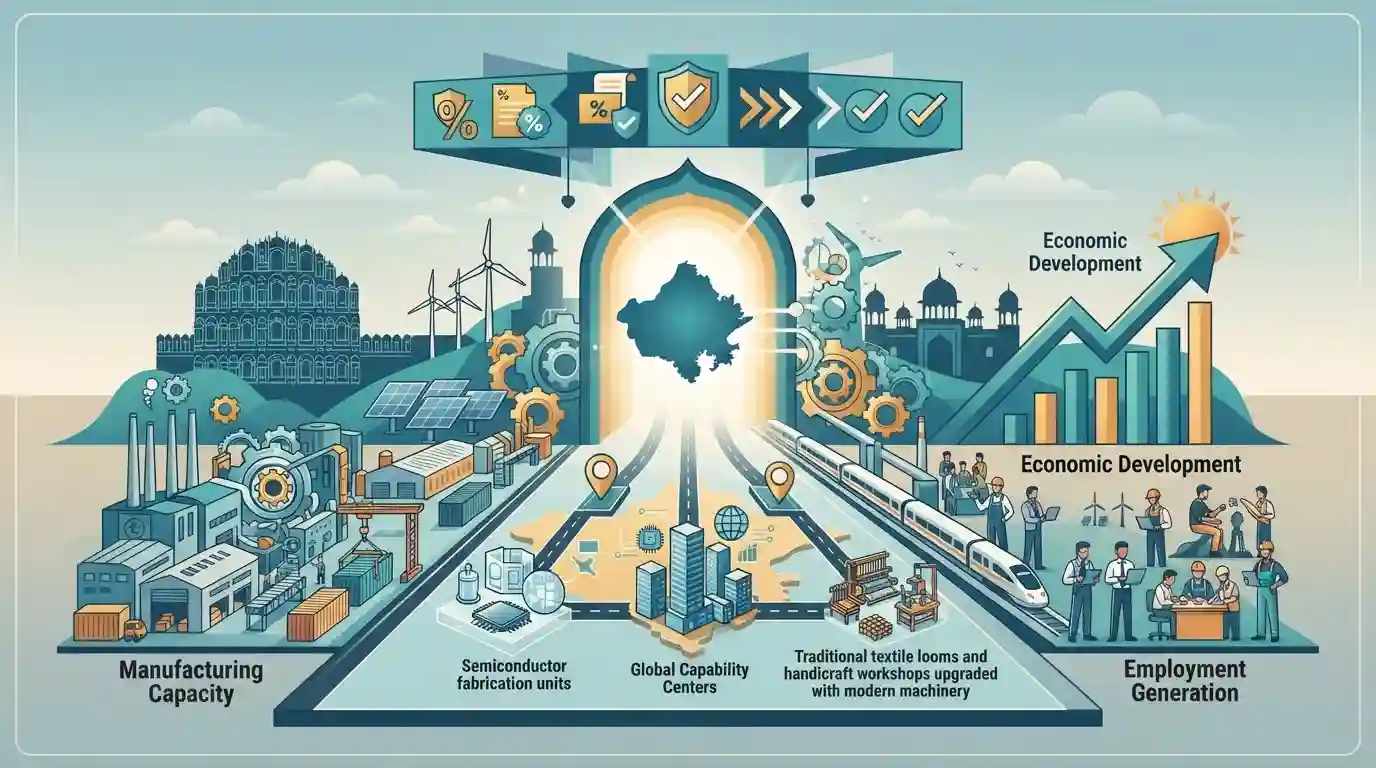
The Rajasthan government has unveiled the Rajasthan Industrial Development Policy 2026, aimed at bolstering industrial growth, manufacturing capacity, and service sector expansion across the state. The policy provides robust incentives for high-tech sunrise industries like semiconductors and Global Capability Centers (GCCs), aligning with the state's long-term economic development and employment generation goals.
Key Points
- The Rajasthan Industrial Development Policy 2026 introduces aggressive fiscal and non-fiscal incentives to attract large-scale industrial investments.
- Special emphasis is placed on sunrise sectors such as semiconductors, electronics design, and Global Capability Centers (GCCs).
- Aims to position Rajasthan as a premier investment hub by streamlining approvals through single-window systems and targeted infrastructure support.
Important Terms
Rajasthan Industrial Development Policy 2026

A strategic policy unveiled by the Rajasthan government to establish the state as a global industrial hub, targeting a USD 350 billion economy with incentives for semiconductors, GCCs, and green growth.
UPSC context
Important for RPSC (Rajasthan Economy and Industrial Policies), testing knowledge of state-level economic targets, sunrise sector incentives, and manufacturing growth.
Bureau of Investment Promotion
The nodal agency in Rajasthan responsible for promoting large-scale investments, providing single-window clearance mechanisms, and facilitating business approvals for state industrial development.
UPSC context
Crucial for RPSC (Rajasthan Administration and Economy), testing the institutional framework for investment facilitation and ease of doing business in Rajasthan.
Prelims Trap
The Rajasthan Industrial Development Policy 2026 is a centrally sponsored scheme implemented by the Ministry of Electronics and IT.
Aspirants often confuse state-specific industrial policies with central schemes like the India Semiconductor Mission (ISM) or mistake fiscal incentive timelines.
Static Concepts Connected
What are the key institutional bodies promoting industrial development and investment in Rajasthan?
- RIICO Role:: Apex agency for industrial infrastructure development across the state, managing industrial areas and growth centres.
- BIP Function:: Facilitates single-window clearances and coordinates large investment proposals under schemes like the industrial development policy.
- RFC & MSME:: Promotes micro, small, and medium enterprises, offering targeted financial and technical assistance under state MSME frameworks.
Cross-Topic Patterns
State Industrial Policies + National Semiconductor Mission
Rajasthan's push for high-tech sunrise sectors mirrors national initiatives like ISM (India Semiconductor Mission), linking state-level industrial policy with national electronics manufacturing clusters.
Single-Window Clearances + Ease of Doing Business
The integration of single-window systems for semiconductor and GCC investments intersects with the Ease of Doing Business framework monitored by DPIIT.

Rajasthan's industrial policy incentives for semiconductors and GCCs likely to appear in statement-based RPSC economic development questions.
Linked PYQs · 3
Linked PYQs · 3
- 2025RPSC_PRELIMSGS1
Which of the following statements regarding the Raj Nivesh Portal of Rajasthan is incorrect?
- 2025RPSC_PRELIMSGS1
For how long will the ‘Rajasthan ‘MSME Policy 2024’ remain in effect?
- 2025RPSC_PRELIMSGS1
Consider the following statements with reference to the goals of the Rajasthan Mineral Policy – 2024: A. To provide employment to 1 crore direct and indirect persons by 2046-47 and 50 lakh persons by 2029-30. B. To increase the contribution of the mineral sector to the state’s Gross State Domestic Product from 3.4 percent in 2023-24 to 5 percent by 2029-30 and 8 percent by 2046-47. C. To increase the number of minerals covered under mining to 70 from 58 by 2047. Which of the statements are correct?
