Rajasthan Industrial Policy Incentives For Semiconductors And GCCs
Source:goodreturns ↗
Why It Matters
Crucial for RPSC RAS aspirants as state-specific industrial policies, economic initiatives, investment schemes, and sunrise sector targets (semiconductors, GCCs) form a core part of the Rajasthan economy syllabus.
Summary
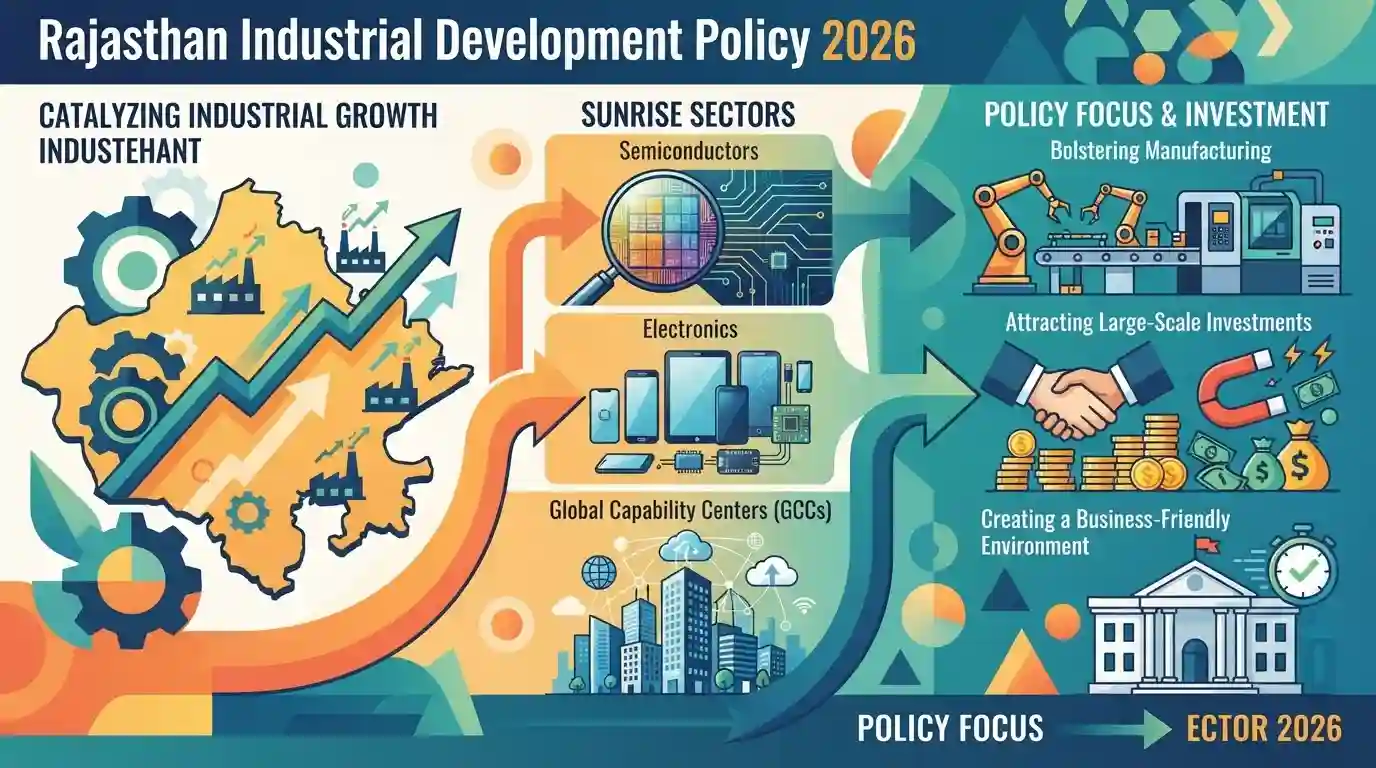
The Rajasthan Industrial Development Policy 2026 has been rolled out to catalyze industrial growth in the state, offering specific incentives for sunrise sectors such as semiconductors, electronics, and Global Capability Centers (GCCs). The policy focuses on bolstering state manufacturing, attracting large-scale investments, and creating a business-friendly environment aligned with modern economic trends.
Key Points
- The Rajasthan Industrial Development Policy 2026 introduces aggressive fiscal and non-fiscal incentives to attract cutting-edge investments, particularly targeting high-tech sectors like semiconductors and Global Capability Centers (GCCs).
- The policy aims to modernize Rajasthan's industrial ecosystem, boost ease of doing business, enhance manufacturing competitiveness, and generate large-scale employment.
- It outlines customized packages for mega and ultra-mega projects, focusing on technological up-gradation, infrastructure development, and sustainable industrial practices.
Important Terms
Rajasthan Industrial Development Policy 2026

A flagship state policy approved by the Rajasthan cabinet aimed at boosting manufacturing, attracting investments in sunrise sectors like semiconductors and GCCs, and achieving a USD 350 billion economy by 2028-29.
UPSC context
Important for RPSC Mains (Paper III - Economy of Rajasthan / Industrial Development Policies). Tests knowledge of state economic targets and sunrise sectors.
Global Capability Centers (GCCs)
Offshore or regional hubs established by multinational corporations to handle IT services, research and development, and back-office operations, increasingly targeted by Rajasthan under its new industrial policy.
UPSC context
Relevant for RPSC Economic Development and emerging economic sectors in Rajasthan, testing understanding of modern service-sector investments and tech-driven employment.
Prelims Trap
Rajasthan Industrial Development Policy 2026 aims solely at traditional handicraft and textile promotion without high-tech focus.
Aspirants often confuse state-specific industrial policies with national schemes like Make in India or PLI; Rajasthan's 2026 policy targets a specific $350 billion economy goal by 2028-29.
Static Concepts Connected
What are the key industrial corridors passing through Rajasthan?
- DMIC Route: Delhi-Mumbai Industrial Corridor (DMIC) covers a major influence zone in eastern and southern Rajasthan including Jaipur and Bhiwadi.
- AKIC Coverage: Amritsar-Kolkata Industrial Corridor (AKIC) touches northern districts of Rajasthan, facilitating logistics and manufacturing.
- Freight Corridor: Dedicated Freight Corridor (DFC) runs parallel to DMIC, offering robust multimodal logistics support for industrial hubs.
Cross-Topic Patterns
Industrial Policy + DMIC Corridor Planning
Rajasthan's target of a $350 billion economy links industrial policy with structural capital allocation and regional corridor planning like the DMIC.
Sunrise Sectors + State Industrial Diversification
The inclusion of semiconductors and GCCs reflects a strategic shift from traditional mineral/textile manufacturing to high-tech sunrise sectors in state industrial frameworks.

Rajasthan Industrial Policy 2026 targets ($350B goal, 4 pillars, sunrise sectors) will be tested in RPSC match-the-following or statement questions.
Linked PYQs · 3
Linked PYQs · 3
- 2025RPSC_PRELIMSGS1
The Ease of Doing Business ranking for states is issued by
- 2025RPSC_PRELIMSGS1
The correct order of decreasing contribution of different sectors in Rajasthan’s Gross Fixed Capital Formation is
- 2023RPSC_PRELIMSGS1
Which of the following facts about the Rajasthan Chief Minister Small Industry Promotion Scheme is not correct?
