Indira Gandhi Matritva Poshan Yojana Benefits And Eligibility Rules
Source:jankaari ↗
Why It Matters
Important for RPSC RAS aspirants to understand state-specific welfare initiatives, maternity benefits, and nutrition schemes aimed at reducing infant and maternal mortality in Rajasthan.
Summary
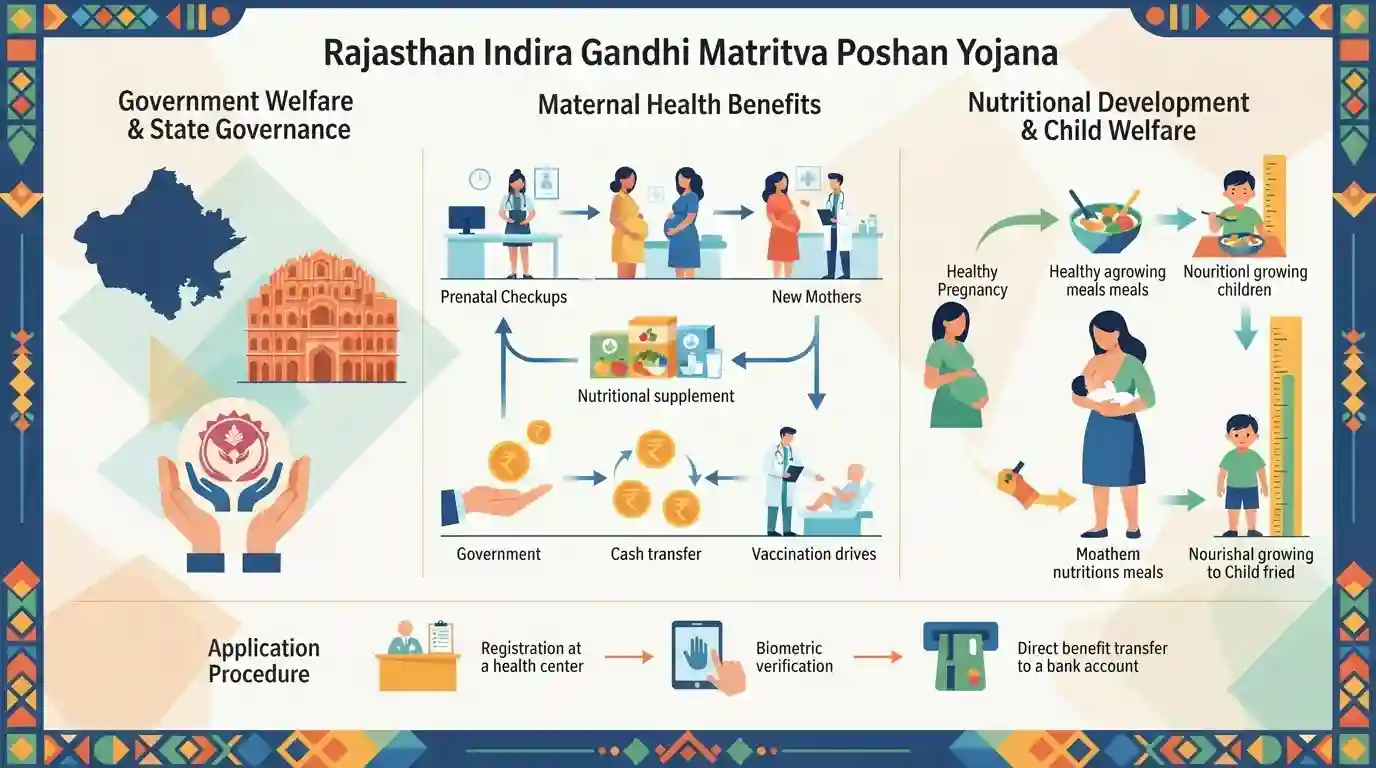
The article outlines the details of the Rajasthan Indira Gandhi Matritva Poshan Yojana, including its benefits, eligibility criteria, and application procedure, focusing on its role in maternal and child health and nutritional development in the state.
Key Points
- Indira Gandhi Matritva Poshan Yojana is a state-level maternity benefit scheme in Rajasthan aimed at improving the health and nutritional status of pregnant women and lactating mothers and their infants (0-6 months).
- The scheme provides cash transfers in multiple installments directly to the beneficiaries' bank accounts, conditional upon fulfilling specific health and nutrition milestones.
- It targets vulnerable and poor pregnant/lactating women in selected or state-wide districts of Rajasthan to combat malnutrition and reduce low birth weight.
Important Terms
Indira Gandhi Matritva Poshan Yojana

A flagship state welfare scheme launched by the Rajasthan government to provide financial assistance (₹6,000) to pregnant women and lactating mothers for nutritional support.
UPSC context
RPSC Paper II (Social Development & Welfare Schemes in Rajasthan): Tests knowledge of state-specific maternal health and nutrition initiatives.
Pradhan Mantri Matru Vandana Yojana
A centrally sponsored conditional maternity benefit scheme providing partial wage compensation to women for their first live birth.
UPSC context
RPSC/UPSC Prelims: Tests coordination between central welfare schemes and state-level nutritional programs.
Department of Women and Child Development Rajasthan
The nodal state department responsible for formulating and implementing policies, nutrition programs, and welfare schemes for women and children in Rajasthan.
UPSC context
RPSC Paper II (Rajasthan Administration): Tests governance structure and institutional mechanisms for child development.
Prelims Trap
Indira Gandhi Matritva Poshan Yojana provides maternity benefits for the first child of every pregnant woman in Rajasthan.
Aspirants often confuse IGMPY with PMMVY, assuming IGMPY covers all live births. In reality, IGMPY specifically targets the second child and beyond in targeted districts/statewide, unlike PMMVY's first child focus.
Static Concepts Connected
What are the key objectives and implementation details of the Indira Gandhi Matritva Poshan Yojana in Rajasthan?
- Launch & Aim: Launched in November 2020 by the Government of Rajasthan to improve health and nutrition for pregnant and lactating women and infants (0-6 months).
- Cash Benefit: Provides a financial assistance of ₹6,000 in multiple conditional installments directly credited via DBT to beneficiaries' bank accounts.
- Target Group: Primarily focuses on providing nutritional support for the second child and beyond to combat undernutrition and low birth weight.
- Expansion: Initially launched in five tribal-dominated districts (Pratapgarh, Banswara, Dungarpur, Udaipur, Baran) and later expanded statewide.
Cross-Topic Patterns
State vs Central Maternity Schemes (PMMVY vs IGMPY)
While PMMVY provides maternity benefits for the first live birth at the national level, IGMPY specifically fills the gap by targeting the second child and beyond in Rajasthan.
DBT Cash Transfers & Public Health Integration
Conditional cash transfers under IGMPY link direct benefit transfer (DBT) mechanics with nutrition and immunization milestones under National Health Mission (NHM).

RPSC questions on IGMPY often test target beneficiary specifics (e.g., second child/beyond) and initial pilot districts versus statewide expansion.
Linked PYQs · 1
Linked PYQs · 1
- 2023RPSC_PRELIMSGS1
Which scheme aims to improve the health and nutritional status of pregnant women and lactating mothers and their infants (0 to 6 months) by promoting the use of appropriate practices, care, and services during pregnancy, safe delivery, and breastfeeding?
