HPCL Investment and RTPP Act Preferences Drive Retail Fuel Expansion
Source:udaipurtimes ↗
Why It Matters
The joint venture project HRRL (Pachpadra, Barmer) is a major economic driver in Rajasthan. Understanding land allotment policies, procurement laws (RTPP Act), and capital investments by oil PSUs is critical for the RPSC RAS Prelims and Mains (Economy and Public Administration sections).
Summary
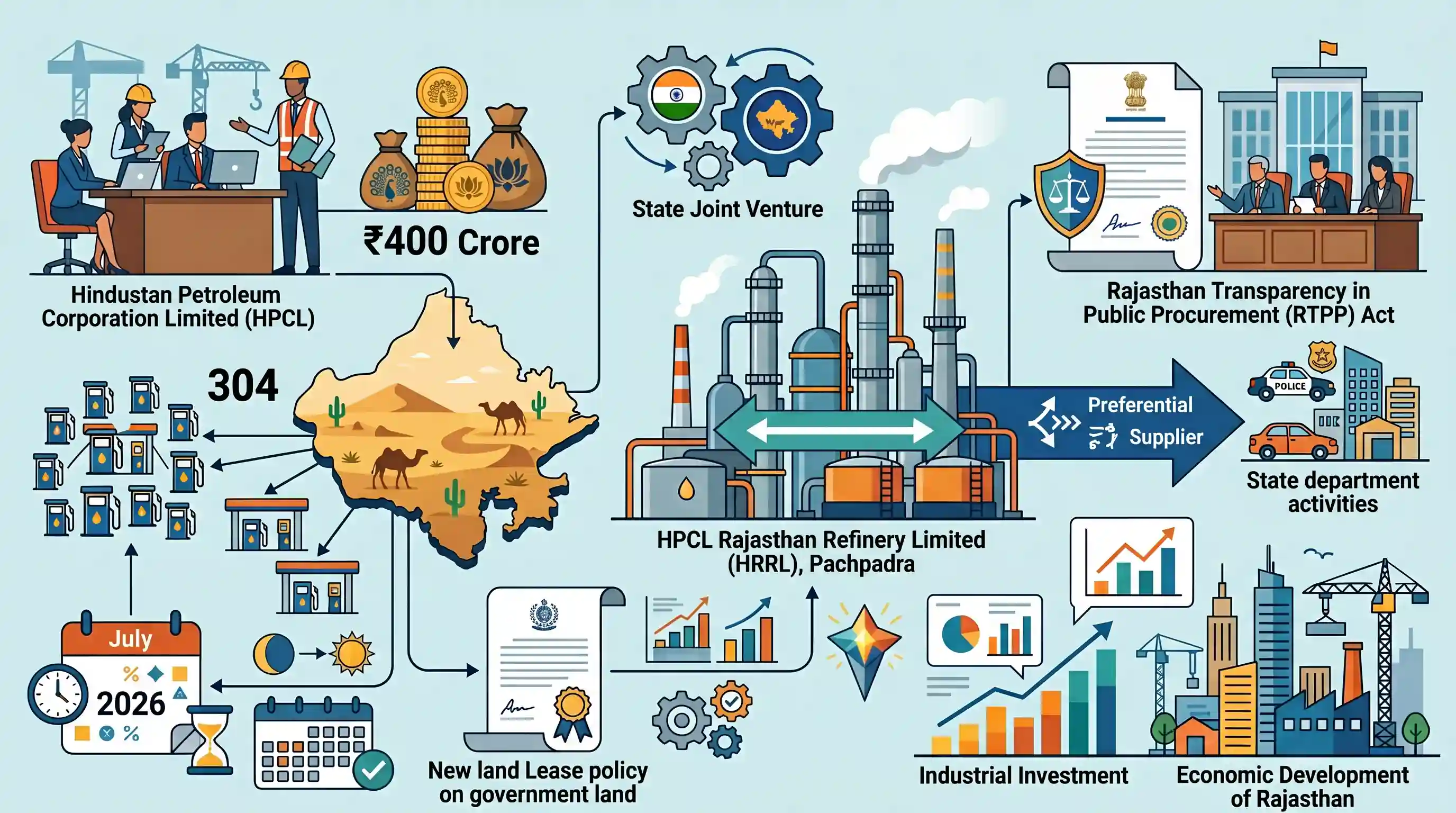
Hindustan Petroleum Corporation Limited (HPCL) is planning to invest ₹400 crore to establish 304 retail fuel outlets across Rajasthan on identified government land leased under a dedicated policy to be framed by July 2026. To optimize the refining capacity of HPCL Rajasthan Refinery Limited (HRRL), HPCL has requested preferential supplier status under the Rajasthan Transparency in Public Procurement (RTPP) Act for state department procurement.
Key Points
- Hindustan Petroleum Corporation Limited (HPCL) is planning to invest ₹400 crore to set up 304 retail fuel outlets across Rajasthan.
- The Rajasthan Government has already identified 304 government-owned land sites, which will be leased to HPCL. A lease-based land allotment policy is expected to be formulated by the end of July 2026.
- HPCL and HPCL Rajasthan Refinery Limited (HRRL) have requested preferential supplier status under the Rajasthan Transparency in Public Procurement (RTPP) Act for fuel procurement by various state departments, aimed at maximizing the utilization of HRRL's refining capacity within the state.
- The infrastructure project was reviewed in a high-level meeting chaired by Chief Secretary Srinivas along with other senior administrative officers of the state.
Important Terms
Rajasthan Transparency in Public Procurement (RTPP) Act

A state law enacted in 2012 to regulate government procurement in Rajasthan, ensuring transparency, accountability, fair competition, efficiency, and integrity across state departments and public sector enterprises.
UPSC context
GS Paper II (Governance) & III (Economy). Tests state-level frameworks for fiscal discipline, public procurement, and administrative transparency.
HPCL Rajasthan Refinery Limited (HRRL)
A joint venture between HPCL (74% stake) and the Government of Rajasthan (26% stake) executing a 9 MMTPA greenfield Refinery-cum-Petrochemical Complex at Pachpadra, which achieved commercial operations in June 2026.
UPSC context
GS Paper III (Infrastructure & Energy). Tests understanding of energy joint ventures, regional industrialization, petrochemical ecosystems, and national refining targets.
Hindustan Petroleum Corporation Limited (HPCL)
A Maharatna Central Public Sector Enterprise (CPSE) and subsidiary of ONGC, under the Ministry of Petroleum and Natural Gas, primarily engaged in refining, marketing, and retail distribution of petroleum products in India.
UPSC context
GS Paper III (Energy & CPSEs). Tests understanding of India's state-owned energy corporations, national energy security, and oil refining capabilities.
Preferential Supplier Status
A procurement mechanism under public procurement rules granting purchase or price preference to selected state enterprises, local industries, or entities to support state socio-economic policies and local industrial development.
UPSC context
GS Paper III (Economy). Tests concepts of market competition, government procurement policies, and state intervention in promoting domestic industrial growth.
Prelims Trap
HPCL Rajasthan Refinery Limited (HRRL) is a 50:50 joint venture, or a state-majority enterprise where the Government of Rajasthan holds the controlling stake.
HPCL holds a 74% majority equity share, while the Government of Rajasthan holds 26%. Aspirants often assume state-level strategic infrastructure JVs are split 50:50 or favor the state government.
Static Concepts Connected
What are Price and Purchase Preferences in public procurement?
- Definition: Policy instruments allowing government entities to buy from preferred sectors (like MSEs, local JVs, or domestic makers) even if their bids are slightly higher (usually within a 15% margin).
- Legal Framework: Governed by General Financial Rules (GFR) at the Union level, and state-specific statutes like the RTPP Act, 2012 in Rajasthan.
- Strategic Objective: Aims to foster regional industrialization, ensure off-take for strategic state-backed projects, and promote domestic manufacturing.
Why are modern oil refineries integrated with petrochemical complexes?
- Value Addition: Directly converting refinery streams (like naphtha and gases) into polymers and plastics yields higher margins than refining fuel alone.
- Energy Transition: Hedging against the long-term decline in transport fuel demand driven by electric vehicle penetration.
- Resource Efficiency: Shared utilities, integrated heat systems, and co-located storage reduce both capital expenditures and operational energy footprints.
Cross-Topic Patterns
Sub-national procurement & WTO GPA
India is not a party to the WTO Government Procurement Agreement (GPA). This allows states to use legislations like the RTPP Act to give purchase preferences to domestic or state-specific JVs.
Resource-adjacent refinery geography
HRRL Pachpadra represents a shift towards inland, wellhead-adjacent refining (utilizing Barmer crude) to service landlocked northwestern domestic markets, reducing coastal transport dependencies.

Mains 2026 may evaluate how sub-national procurement preferences act as critical fiscal de-risking tools for capital-intensive CPSE-State JVs.
Linked PYQs · 1
Linked PYQs · 1
- 2018RPSC_PRELIMSGS1
The proposed oil refinery in Pachpadra, Barmer, is a joint venture of which?
