Hospital ICU Fire in Jaipur Kills Patients Amid Negligence Allegations
Source:The Hindu ↗
Why It Matters
It highlights the systemic deficiencies in India's public healthcare infrastructure, particularly regarding fire safety enforcement and emergency preparedness, while also raising critical ethical questions about the accountability and compassion of public medical staff during disasters.
Summary
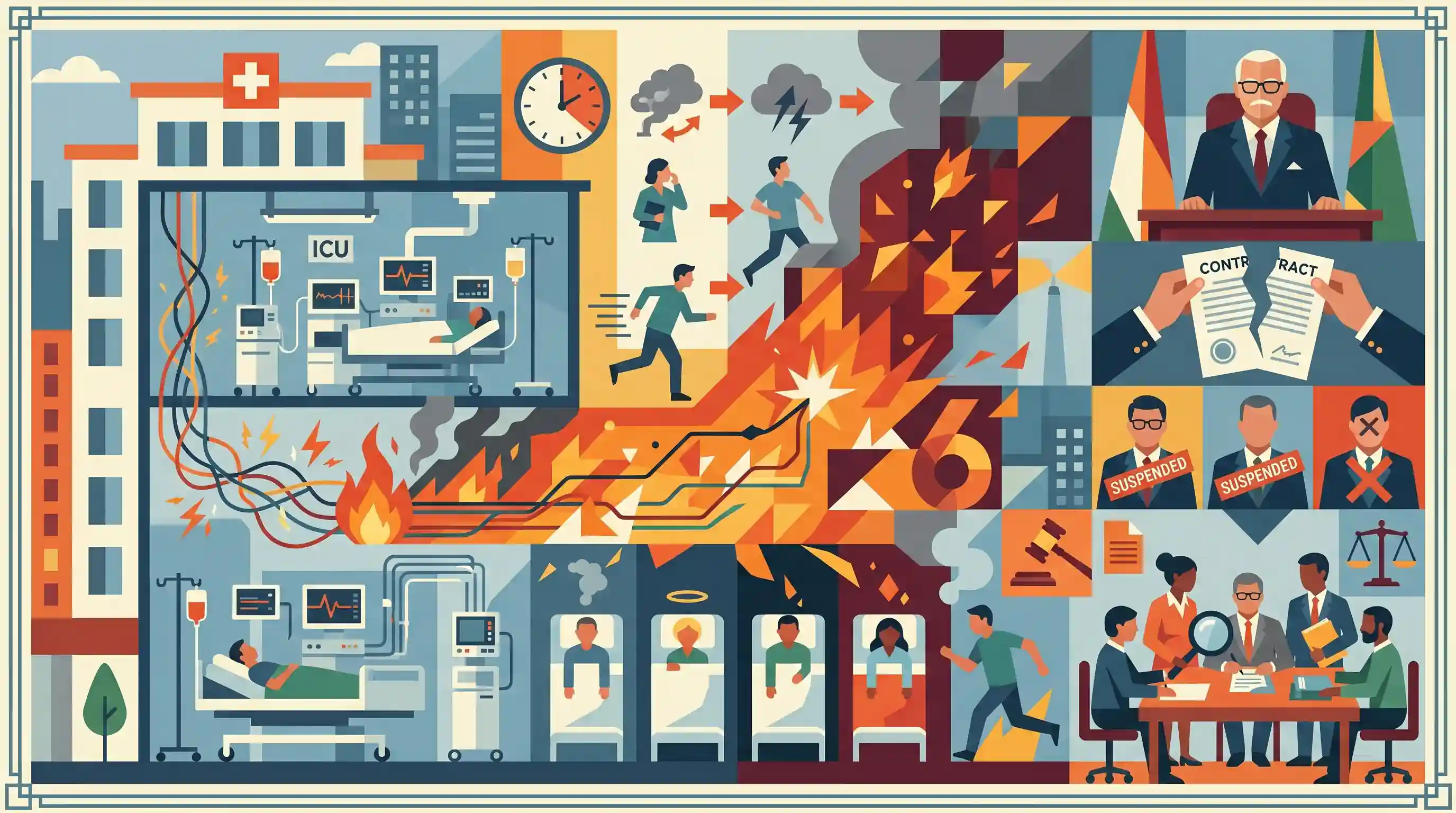
A devastating fire, suspected to have been caused by a short circuit, erupted in an ICU at the trauma centre of the Sawai Man Singh (SMS) Government Hospital in Jaipur, claiming the lives of six patients. Relatives of the deceased alleged extreme negligence, reporting that the hospital staff ignored warnings about smoke 20 minutes before the fire and subsequently abandoned the patients as the blaze spread. In response, the Rajasthan government suspended top hospital administrators, cancelled the fire safety contractor's tender, and formed a six-member probe committee led by Medical Education Commissioner Iqbal Khan. The tragedy underscores urgent concerns regarding emergency preparedness, public health infrastructure governance, and administrative accountability in state-run hospitals.
Key Points
- A massive fire broke out in the neurosurgery ICU at the trauma centre of the State-run Sawai Man Singh (SMS) Hospital in Jaipur, killing six patients due to burns and suffocation.
- Families of the victims alleged severe medical negligence, stating that hospital staff ignored earlier warnings about sparks and smoke and fled as the fire spread, leaving patients behind.
- The State government removed the trauma centre in-charge and hospital superintendent, suspended an executive engineer, and cancelled the tender of the hospital's fire safety agency, S.K. Electric Company.
- A six-member high-level committee headed by Medical Education Commissioner Iqbal Khan was constituted to investigate the causes of the fire.
- The incident exposes critical vulnerabilities in the fire safety and disaster preparedness protocols of India's public healthcare infrastructure.
Important Terms
Sawai Man Singh (SMS) Government Hospital

Rajasthan's premier state-run hospital in Jaipur; site of a fatal 2025 ICU fire that highlighted systemic lapses in public health infrastructure and emergency preparedness.
UPSC context
GS Paper 2 (Health Infrastructure); case study for administrative failure and safety protocols in large government-run facilities.
Medical Negligence
Failure of medical professionals or staff to exercise reasonable care, causing harm. It involves legal (BNS Section 106) and ethical dimensions regarding the duty of care.
UPSC context
GS Paper 4 (Ethics) & GS Paper 2 (Governance); tests understanding of professional duties and legal accountability.
Administrative Accountability
The obligation of public administrators to report, explain, and be answerable for the consequences of their actions or omissions in governance and service delivery.
UPSC context
GS Paper 2 (Governance) & GS Paper 4 (Ethics); pertains to the responsibility of senior officials for systemic failures under their watch.
S.K. Electric Company
The private contractor responsible for maintaining fire safety systems at SMS Hospital; its contract was cancelled and an FIR filed following the 2025 fire.
UPSC context
GS Paper 3 (Disaster Management/Infrastructure); highlights the risks and accountability mechanisms in outsourcing essential public safety services.
National Building Code (NBC) of India
A comprehensive instrument by the Bureau of Indian Standards providing guidelines for building construction and fire safety to ensure public welfare and hazard prevention.
UPSC context
GS Paper 3 (Disaster Management); central to discussing regulatory compliance and safety standards for institutional buildings.
Article 21 (Right to Health)
Constitutional provision protecting the right to life, which the Judiciary interprets as including the right to health and a safe environment for patients.
UPSC context
GS Paper 2 (Polity); essential for discussing the state's constitutional obligation to ensure safe public health facilities.
Prelims Trap
The National Building Code (NBC) is legally binding and directly enforced by the NDMA across all Indian states.
The NBC is a model code published by the Bureau of Indian Standards (BIS). It is legally enforced by state and local municipal bodies, not NDMA.
Static Concepts Connected
What is the regulatory framework governing hospital fire safety in India?
- NBC 2016 Part 4: Classifies hospitals as 'Group C' institutional buildings, mandating strict fire resistance, designated exits, and evacuation protocols.
- State-level Enforcement: Fire services are a State subject. Local municipalities adopt NBC guidelines into building bylaws to issue No Objection Certificates (NOCs).
- NDMA Guidelines: Recommends regular electrical load audits and Hospital Incident Response Systems (HIRS) for proactive disaster mitigation.
How does the Constitution frame the Right to Health and public infrastructure?
- Article 21 inclusion: Through expansive interpretation, the Supreme Court has ruled that the Right to Life inherently encompasses the Right to Health and access to safe emergency medical care.
- Article 47 DPSP: Directs the State to improve public health and the standard of living, creating an obligation to maintain functional and safe healthcare infrastructure.
Cross-Topic Patterns
Urban Heatwaves + Electrical Short Circuits
Rising temperatures and heatwaves severely strain legacy hospital electrical systems via HVAC usage, linking climate change directly to increased urban fire vulnerabilities.
Disaster Preparedness + Foundational Ethics
The alleged abandonment of patients by staff perfectly frames a GS4 case study on dereliction of duty versus foundational values like compassion and professional integrity.

Expect a GS3 Mains question evaluating the enforcement of NDMA guidelines and National Building Code in public health infrastructure.
Linked PYQs · 4
Linked PYQs · 4
- 2021MainsGS2
“Besides being a moral imperative of a Welfare State, primary health structure is a necessary precondition for sustainable development.” Analyze.
- 2024MainsGS2
In a crucial domain like the public healthcare system the Indian State should play a vital role to contain the adverse impact of marketisation of the system. Suggest some measures through which the State can enhance the reach of public healthcare at the grassroots level.
- 2013MainsGS3
How important are vulnerability and risk assessment for pre-disaster management ? As an administrator, what are key areas that you would focus on in a Disaster Management System.
- 2022MainsGS4
Apart from intellectual competency and moral qualities, empathy and compassion are some of the other vital attributes that facilitate the civil servants to be more competent in tackling the crucial issues or taking critical decisions. Explain with suitable illustrations.
