Rajasthan Orders Daily Monitoring of High Risk Pregnancies
Source:indianmasterminds ↗
Why It Matters
Maternal Mortality Rate (MMR) is a crucial human development indicator and part of the Sustainable Development Goals (SDG 3). Rajasthan's targeted micro-monitoring approach via ANMs, real-time tracking, and institutional linkages reflects an important governance model for health interventions that could feature in public policy questions.
Summary
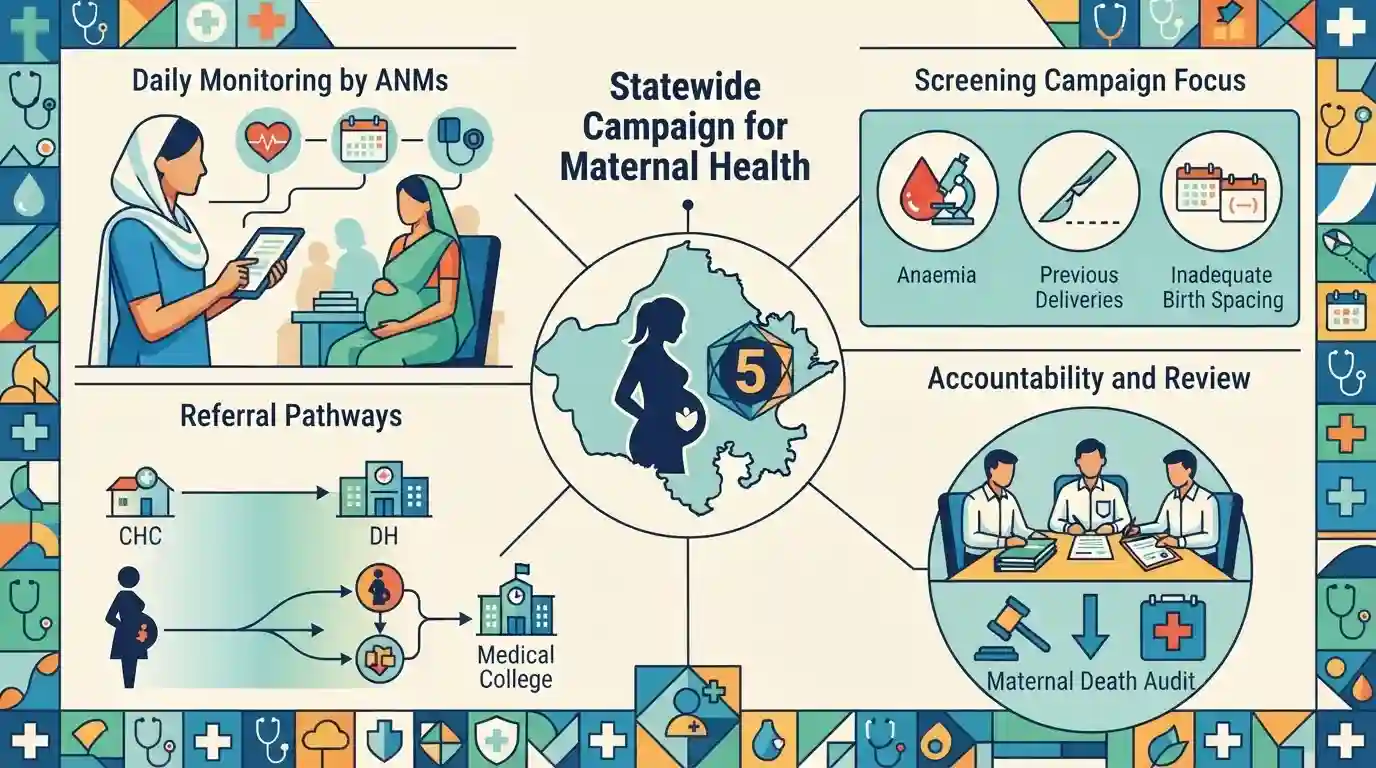
In a bid to reduce maternal mortality, the Rajasthan government has initiated the daily monitoring of high-risk pregnancies through dedicated Auxiliary Nurse Midwives (ANMs). Chief Secretary V Srinivas mandated that high-risk cases be linked to specific healthcare institutions—from Community Health Centres to Medical Colleges—depending on the severity of the risk. A five-day statewide campaign will screen pregnant women, focusing on risk factors like anaemia, previous surgical deliveries, and inadequate birth spacing. Furthermore, stringent maternal death audits and weekly reviews by district health officers have been ordered to ensure accountability and improve systemic interventions.
Key Points
- Rajasthan Chief Secretary V Srinivas directed the daily monitoring of high-risk pregnancies by dedicated Auxiliary Nurse Midwives (ANMs) to curb the maternal mortality rate.
- High-risk pregnant women will be strategically linked to appropriate healthcare facilities, ranging from CHCs to Medical Colleges, based on their risk severity.
- A five-day state-wide screening campaign starting July 15 aims to identify and screen all pregnant women, particularly targeting those with anaemia, low birth spacing, or previous surgical deliveries.
- The state mandated stringent maternal death reviews and audits, with weekly meetings by CMHOs to analyze every maternal death and prevent future occurrences.
- Medical colleges in Bikaner, Jodhpur, Kota, and Ajmer will be equipped with 100 new computers to enhance online tracking and real-time monitoring of high-risk cases.
Important Terms
Maternal Mortality

The death of a woman while pregnant or within 42 days of termination of pregnancy, from any cause related to or aggravated by the pregnancy, excluding accidental or incidental causes.
UPSC context
GS2 (Public Health/Social Justice). Core indicator of healthcare quality; tested in demographic trends, SDG 3.1 targets, and human development indices.
High-Risk Pregnancy (HRP)
A pregnancy where the mother or fetus faces increased health risks due to factors like severe anaemia, inadequate birth spacing, previous surgical deliveries, or existing medical conditions.
UPSC context
GS2 (Health). Relevant to government schemes targeting maternal and child health outcomes, infant mortality, and safe motherhood interventions.
Auxiliary Nurse Midwife (ANM)
A village-level female health worker who serves as the first point of contact between the community and public health services, responsible for maternal care, immunization, and family planning.
UPSC context
GS2 (Healthcare Infrastructure). Tests grassroots public health delivery mechanisms, rural health schemes, and India's three-tier healthcare system.
Community Health Centres (CHCs)
Secondary-level healthcare facilities in India's three-tier public health system, serving as referral centers for Primary Health Centres (PHCs) and providing specialist medical, surgical, and obstetric care.
UPSC context
GS2 (Governance/Social Sector). Crucial for evaluating India's rural healthcare infrastructure, "missing middle" health gaps, and NHM implementation.
National Health Mission (NHM)
A flagship Indian government initiative launched in 2013, subsuming rural and urban health missions, to provide accessible, affordable, and quality healthcare, especially to vulnerable populations.
UPSC context
GS2 (Government Policies). Frequently tested in mains regarding health policy efficacy, funding allocations, and overarching disease control targets.
Rajasthan Medical Services Corporation Limited (RMSCL)
A state-owned company acting as the centralized procurement agency for the Rajasthan government to supply generic medicines, surgical equipment, and sutures free of cost at government facilities.
UPSC context
GS2 (State Governance/Health). Illustrates successful state-level interventions in public health logistics, centralized drug procurement, and reducing out-of-pocket expenditure.
Prelims Trap
Maternal Mortality Ratio (MMR) is defined as the number of maternal deaths per 100,000 women of reproductive age (15–49 years).
UPSC frequently interchanges 'Ratio' (per 100,000 live births) and 'Rate' (per 100,000 women of reproductive age). They represent entirely different demographic denominators.
Static Concepts Connected
What are the structural differences between ANMs, ASHAs, and Anganwadi Workers?
- ANMs (Auxiliary Midwives): Salaried clinical professionals operating at the Sub-Centre level; serve as the first official contact point in India's primary healthcare.
- ASHAs (Accredited Activists): Community-selected volunteer health activists incentivized under NHM; serve as social mobilizers and referral linkages.
- Anganwadi Workers (AWWs): Part-time workers under the ICDS scheme of the Ministry of Women and Child Development, focusing on nutrition and pre-school education.
How do Maternal Mortality Ratio and Maternal Mortality Rate differ?
- Maternal Mortality Ratio: Measures maternal deaths per 100,000 live births in a given period; it is a measure of the risk of death once pregnant.
- Maternal Mortality Rate: Measures maternal deaths per 100,000 women of reproductive age (usually 15–49 years); it reflects both the risk of death and the fertility rate.
Cross-Topic Patterns
Sub-national Healthcare + SDG 3.1
State-specific pregnancy tracking models demonstrate how federal units customize national health missions to target localized maternal mortality bottlenecks and fulfill SDG 3.1.
Frontline Cadres + Public Policy
Comparing the administrative, financial, and clinical roles of ANMs, ASHAs, and Anganwadi workers highlights systemic issues in gendered and informalized frontline labor in India.

Distinctions between MMR Ratio/Rate and structural differences in grassroot health cadres (ANM vs ASHA) are prime targets for Prelims 2026.
Linked PYQs · 1
Linked PYQs · 1
- 2021RPSC_PRELIMSGS1
Under the Ayushman Bharat Mahatma Gandhi Rajasthan Health Insurance Scheme, the amount provided per family per year in the event of a critical illness health insurance is
