Rajasthan High Court Stays Nursing Counselling Over NOC Delays
Source:courtbook ↗
Why It Matters
This case highlights the active role of the state judiciary (Rajasthan High Court) in checking administrative inertia and protecting institutional rights. It underscores the legal enforceability of policy timelines (like the 90-day NOC rule) and the impact of administrative delays on regional educational infrastructure and professional healthcare courses in Rajasthan.
Summary
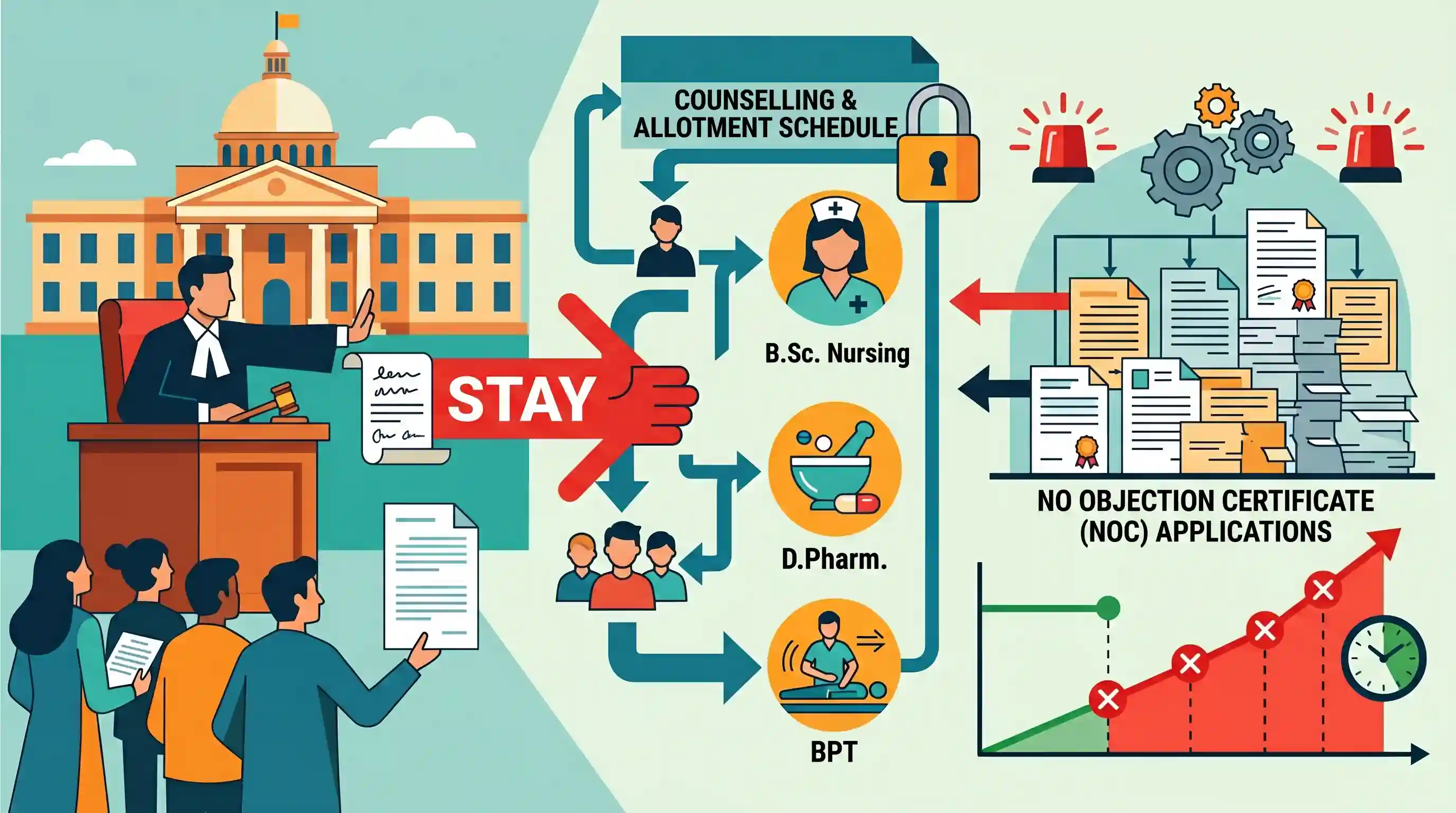
The Rajasthan High Court has stayed the RUHS CUET-2026 counselling and allotment schedule for B.Sc. Nursing, D.Pharm., and BPT courses. This interim order was passed by Justice Mukesh Rajpurohit in a batch of petitions led by Vivekanand Vidya Ashram Sansthan v. State of Rajasthan, due to the State Government's failure to decide on the No Objection Certificate (NOC) applications of educational institutions for over 1.5 years, violating its own 90-day policy timeline.
Key Points
- The Rajasthan High Court issued an interim stay on the RUHS CUET-2026 counselling and allotment schedule for B.Sc. Nursing, D.Pharm., and BPT courses.
- The bench, led by Justice Mukesh Rajpurohit, observed that the State Government had kept the No Objection Certificate (NOC) applications of educational institutions pending for over 1.5 years without proper justification.
- Under the state's updated guidelines issued on October 15, 2024, the government is mandated to decide on college NOC applications within a 90-day timeline.
- The court noted that allowing counselling to proceed while these applications are pending would cause irreparable damage to private institutions, effectively depriving them of an academic session.
- The High Court relied on the Division Bench judgment in the Fortune Foundation case, which ruled that NOC applications should be resolved before counselling commences to ensure fair participation.
Important Terms
Rajasthan High Court

The highest judicial authority in Rajasthan, established under the Constitution of India, exercising writ jurisdiction and judicial review over state administrative actions to protect legal and fundamental rights.
UPSC context
GS Paper II (Polity). Tests understanding of the state judiciary, its writ jurisdiction, and role in ensuring executive accountability.
Rajasthan University of Health Sciences (RUHS)
A state-level medical university established in 2005 in Jaipur, tasked with regulating, affiliating, and conducting examinations and admissions for medical, nursing, and paramedical institutions in Rajasthan.
UPSC context
GS Paper II (Social Sector/Education). Tests administrative mechanisms of state higher education and healthcare human resource management.
State Government Guidelines for Establishing Nursing Colleges (October 2024)
A regulatory policy issued by the Rajasthan Government on October 15, 2024, setting infrastructural requirements and a mandatory 90-day timeline for deciding No Objection Certificate (NOC) applications.
UPSC context
GS Paper II (Governance). Tests knowledge of public policy implementation, administrative delays, and regulatory frameworks in professional education.
RUHS CUET-2026 Counselling and Allotment Schedule
The state-wide centralized admission process conducted by RUHS in 2026 to allocate seats in nursing, pharmacy, and physiotherapy courses based on entrance exam merit.
UPSC context
GS Paper II (Education & Governance). Tests understanding of centralized entrance frameworks, transparent seat allocation, and the impact of judicial stays.
Prelims Trap
An interim stay granted by a High Court under Article 226 remains active indefinitely until final disposal of the main writ petition.
Under Article 226(3), if an application to vacate an ex-parte interim stay is not disposed of within two weeks, the stay automatically stands vacated.
Static Concepts Connected
How does writ jurisdiction under Article 226 differ from Article 32 of the Constitution?
- Broader Scope: Article 226 allows writs for fundamental rights and 'any other purpose' (legal rights), whereas Article 32 is strictly restricted to fundamental rights.
- Discretionary Power: Article 32 is itself a fundamental right, making remedy mandatory, while Article 226 is a discretionary constitutional remedy exercised by High Courts.
- Interim Orders: Article 226(3) mandates disposal of applications to vacate ex-parte interim orders within two weeks, failing which the stay automatically stands vacated.
What is the administrative law principle regarding state administrative delays?
- Irreparable Prejudice: Courts enforce the doctrine that public authorities cannot penalize or prejudice private entities due to the state's own administrative or bureaucratic delays.
- Legitimate Expectation: Private entities have a legitimate expectation that state departments will adhere to their own published statutory or policy timelines.
Cross-Topic Patterns
Judicial oversight and executive inertia
Judicial intervention in administrative delays highlights the expanding role of Article 226 in enforcing governance accountability and protecting citizens' economic livelihoods from state inaction.
Health infrastructure vs bureaucratic red-tape
Delays in licensing allied health colleges directly throttle India's healthcare workforce expansion, undermining National Health Policy goals and stalling rural medical capacity building.

Writ jurisdiction nuances, especially the procedural timeline of Article 226(3) vs Article 32, are highly likely for a 2026 Polity MCQ.
Linked PYQs · 1
Linked PYQs · 1
- 2023RPSC_PRELIMSGS1
According to Article 217 (1) of the Constitution, the President shall make the appointment of a judge of the Rajasthan High Court (other than the Chief Justice) after consultation with whom?
