Rajasthan High Court Orders Suspension of Revenue Officials
Source:livelaw ↗
Why It Matters
This case serves as a key example of the Rajasthan High Court exercising its judicial review and supervisory powers over state administrative machinery, demonstrating the accountability of local revenue officers (Tehsildars and Patwaris) to judicial directives. It directly aligns with RPSC syllabus topics on local administrative machinery, district revenue administration, and the state judiciary.
Summary
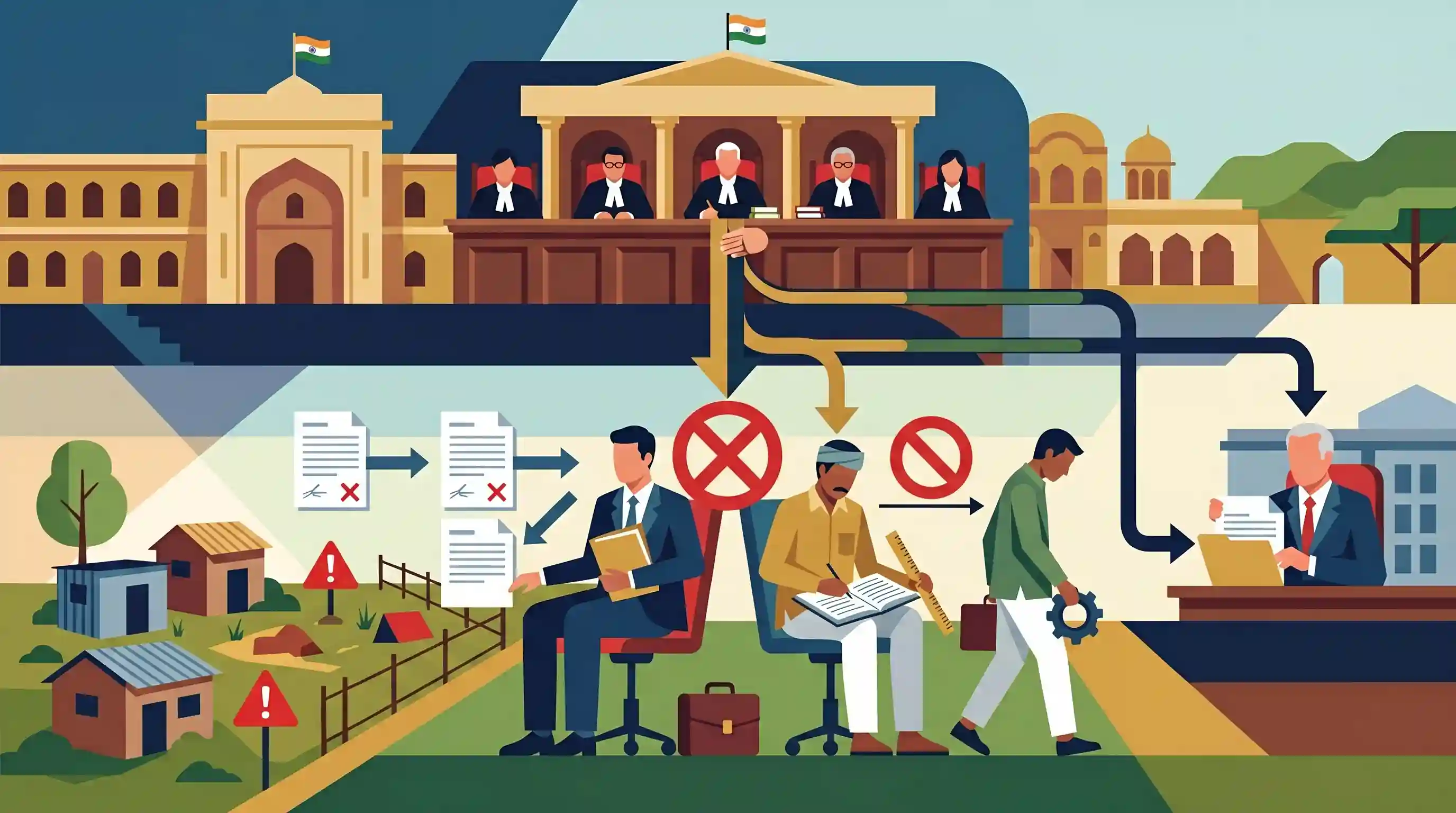
In Roopraj Prajapat v. State of Rajasthan & Ors., the Rajasthan High Court ordered the suspension of a Tehsildar and Patwari from Karauli district and directed the Revenue Secretary to launch departmental proceedings against them for failing to remove land encroachments despite multiple court orders. The division bench ruled that their failure to act was disrespectful to judicial authority and constituted a neglect of duty.
Key Points
- The Rajasthan High Court (Division Bench of Acting Chief Justice Sanjeev Prakash Sharma and Justice Maneesh Sharma) directed the Revenue Secretary to initiate departmental proceedings and suspend the Tehsildar and Patwari of Khedli village, Karauli district.
- The disciplinary action was taken due to the officials' failure to remove illegal encroachments despite multiple judicial orders, which the court categorized as showing disrespect and a failure to perform public duties.
- The Court directed the Additional Advocate General (AAG) to instruct the local Station House Officer (SHO) and other revenue authorities to immediately remove the encroachments and submit a report.
- This case highlights the judicial oversight of local revenue administration and the enforcement of writ jurisdiction under Article 226 of the Constitution of India.
Important Terms
Rajasthan Land Revenue Act, 1956

A state legislation that provides the legal and administrative framework for land categorization, revenue assessment, collection, and dispute resolution, including addressing unauthorized land occupation or trespassing in Rajasthan.
UPSC context
GS Paper II (State Legislations) and GS Paper III (Land Reforms), testing understanding of regional land governance and tenancy frameworks.
Board of Revenue
The highest quasi-judicial body and revenue court in Rajasthan, headquartered in Ajmer, responsible for supervising subordinate revenue courts and adjudicating appeals, revisions, and references regarding land disputes.
UPSC context
GS Paper II (Statutory & Quasi-Judicial Bodies) and State Polity, assessing knowledge of administrative dispute resolution mechanisms.
Rajasthan High Court
The highest judicial institution in the state of Rajasthan, established in 1949, which possesses original, appellate, and writ jurisdiction to safeguard fundamental rights and enforce judicial compliance.
UPSC context
GS Paper II (Structure & Functioning of State Judiciary), examining powers like writ jurisdiction and judicial oversight over executive actions.
Tehsildar
A gazetted land revenue officer and executive magistrate at the tehsil/sub-district level, responsible for revenue collection, land record maintenance, resolving minor property disputes, and supervising patwaris.
UPSC context
GS Paper II (District Administration) and Public Administration, testing knowledge of sub-district governance, revenue administration, and magisterial roles.
Patwari
A village-level administrative officer responsible for measuring agricultural fields, maintaining local land ownership records (like Jamabandi), recording crop patterns (Girdawari), and acting as a primary liaison between farmers and the state government.
UPSC context
GS Paper II (Local/Rural Administration) and GS Paper III (Land Reforms), testing understanding of grassroots-level revenue machinery.
Revenue Department of Rajasthan
The administrative wing of the state government responsible for policy formulation and implementation concerning land governance, revenue collection, land allotment, and the overall management of land records.
UPSC context
GS Paper II (State Administrative Structure) and GS Paper III (Land Reforms), testing understanding of the executive machinery in land administration.
Prelims Trap
Under Article 226, High Courts possess the direct administrative power to suspend state civil servants for non-compliance.
The High Court cannot issue direct administrative suspension orders; it must direct the competent executive authority to initiate disciplinary actions under state service rules.
Static Concepts Connected
How does writ jurisdiction under Article 226 differ from Article 32?
- Scope of remedy: Article 32 is limited to Fundamental Rights, while Article 226 extends to 'any other purpose' including ordinary legal rights.
- Discretionary nature: Article 32 is itself a Fundamental Right and cannot be refused, whereas Article 226 is a discretionary remedy.
- Territorial reach: The Supreme Court's jurisdiction extends nationwide, whereas the High Court's is restricted to its state boundaries or cause of action.
What is the structural hierarchy of district land revenue administration?
- District Collector: Serves as the head of revenue administration at the district level, supervising all land-related records and officers.
- Tehsildar: Acts as the key executive and quasi-judicial officer at the sub-district level, managing revenue collection and mutations.
- Patwari: Represents the lowest state functionary at the village level, maintaining the Jamabandi (record of rights) and crop records.
Cross-Topic Patterns
Judicial enforcement of executive duties
High Courts directing the suspension of administrative officials showcases the growing judicial role in enforcing civil service accountability, impacting the traditional separation of powers.
Land digitization and local governance
Weak administrative enforcement by Patwaris undermines land record digitization (DILRMP), leading to prolonged property disputes and high pendency rates in state High Courts.

2026 exams may test the limits of Article 226 writs in directing departmental disciplinary actions against state civil servants.
Linked PYQs · 3
Linked PYQs · 3
- 2023RPSC_PRELIMSGS1
The post of Tehsildar is appointed by:
- 2023RPSC_PRELIMSGS1
According to Article 217 (1) of the Constitution, the President shall make the appointment of a judge of the Rajasthan High Court (other than the Chief Justice) after consultation with whom?
- 2023RPSC_PRELIMSGS1
According to Article 217(1) of the Constitution, who does the President appoint on the advice of whom, other than the Chief Justice of the Rajasthan High Court?
