Rajasthan high court quashes prolonged suspension of IRS officer
Source:LiveLaw ↗
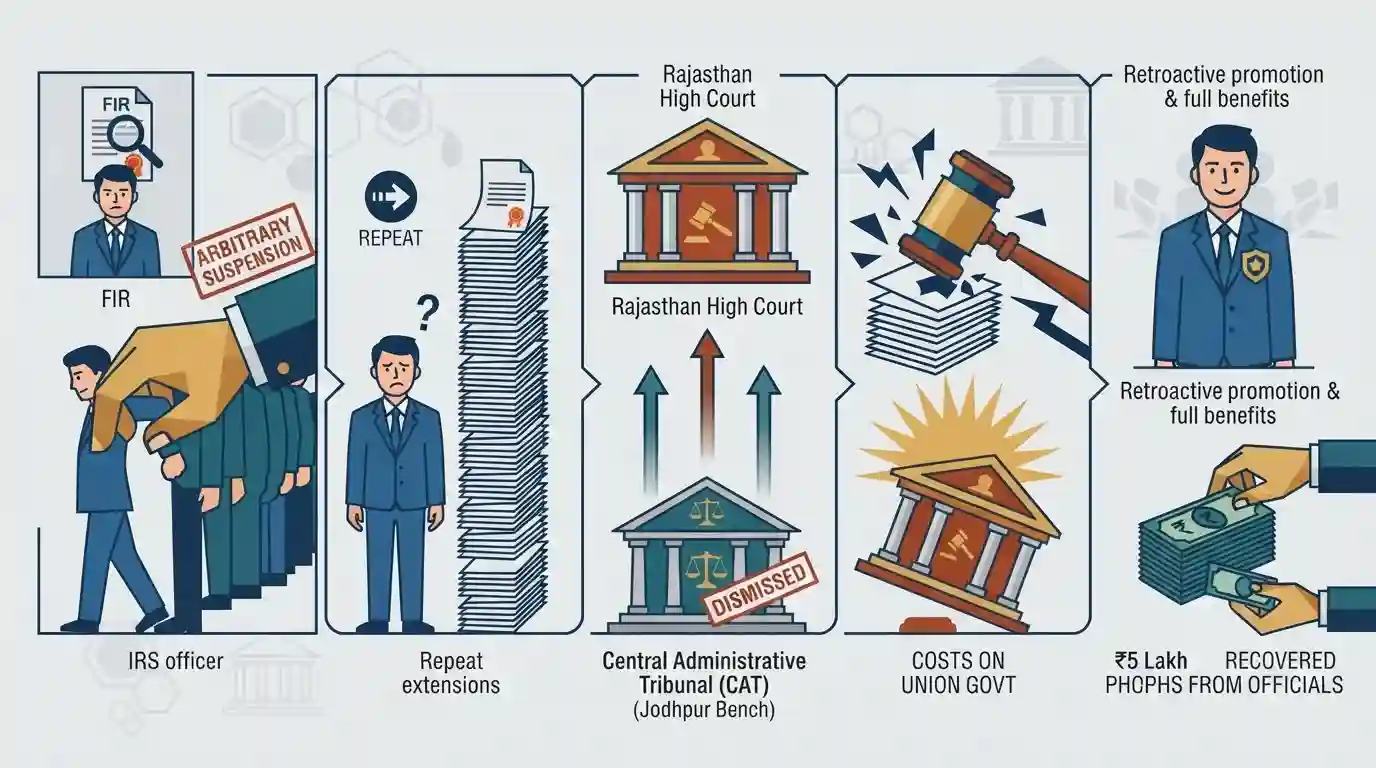
Why It Matters
The judgment serves as an important precedent regarding the rights of civil servants, the limits of administrative discretion in extending suspensions under the CCS (CCA) Rules, and the High Court's writ jurisdiction under Article 226 to review and correct administrative overreach and tribunal decisions.
Summary
The Rajasthan High Court severely indicted the Central Government for the prolonged and arbitrary suspension of an IRS officer, labeling it an act of 'personal vendetta'. The officer, suspended initially following a corruption FIR, faced 11 extensions of his suspension even though the trial court had discharged him and no chargesheet was filed. The Central Administrative Tribunal (Jodhpur Bench) had earlier dismissed his plea against the suspension. The High Court, setting aside the Tribunal's order, emphasized that suspension is not a punishment and its continuous extension without justifiable reasons constitutes an abuse of administrative power under the CCS (CCA) Rules. The Court ordered the officer's retroactive reinstatement with full consequential benefits, including promotion on par with his juniors, and imposed a cost of ₹5 Lakh on the Union Government, to be recovered from the responsible officials.
Key Points
- The Rajasthan High Court quashed the prolonged suspension of an Indian Revenue Service (IRS) officer, terming it a result of 'personal vendetta' and abuse of power by the Central Government.
- The Court imposed a cost of ₹5 Lakh on the Central Government for the mental agony and financial loss caused to the officer, directing that it be recovered from the erring officers.
- The officer was suspended after an FIR under the Prevention of Corruption Act, but the suspension was extended 11 times despite no chargesheet being filed and the trial court discharging him.
- The High Court directed that the officer be deemed reinstated from the date of the first suspension extension and be considered for promotion alongside his juniors.
- The ruling highlighted that the power of suspension under the Central Civil Services (Classification, Control and Appeal) Rules cannot be used as an arbitrary tool for punishment.
Important Terms
Central Civil Services (Classification, Control and Appeal) Rules, 1965

The statutory framework governing the classification, disciplinary procedures, penalties, and appeals for Central Government employees. It ensures accountability, transparency, and prevents arbitrary administrative actions like indefinite suspensions.
UPSC context
GS-2 (Role of Civil Services). Tests understanding of civil service conduct rules, disciplinary mechanisms, and legal safeguards against administrative abuse.
Central Administrative Tribunal
A quasi-judicial body established under Article 323A of the Constitution to adjudicate disputes regarding the recruitment and service conditions for public servants in India, ensuring speedy and inexpensive administrative justice.
UPSC context
GS-2 (Statutory, Regulatory and Quasi-Judicial Bodies). Tests knowledge of administrative tribunals, their constitutional basis, and their jurisdiction over civil service disputes.
Central Board of Indirect Taxes and Customs (CBIC)
A nodal national agency under the Ministry of Finance responsible for administering indirect taxes like Customs, Central Excise, and GST. It serves as the cadre-controlling authority for Indian Revenue Service officers.
UPSC context
GS-2 (Statutory Bodies) and GS-3 (Indian Economy). Relevant for questions on indirect tax administration and the organizational framework of revenue civil services.
Prelims Trap
Article 311 of the Constitution provides safeguards to civil servants against arbitrary suspension.
Article 311 strictly protects against dismissal, removal, or reduction in rank. Suspension is an interim administrative measure governed by statutory service rules, not a Constitutional penalty.
Static Concepts Connected
What is the appellate hierarchy for Central Administrative Tribunal (CAT) orders?
- Original Jurisdiction: Established under Article 323A, CAT handles original service disputes for central government employees.
- Judicial Review: Per the L. Chandra Kumar judgment (1997), CAT orders must be appealed to the Division Bench of the respective High Court, not directly to the Supreme Court.
How does the Constitution protect civil servants under Article 311?
- Authority Limit: A civil servant cannot be dismissed or removed by an authority subordinate to the one that appointed them.
- Inquiry Right: They must be given a reasonable opportunity of being heard regarding the charges, except in cases of state security or criminal conviction.
Cross-Topic Patterns
Tribunalization vs. Judicial Review
The High Court overturning a CAT bench highlights the L. Chandra Kumar doctrine, where administrative tribunal decisions remain subject to writ jurisdiction of High Courts under Articles 226/227.
Ethics, PoCA & Civil Service Rules
Bridges GS-IV (probity) and GS-II. FIRs under the Prevention of Corruption Act do not bypass the Supreme Court’s 90-day limit on un-chargesheeted suspensions under CCS Rules.

Expect a multi-statement Prelims question distinguishing Article 311 protections (dismissal) from statutory CCS rules (suspension).
Linked PYQs · 2
Linked PYQs · 2
- 2013RPSC_PRELIMSGS1
List-1 is matched with List-2 and the correct answer is selected using the codes given below - List-1 – List-2 Constitutional Article – Provision A. 215 1. Transfer of a judge from one High Court to another High Court B. 222 2. Power of superintendence over all courts C. 226 3. Power of the High Court to issue certain writs D. 227 4. The High Court as a court of record Code:
- 2025RPSC_PRELIMSGS1
Under which article of the Constitution is there a mandatory consultation provision with the Rajasthan Public Service Commission in disciplinary cases affecting serving personnel under the Government of Rajasthan?
