Rajasthan Madrasa Regulation Steps Noted By High Court
Source:Indian Express ↗
Why It Matters
Important for RPSC RAS aspirants tracking state-level judicial proceedings, administrative governance of minority institutions, and public policy decisions affecting educational standards in Rajasthan.
Summary
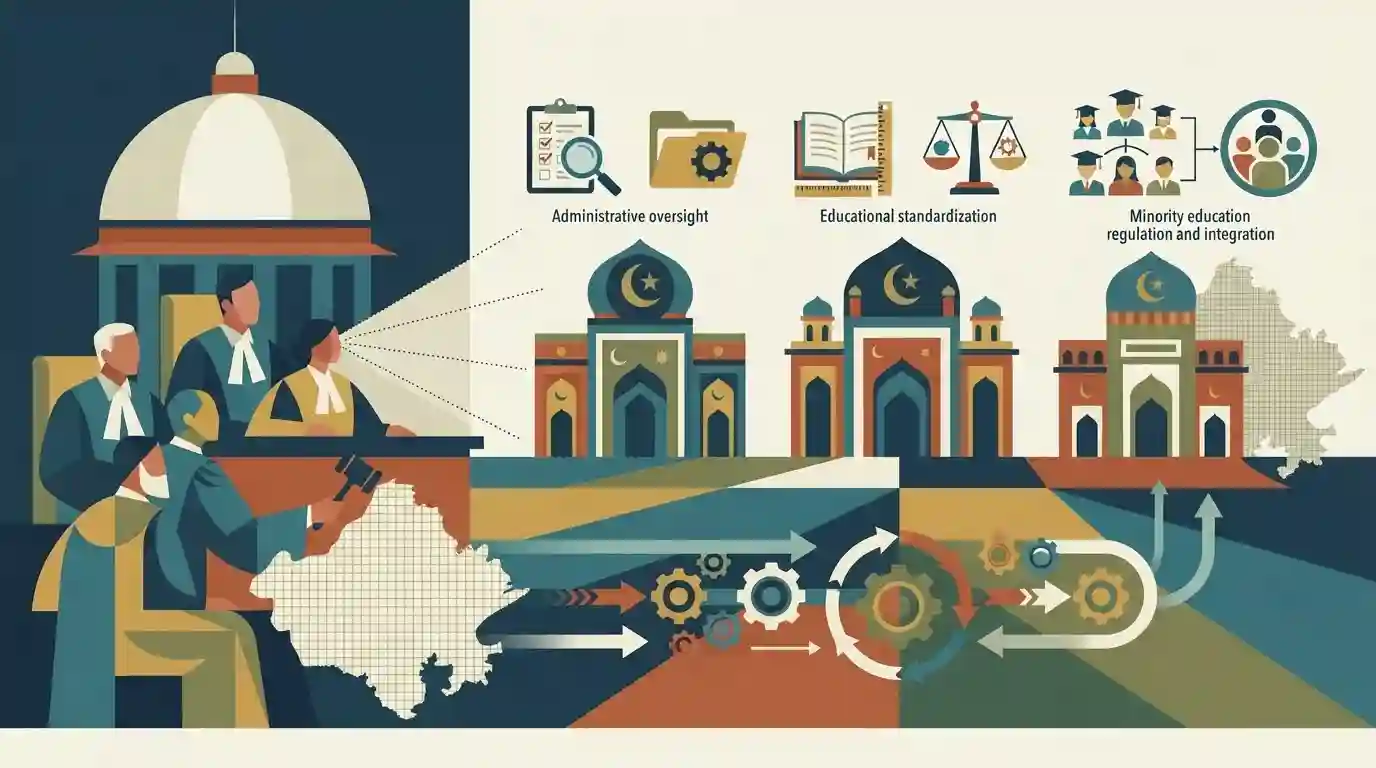
The Rajasthan High Court took note of state government measures aimed at regulating around 3,000 madrasas in Rajasthan, addressing aspects of administrative oversight, educational standardisation, and policy implementation for minority institutions.
Key Points
- The Rajasthan High Court noted steps taken by the state government to regulate approximately 3,000 madrasas across the state.
- The regulatory initiative focuses on bringing standardisation, administrative oversight, and transparency to the functioning and education quality within these religious-cum-educational institutions.
- The issue highlights the intersection of state executive policy, minority welfare governance, and judicial oversight in Rajasthan.
Important Terms
Rajasthan High Court

The highest judicial body in Rajasthan, exercising original and appellate civil/criminal jurisdiction as well as power of judicial review under Article 226 of the Constitution of India.
UPSC context
RPSC RAS Paper II (Indian & Rajasthan Polity): Tests knowledge of state judiciary powers, writ jurisdictions, and judicial review.
State Government of Rajasthan
The legislative and executive organ governing the state of Rajasthan, responsible for framing policies, administering statutes like the Madarsa Board Act, and executing welfare schemes.
UPSC context
RPSC RAS Paper II (Polity and Governance): Important for questions on executive functioning, state policy implementation, and administrative oversight.
Prelims Trap
Minority institutions protected under Article 30 are completely exempt from any state administrative oversight, standardisation, or curriculum alignment.
Aspirants often confuse minority educational institutions under Article 30 as being entirely immune from government regulations regarding educational standards, teacher qualifications, and safety norms.
Static Concepts Connected
What are the constitutional provisions governing minority educational institutions and state regulations in India?
- Article 30(1):: Guarantees all religious and linguistic minorities the right to establish and administer educational institutions of their choice.
- Article 30(2):: Prohibits the state from discriminating against any educational institution in granting aid on the ground that it is managed by a minority.
- Reasonable Regulations:: Regulatory standards such as academic excellence, sanitation, and health do not violate Article 30; regulations must ensure educational standards rather than take over administration.
Cross-Topic Patterns
Minority Educational Rights vs. RTE Mandates
Madrasa regulation debates in Rajasthan test the balance between Article 30 minority educational rights and the state's regulatory power under Article 21A and RTE Act, 2009.
High Court Writ Jurisdiction and State Executive Policy
Judicial interventions regarding administrative oversight of religious institutions connect directly with high court writ jurisdiction under Article 226 in state policy matters.

Rajasthan High Court actions on madrasa standardisation and RTE alignment likely to be tested via multi-statement polity MCQs.
Linked PYQs · 3
Linked PYQs · 3
- 2024RPSC_PRELIMSGS1
According to the Rajasthan Lokayukta and Deputy Lokayukta Act, 1973, the Lokayukta in Rajasthan can investigate allegations against ministers and public servants in certain cases. Which of the following subject is included in such cases? (i) Involves grievance/any suffering caused by public servant. (ii) Used his position as a public servant to obtain, for himself or for any other person, any valuable thing or financial benefit. (iii) Sexual harassment of woman, cause injury to any person. (iv) Can be related to being guilty of corruption of the trust reposed in him as a public servant.
- 2023RPSC_PRELIMSGS1
According to Article 217 (1) of the Constitution, the President shall make the appointment of a judge of the Rajasthan High Court (other than the Chief Justice) after consultation with whom?
- 2018RPSC_PRELIMSGS1
Under the Rajasthan government's post-matric scholarship scheme for students of minority communities, financial assistance is provided to students who have a certain combination of parental income and marks obtained in the previous examination. What is that certain combination?
