Rajasthan High Court dismisses petition on municipal poll reservation
Source:livelaw ↗
Why It Matters
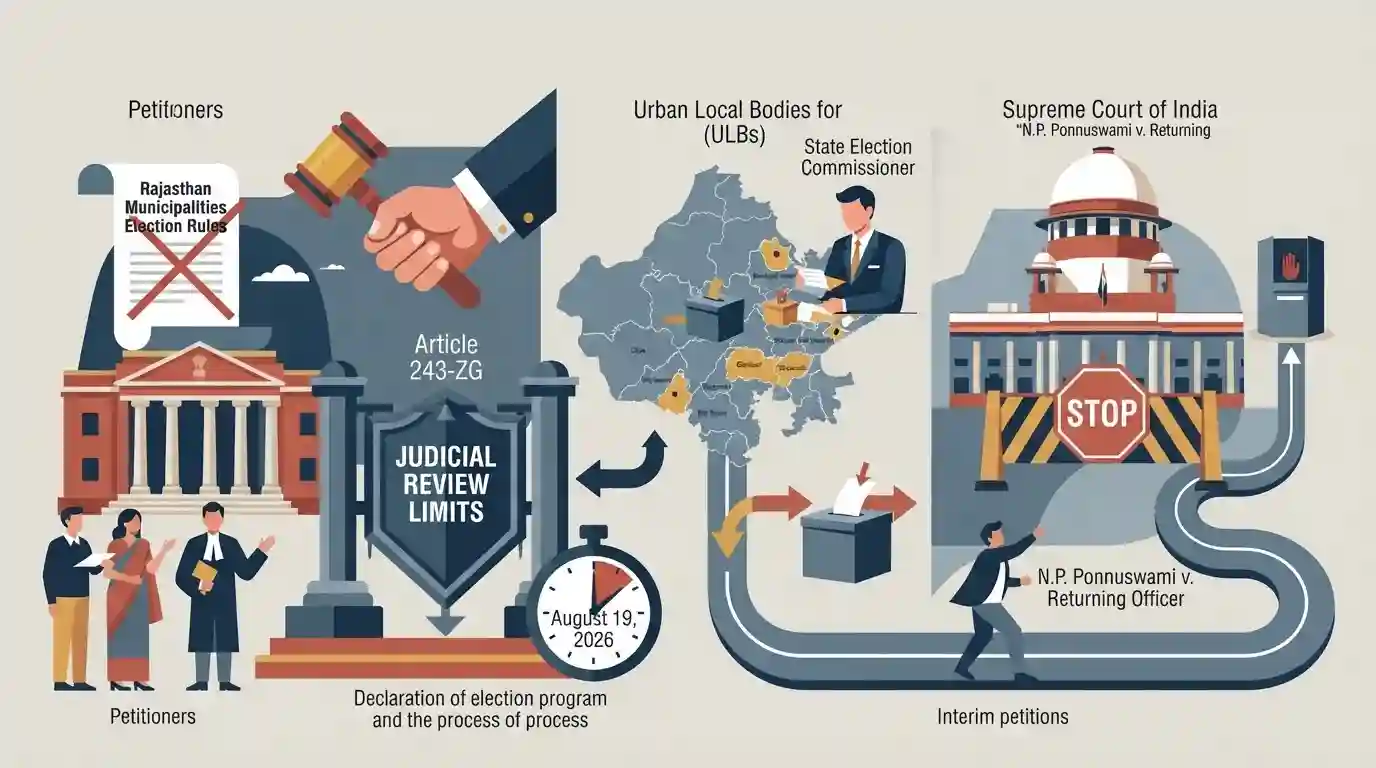
It highlights the scope of Article 243-ZG (introduced by the 74th Amendment Act) regarding judicial non-interference in local body elections and clarifies when the electoral process formally begins for municipal elections in Rajasthan.
Summary
The Rajasthan High Court has dismissed a petition challenging the reservation of seats in the upcoming municipal elections in the state. The Court ruled that under Article 243-ZG of the Constitution, judicial interference in municipal electoral matters is barred once the election process has begun. The State Election Commissioner had declared the election program on August 19, 2026, which the Court deemed as the commencement of the process, citing the landmark 6-judge Supreme Court ruling in N.P. Ponnuswami v. Returning Officer. This overrides the petitioners' reliance on Rajasthan Municipalities Election Rules and a recent smaller-bench SC judgment, reinforcing the principle that electoral processes cannot be derailed by interim judicial interventions.
Key Points
- The Rajasthan High Court dismissed a plea challenging municipal poll reservations, citing Article 243-ZG of the Constitution.
- Article 243-ZG prohibits judicial interference in municipal electoral matters once the election process has commenced.
- The court held that the election process begins with the State Election Commission's declaration of the election program (August 19, 2026), not just the formal notification.
- The judgment relied on the 6-judge Constitution Bench precedent in N.P. Ponnuswami v. Returning Officer, Namakkal Constituency over smaller bench decisions.
Important Terms
Article 243-ZG

A constitutional provision barring judicial interference in municipal electoral matters. It mandates that municipal election disputes, including seat reservations, can only be challenged via an election petition after the election process concludes.
UPSC context
Crucial for RPSC/UPSC Polity (Paper II) to understand the limits of judicial review in local governance and electoral processes.
State Election Commission
An independent constitutional body established under Articles 243K and 243ZA. It directs and controls the preparation of electoral rolls and conducts free and fair elections for Panchayats and Urban Local Bodies.
UPSC context
Highly relevant for RPSC Polity; tests knowledge of local self-government, state-level constitutional bodies, and decentralized democracy.
N.P. Ponnuswami v. Returning Officer
A landmark 1952 Supreme Court judgment establishing that "election" covers the entire process from notification to results. It ruled that courts cannot interrupt ongoing elections, restricting challenges solely to post-election petitions.
UPSC context
Vital for Polity exams to understand the constitutional bar on intermediate judicial intervention in ongoing elections.
Rajasthan Municipalities Election Rules
State-specific statutory rules governing the procedural conduct of municipal elections in Rajasthan. These rules outline the mechanisms for delimitation, ward-wise reservation of seats by lottery, and the declaration of election programs.
UPSC context
Important for RPSC General Studies focusing on state administration, local urban governance laws, and state electoral frameworks.
74th Constitutional Amendment Act
A 1992 constitutional amendment giving constitutional status to Urban Local Bodies. It introduced Part IXA, establishing provisions for the State Election Commission, regular municipal elections, and structured urban local governance.
UPSC context
A core RPSC Polity topic (Paper II) testing urban local governance, democratic decentralization, and municipal administration.
Prelims Trap
Municipal election processes legally commence only upon the formal gazette notification by the State Government.
Courts hold the process begins the moment the State Election Commission declares the election schedule, immediately triggering the Article 243-ZG bar on judicial intervention.
Static Concepts Connected
Which Constitutional Articles restrict judicial interference in local elections?
- Panchayats: Article 243-O bars courts from questioning delimitation, seat allotment, or elections except via formal election petitions.
- Municipalities: Article 243-ZG provides the exact same judicial immunity for Urban Local Body (ULB) electoral matters.
What is the structure of the Rajasthan State Election Commission?
- Establishment: Constituted in July 1994 to conduct local body elections under Articles 243-K (Panchayats) and 243-ZA (Municipalities).
- Composition: It is a single-member commission headed by a State Election Commissioner appointed by the Governor.
Cross-Topic Patterns
Electoral Bar & Article 329
The local body judicial bar (243-O/243-ZG) mirrors Article 329(a) for Parliamentary elections, where delimitation and seat allocation are similarly immune from mid-process court challenges.
Constitutional Precedents & SEC Powers
The reliance on the 1952 Ponnuswami case highlights how foundational Supreme Court judgments defining ECI's electoral powers are applied identically to protect State Election Commission mandates.

Expect matching questions pairing Articles (243-O, 243-ZG, 243-ZA) with their subjects, or multi-statement questions on SEC authority.
Linked PYQs · 2
Linked PYQs · 2
- 2018RPSC_PRELIMSGS1
Which of the following Act/Rule provides for joint meetings of Gram Sabhas in Rajasthan?
- 2021RPSC_PRELIMSGS1
Which Constitutional Amendment Act related to the National Judicial Appointments Commission was declared unconstitutional by the Constitution Bench of the Supreme Court?
