Rajasthan High Court Directive on State Litigation Policy for Appeals
Source:supremetoday-ai ↗
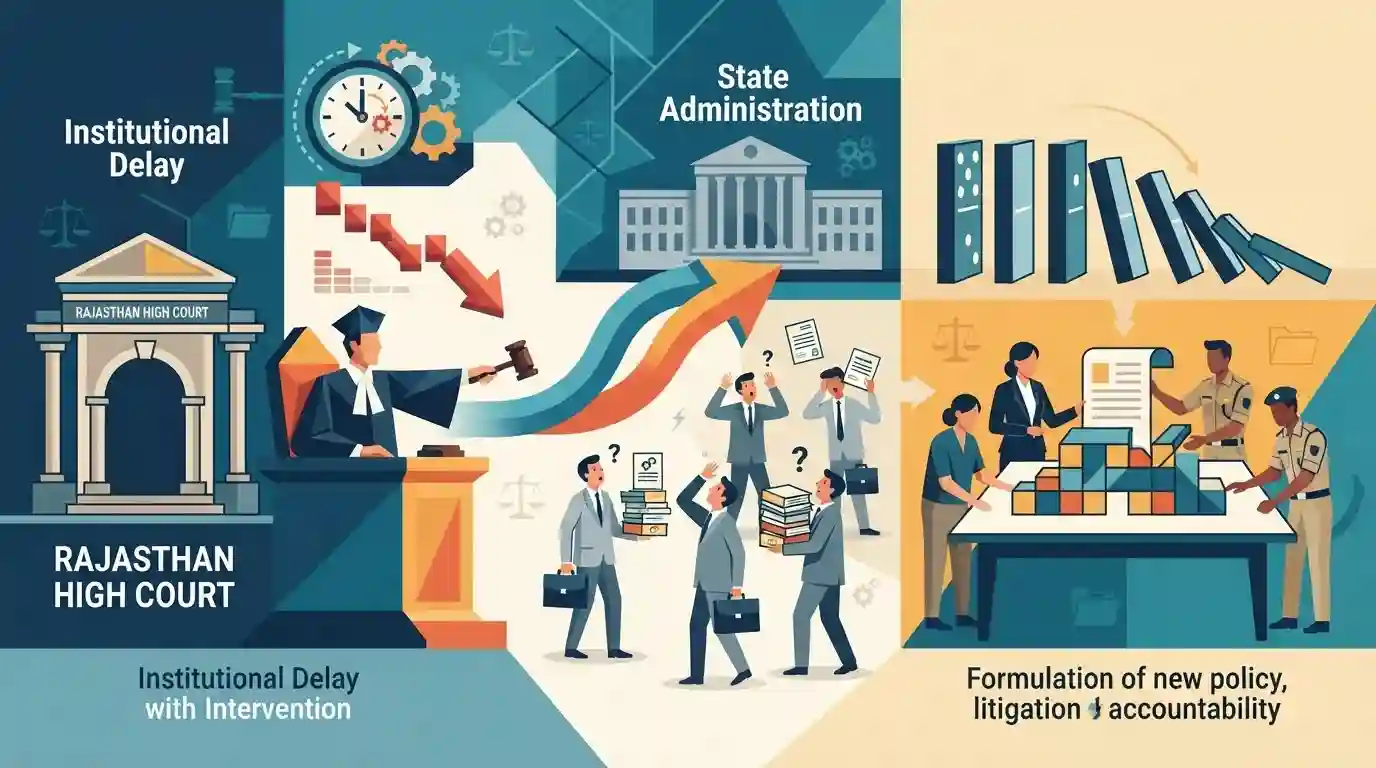
Why It Matters
The directive emphasizes the accountability of state machinery in judicial administration, addressing systemic delays in criminal justice delivery relevant to governance and legal reforms in Rajasthan.
Summary
The Rajasthan High Court directed the State of Rajasthan to formulate a dedicated litigation policy to curb prolonged delays in filing criminal appeals. The court noted that institutional delays by state authorities contribute significantly to backlogs and undermine the criminal justice delivery system, calling for strict administrative measures and accountability.
Key Points
- The Rajasthan High Court directed the state government to formulate a comprehensive state litigation policy to address delays in filing criminal appeals.
- The court expressed concern over recurring inordinate delays by state authorities in pursuing criminal matters, which impacts judicial efficiency.
- A litigation policy aims to streamline government litigation, reduce frivolous appeals, and fix accountability for procedural lapses.
Important Terms
State Litigation Policy

A policy framework formulated by a state government to regulate government litigation, reduce frivolous appeals, ensure timely action, and transform the state into an efficient and responsible litigant.
UPSC context
Important for RPSC Polity and Governance (Paper II); tests knowledge of judicial reforms, state administration, and judicial backlog reduction strategies.
Rajasthan High Court
The highest judicial tribunal in the state of Rajasthan, exercising constitutional and appellate jurisdiction under Articles 226 and 227 of the Indian Constitution.
UPSC context
Crucial for RPSC Indian Judiciary and Polity topics (Paper II); tests awareness of high court powers, writ jurisdictions, and judicial administration in Rajasthan.
State Government of Rajasthan
The executive organ of the state comprising elected ministers and administrative machinery responsible for governance, law enforcement, and policy implementation in Rajasthan.
UPSC context
Key for RPSC State Administration and Governance (Paper II); tests understanding of executive accountability, administrative delays, and institutional mechanisms.
Prelims Trap
State litigation policies are mandatory statutory laws enacted exclusively by the Parliament of India.
Aspirants often assume a State Litigation Policy is enacted via a central parliamentary statute, when it is typically formulated through executive/administrative resolution by the respective state cabinet.
Static Concepts Connected
What is a State Litigation Policy and what are its core objectives?
- Responsible Litigant: Government litigant is considered a responsible litigant (responsible litigant principle) rather than an ordinary private party contesting every case.
- Objectives: Reduces frivolous appeals, curtails inordinate procedural delays, and fixes administrative accountability for bureaucratic lethargy in filing matters.
- ADR Focus: Encourages alternative dispute resolution (ADR) and pre-litigation mediation before clogging court dockets.
Cross-Topic Patterns
State Litigation Policy & Judicial Pendency
State litigation policies connect administrative accountability with judicial pendency, reflecting similar administrative reforms in police investigations and prison management under the RPSC governance syllabus.

Rajasthan High Court's directive on State Litigation Policy will likely be tested via statement-based questions on judicial reforms.
Linked PYQs · 2
Linked PYQs · 2
- 2025RPSC_PRELIMSGS1
On which date did Premil Kumar Mathur assume charge of the office of ‘Registrar General’ of the Rajasthan High Court?
- 2023RPSC_PRELIMSGS1
According to Article 217 (1) of the Constitution, the President shall make the appointment of a judge of the Rajasthan High Court (other than the Chief Justice) after consultation with whom?
