Rajasthan High Court Seeks Police Investigation Wing Separation Plan
Source:livelaw ↗
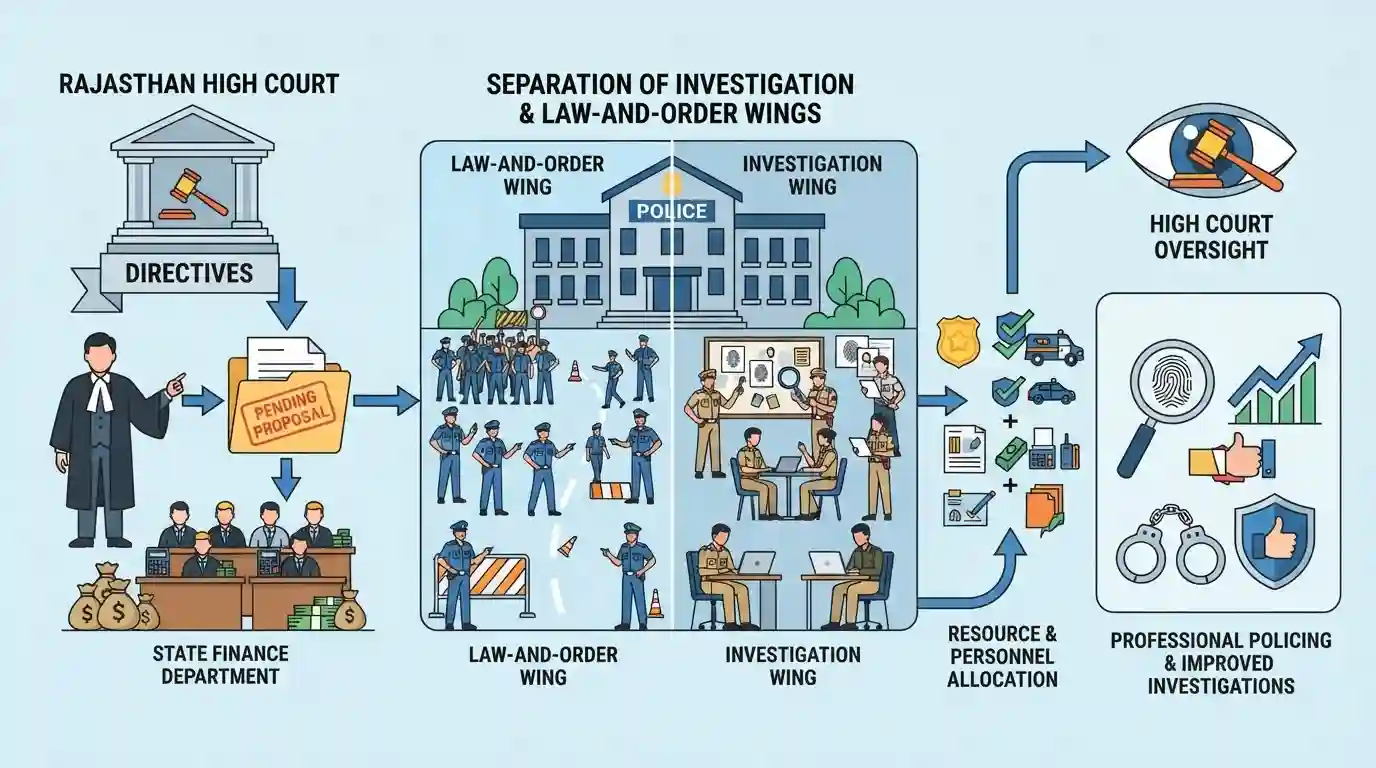
Why It Matters
Separation of investigation from law and order is a crucial administrative reform mandated by the Supreme Court to professionalize the police force. It highlights the intersection of judicial directives, state administrative processes, and financial approvals, making it highly relevant for polity and governance sections in civil service exams.
Summary
The Rajasthan High Court has issued directives to the State Finance Department to expedite its review of a pending proposal to separate the investigation and law-and-order wings of the Rajasthan Police. This structural reform, famously mandated by the Supreme Court's 2006 Prakash Singh judgement, seeks to professionalize the police force, improve the quality of criminal investigations, and insulate them from routine law enforcement duties. The proposal currently requires financial clearance for resource and personnel allocation, and the High Court's active oversight aims to accelerate this critical governance reform.
Key Points
- The Rajasthan High Court directed the State Finance Department to expedite its response on a proposal to separate the investigation wing from the law and order wing of the state police.
- This separation aligns with the Supreme Court's landmark 2006 Prakash Singh judgement on police reforms, which aimed to ensure independent, speedy, and specialized criminal investigations.
- The delay in implementation highlights administrative bottlenecks, as creating separate wings requires the Finance Department's financial clearance for additional posts, infrastructure, and resources.
- The High Court's intervention underscores judicial oversight over state administrative machinery to enforce long-pending governance reforms.
Important Terms
Prakash Singh Directives

A landmark 2006 Supreme Court framework containing seven binding directives to modernize and professionalize police forces, specifically mandating the separation of criminal investigation from routine law-and-order duties.
UPSC context
Crucial for GS Paper 2 (Governance) and GS Paper 3 (Internal Security) regarding structural police reforms and institutional accountability.
Supreme Court of India
India's apex judicial body, whose landmark rulings—like the 2006 police reform directives—serve as binding mandates to correct systemic governance failures and uphold constitutional rights.
UPSC context
Central to GS Paper 2 (Indian Constitution), focusing on judicial activism, the enforcement of systemic reforms, and center-state compliance.
Rajasthan High Court
The highest judicial authority in Rajasthan, exercising its constitutional mandate to monitor executive inaction and compel state departments to implement delayed administrative reforms.
UPSC context
Relevant to GS Paper 2 (Judiciary), illustrating how High Courts actively intervene to ensure the execution of systemic governance reforms.
State Finance Department
The state administrative body responsible for public fiscal management, resource allocation, and providing mandatory financial clearances for structural reforms, personnel deployment, and infrastructure upgrades.
UPSC context
Important for GS Paper 2 (State Administration), demonstrating how financial bottlenecks can directly impact or delay critical governance initiatives.
Rajasthan Police
The state-level law enforcement agency tasked with maintaining public order and preventing crime, currently pursuing structural bifurcation to improve the professional quality of its criminal investigations.
UPSC context
Acts as a state-specific case study in GS Paper 3 (Internal Security) on executing police modernization and resource optimization.
Prelims Trap
The Central Government has the authority to unilaterally implement structural police reforms across all states.
'Police' and 'Public Order' are State subjects under the 7th Schedule. The Centre can only draft model laws (like the Model Police Act 2006); states must enact and fund them.
Static Concepts Connected
What are the key directives of the Prakash Singh (2006) judgement on police reforms?
- State Security Commission: Set up a commission to ensure the state government does not exercise unwarranted influence over the police force.
- Fixed Tenure: Ensure a minimum two-year tenure for the DGP, IG, and SP to prevent arbitrary political transfers.
- Functional Separation: Functionally separate the investigation wing from the law and order wing to improve specialized crime solving.
- Complaints Authority: Establish authorities at the state and district levels to independently probe allegations of police misconduct.
How does the 7th Schedule govern legislative jurisdiction over police administration?
- State Subject: 'Public Order' and 'Police' are Entries 1 and 2 of the State List, granting states exclusive primary jurisdiction.
- Union Constraints: Central agencies (like the CBI) require the specific or general consent of the state government to operate within state boundaries.
- Model Frameworks: The Central Government can propose frameworks, but adoption and execution of police restructuring rests entirely at the state's discretion.
Cross-Topic Patterns
Police Reforms & Judicial Activism
The High Court pushing a State Finance Department on budget allocation blurs the line between judicial oversight and administrative micro-management, serving as a classic case study for judicial activism.
State Finances & Governance Bottlenecks
Implementing the Prakash Singh directives requires significant fiscal bandwidth for new hiring and infrastructure, connecting structural governance reforms directly to the fiscal health of state exchequers.
Criminal Justice & Trial Pendency
Separating investigation from law and order directly addresses poor conviction rates and shoddy evidence gathering, linking initial police reform to the broader crisis of criminal justice pendency.

Expect a GS2 Mains question connecting Prakash Singh directives with the practical fiscal and administrative hurdles states face today.
Linked PYQs · 3
Linked PYQs · 3
- 2023RPSC_PRELIMSGS1
According to Article 217 (1) of the Constitution, the President shall make the appointment of a judge of the Rajasthan High Court (other than the Chief Justice) after consultation with whom?
- 2025RPSC_PRELIMSGS1
Under which article of the Constitution is there a mandatory consultation provision with the Rajasthan Public Service Commission in disciplinary cases affecting serving personnel under the Government of Rajasthan?
- 2021RPSC_PRELIMSGS1
Who is authorized to appoint the Chairman of the Rajasthan State Human Rights Commission?
