High Court Directs Emergency Medical Facilities in Judicial Complexes
Source:livelaw ↗
Why It Matters
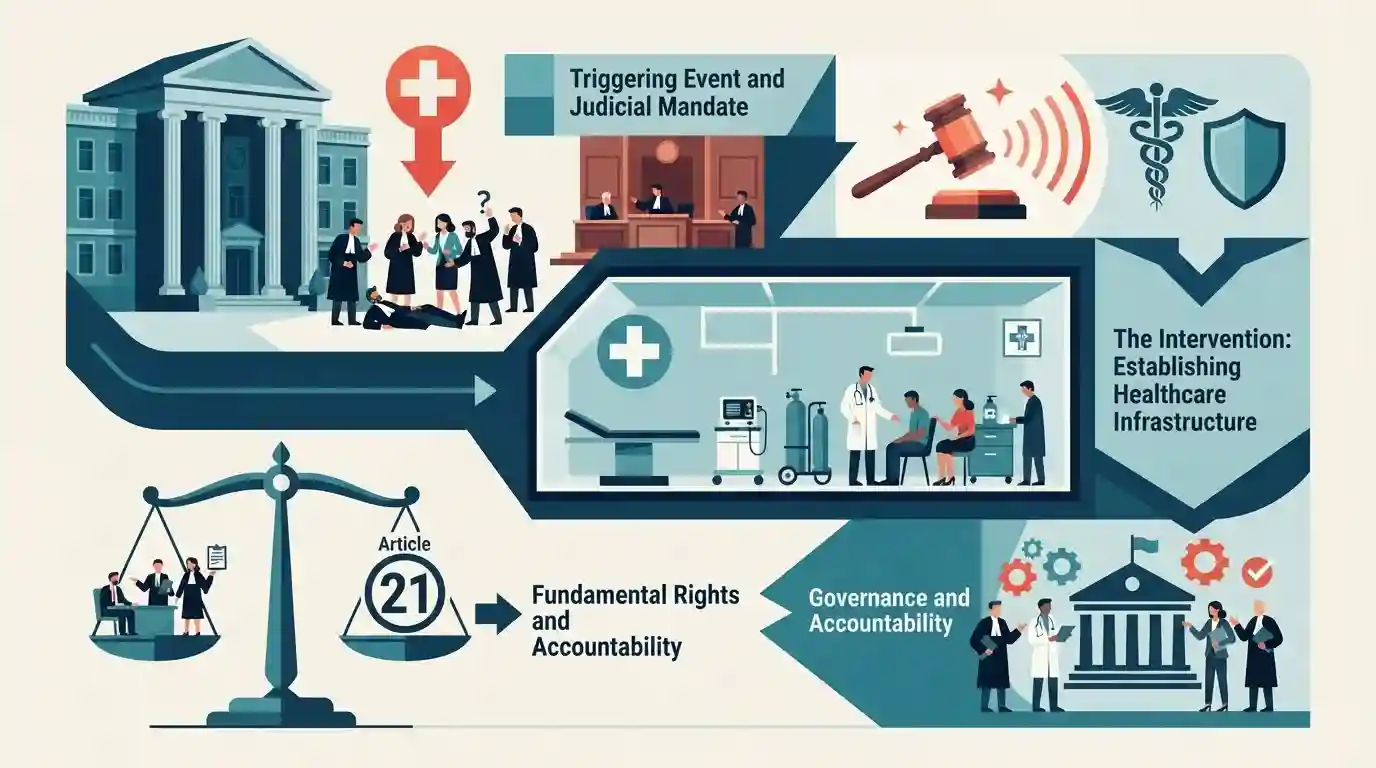
It highlights the systemic gaps in infrastructure within India's judicial complexes and underscores the state's constitutional duty to safeguard the Right to Life (Article 21) by providing emergency medical facilities in essential public spaces.
Summary
The Rajasthan High Court has issued urgent directives to establish immediate medical facilities within court complexes following the tragic death of a lawyer from a heart attack at a Sessions Court. Calling the lack of emergency healthcare infrastructure in public institutions 'alarming', the Court emphasized the necessity of having doctors and life-saving equipment readily available. The intervention highlights the intersection of judicial infrastructure and the fundamental Right to Life (Article 21), compelling state authorities to ensure safe environments equipped to handle medical emergencies for lawyers, litigants, and court staff.
Key Points
- A lawyer passed away due to a heart attack at a Sessions Court complex in Rajasthan, exposing a severe lack of emergency medical care.
- The Rajasthan High Court took suo motu cognizance of the incident, describing the absence of basic life-saving medical facilities in judicial complexes as 'alarming'.
- The High Court ordered immediate deployment of necessary medical infrastructure, including doctors, paramedics, and ambulances, across court complexes.
- The directive reinforces the fundamental Right to Life (Article 21), extending the state's obligation to provide emergency healthcare in essential public institutions like courts.
Important Terms
Article 21 of the Constitution of India

A fundamental right guaranteeing protection of life and personal liberty. Judicial interpretation has expansively included the right to health and emergency medical care, making it a constitutional obligation for the state to provide basic healthcare facilities.
UPSC context
Crucial for GS Paper 2 (Polity); tests knowledge of the judicially expanded scope of Fundamental Rights and the state's welfare obligations.
Rajasthan High Court
The apex judicial authority in Rajasthan. It exercises writ jurisdiction to protect fundamental rights and possesses supervisory control over subordinate courts, enabling it to mandate state action on issues like judicial infrastructure and medical facilities.
UPSC context
Important for GS Paper 2 (State Judiciary); illustrates the constitutional role of High Courts in enforcing rights and ensuring executive accountability.
Sessions Court
The principal criminal trial court in a district, overseen by a judge appointed by the High Court. It tries severe criminal cases and functions as a critical component of the local judicial infrastructure.
UPSC context
Relevant to GS Paper 2 (Judiciary); tests understanding of the subordinate judiciary's hierarchy, jurisdiction, and grassroots infrastructure challenges.
Prelims Trap
The Union Government holds primary constitutional responsibility for developing physical infrastructure in subordinate courts.
Primary constitutional responsibility rests with State Governments. The Union Government merely supplements state resources via the Centrally Sponsored Scheme for Judicial Infrastructure.
Static Concepts Connected
How is the Right to Emergency Medical Care constitutionally protected?
- Article 21: In the landmark Parmanand Katara case (1989), the Supreme Court ruled that Article 21 includes the right to emergency medical aid to preserve life.
- Article 47 (DPSP): It places a primary duty on the State to improve public health, which courts often use to enforce medical infrastructure requirements in public spaces.
- Universal Application: Unlike certain rights restricted to citizens, the Right to Life (and by extension, emergency medical care in state institutions) is guaranteed to all persons.
Who manages and funds Subordinate Court infrastructure?
- State Responsibility: State Governments hold the primary constitutional responsibility for financing and developing infrastructure for District and Subordinate courts.
- Union Supplement: The Centre provides financial assistance through the 'Centrally Sponsored Scheme for Development of Infrastructure Facilities for Judiciary' to augment state efforts.
- High Court Control: Under Article 235 of the Constitution, the administrative control (including postings and promotions) over subordinate courts vests entirely in the respective High Court.
Cross-Topic Patterns
Judicial Infrastructure & Fiscal Federalism
The persistent lack of basic amenities in lower courts highlights state-level fiscal constraints, necessitating the Union's Centrally Sponsored Scheme to bridge the infrastructure gap.
Harmonization of Article 21 and DPSP
Courts continuously expand Article 21 (Right to Life) by reading it harmoniously with DPSP Article 47 (improving public health) to mandate administrative upgrades in public institutions.

GS2 Mains 2026 may feature a question linking the deficit in subordinate judicial infrastructure to the denial of substantive justice.
Linked PYQs · 4
Linked PYQs · 4
- 2025RPSC_PRELIMSGS1
In which year was it incorporated into the Constitution of India that the state shall ensure free legal aid to a citizen due to economic or other disabilities?
- 2023RPSC_PRELIMSGS1
Identify the incorrect statement regarding the Menaka Gandhi case, 1978, concerning the judicial interpretation of Article 21.
- 2024RPSC_PRELIMSGS1
Fundamental Rights provided by which of the following groups of Articles are granted only to 'Citizens' of India?
- 2025RPSC_PRELIMSGS1
Which group of fundamental rights, provided by the articles, are exclusively conferred upon ‘citizens’ of India?
