Rajasthan High Court bans junk food sales near schools
Source:the-statesman ↗
Why It Matters
Highlights the role of the judiciary (suo motu PIL) in enforcing public health and child welfare standards, specifically by addressing nutritional concerns (junk food) and ensuring the quality of educational environments in Rajasthan.
Summary
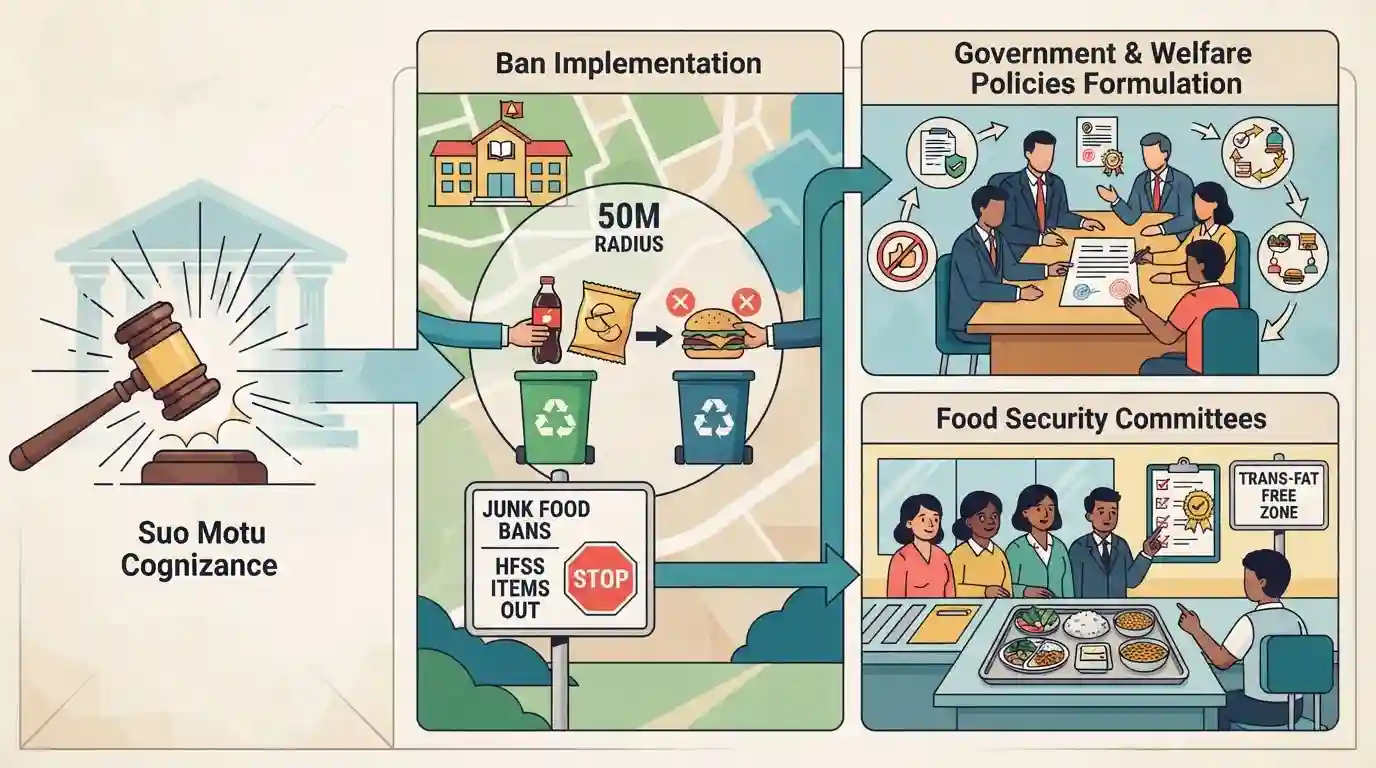
The Rajasthan High Court took suo motu cognizance to safeguard the health of students by imposing a comprehensive ban on the sale of junk food, carbonated drinks, and high-fat, high-sugar, and high-salt (HFSS) items within a 50-meter radius of all schools in the state. Transforming the issue into a Public Interest Litigation (PIL), the bench directed the central and state governments, including education and food supply departments, to formulate actionable welfare policies. Furthermore, the court mandated the formation of food security committees in every school to rigorously monitor the quality of mid-day meals and prevent the sale of harmful trans-fat items on school premises.
Key Points
- The Rajasthan High Court took suo motu cognizance and directed a complete ban on the sale of junk food and soft drinks within a 50-meter radius of all schools across the state.
- A single bench of Justice Anup Kumar Dhand registered a Public Interest Litigation (PIL) addressing critical issues including schoolchildren's health, nutrition, paper leaks, and screen time.
- Show-cause notices were issued to central and state authorities, including education and food supply departments, demanding an actionable welfare policy for students.
- The court mandated the constitution of food security committees comprising teachers, parents, and students to rigorously monitor the quality of mid-day meals and ensure no trans-fat or HFSS items are sold.
Important Terms
Public Interest Litigation (PIL)

A legal action initiated in a court to protect broader public interests, such as public health, rather than individual grievances. The Rajasthan High Court registered a suo motu PIL to ban junk food near schools.
UPSC context
Tested in RPSC RAS Paper-III (Constitution & Polity) under Judicial Activism and the proactive role of the judiciary.
Mid-day Meal Scheme
A centrally sponsored welfare program providing free, hot-cooked meals to children in government schools. The Rajasthan High Court recently mandated strict quality and hygiene monitoring of these meals via school-level food security committees.
UPSC context
Crucial for RPSC RAS Paper-II and III (Governance and Public Health), evaluating knowledge of child nutrition and state welfare policies.
Rajasthan High Court
The highest judicial authority in Rajasthan, seated in Jodhpur. It recently exercised suo motu cognizance to order a ban on high-fat, high-sugar, and high-salt (HFSS) food sales within 50 meters of all state schools.
UPSC context
Highly relevant for RPSC RAS Paper-III (State Political & Administrative System) regarding the judiciary's impact on public health directives.
FSSAI
The Food Safety and Standards Authority of India is the country's apex statutory food regulator. Its guidelines formed the basis for banning the sale of high-fat, high-sugar, and high-salt (HFSS) junk foods near schools.
UPSC context
Important for RPSC RAS Paper-II (Science, Tech & Public Health) and Current Affairs concerning food safety regulations and governance.
Food and Civil Supply Department
A state government department responsible for managing food security, public distribution, and essential commodity supplies. The court directed it to collaborate on actionable policies and ensure food safety compliance around educational institutions.
UPSC context
Relevant for RPSC RAS Paper-III (Public Administration & Governance) testing knowledge of state department functions and food security management.
Prelims Trap
"The 50-meter restriction on selling HFSS foods near schools was introduced for the first time by the Rajasthan High Court."
The 50-meter restriction is not a new judicial invention; FSSAI's 2020 regulations already prohibit the sale and advertisement of HFSS foods within 50 meters of schools. The HC is strictly enforcing it.
Static Concepts Connected
What is the statutory and constitutional basis for nutritional schemes like PM POSHAN?
- Article 47 (DPSP): Article 47 directs the State to raise the level of nutrition, standard of living, and improve public health as a primary duty.
- Statutory Backing: The National Food Security Act (NFSA), 2013 legally entitles schoolchildren up to Class VIII to a hot cooked nutritious meal.
- Grassroots Monitoring: Implementation and quality control are overseen by School Management Committees (SMCs) or specially constituted Food Security Committees.
How does FSSAI regulate HFSS (High Fat, Salt, and Sugar) foods near schools?
- HFSS Definition: HFSS refers to foods high in fat, salt, and sugar that lack essential vitamins and minerals (e.g., carbonated drinks, ultra-processed snacks).
- 2020 Regulations: The Food Safety and Standards (Safe Food and Balanced Diets for School Children) Regulations, 2020 strictly ban their sale and advertisement within 50 meters of school gates.
- Balanced Diet Promotion: FSSAI encourages schools to adopt comprehensive guidelines promoting safe, balanced, and fresh local diets over packaged foods.
Cross-Topic Patterns
Judicial Activism in Public Health
The elevation of student health into a suo motu PIL underscores the judiciary's proactive role in enforcing DPSP (Article 47) when executive implementation of existing FSSAI norms lags.
PM POSHAN vs. HFSS Menace
The dual mandate to protect students from HFSS items while securing mid-day meals highlights India's policy transition from mere 'food security' to qualitative 'nutritional security'.

Expect a multi-statement question linking FSSAI's 50-meter HFSS regulations with Article 47 (DPSP) and NFSA's statutory backing.
Linked PYQs · 3
Linked PYQs · 3
- 2025RPSC_PRELIMSGS1
Consider the following statements regarding the ‘National Food Security Act’ (NFSA) in India: A. It was enacted on 5th July, 2013. B. Currently, approximately 50 crore individuals are covered under the National Food Security Act. C. This Act legally entitles 75% of the rural population and 50% of the urban population to receive subsidized food grains. Choose the correct answer using codes:
- 2024RPSC_PRELIMSGS1
Kwashiorkor, a form of malnutrition, is caused by a deficiency of which of the following?
- 2023RPSC_PRELIMSGS1
Which scheme aims to improve the health and nutritional status of pregnant women and lactating mothers and their infants (0 to 6 months) by promoting the use of appropriate practices, care, and services during pregnancy, safe delivery, and breastfeeding?
