Rajasthan Right to Health Law Sparks Legislative Backlash
Source:Indian Express ↗
Why It Matters
The article serves as an excellent case study on the legislative codification of the Right to Health (Article 21) and the practical challenges of sustaining public welfare policies across different political regimes. It is highly relevant for GS-2 questions on the management of social sectors relating to health, state interventions in public healthcare, and the containment of marketisation in medical services.
Summary
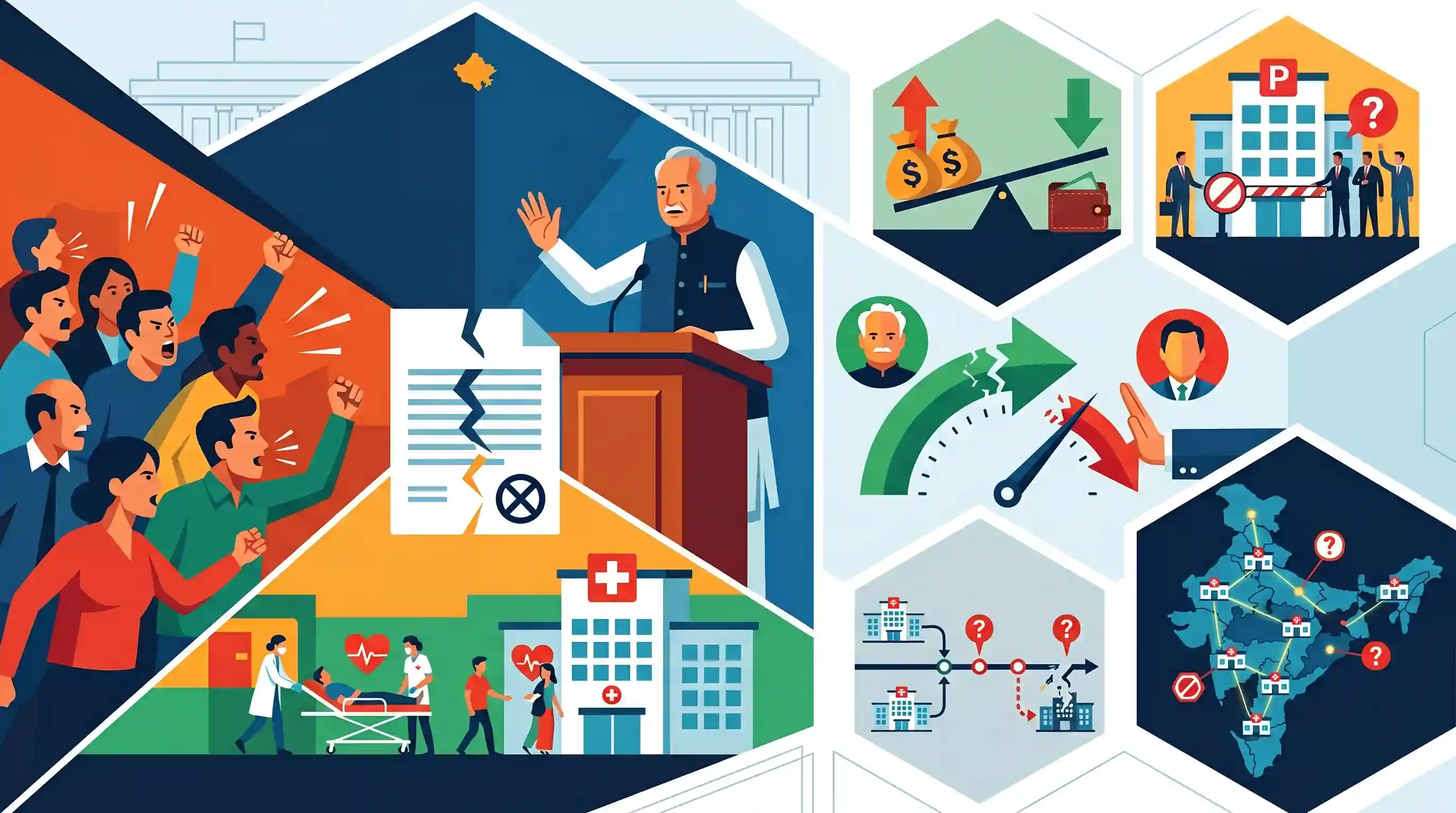
A political storm erupted in the Rajasthan Assembly when the incumbent Health Minister stated that the state does not need the Right to Health law, triggering vehement protests from the opposition. The Right to Health Act, enacted by the previous government, made Rajasthan the first Indian state to grant its residents the legal right to free emergency healthcare at public and select private hospitals. The minister's remarks highlight the vulnerabilities of ambitious welfare legislation to changes in political administration. The debate also brings to the forefront broader policy challenges surrounding the financial viability, private sector compliance, and long-term sustainability of universal health coverage initiatives in India.
Key Points
- The Rajasthan Health Minister faced intense backlash in the state Assembly after stating that the Right to Health law was not needed in the state.
- The Right to Health Act, pioneered by the previous government, legally guarantees residents access to free emergency treatment at public and designated private hospitals.
- The opposition strongly protested the minister's remark, viewing it as an attempt to dilute a crucial welfare measure aimed at universal healthcare.
- The controversy underscores the challenges of political discontinuity and the complex dynamics of integrating the private sector into state-mandated public health frameworks.
Important Terms
Right to Health Act (Rajasthan)

India’s first legislation (2023) guaranteeing residents free emergency medical care at public and select private facilities, ensuring treatment regardless of ability to pay upfront.
UPSC context
GS Paper 2: Social Justice; Government Policies. First-of-its-kind state legislation testing federal policy on health rights.
Universal Health Coverage (UHC)
A health system goal ensuring all individuals access quality services—preventive, curative, and rehabilitative—without facing financial hardship, aligned with Sustainable Development Goal 3.8.
UPSC context
GS Paper 2: Health. Relates to National Health Policy targets and global healthcare commitments.
Article 21
A Fundamental Right protecting life and personal liberty, which the Supreme Court has judicially expanded to include the right to health and medical care.
UPSC context
GS Paper 2: Indian Constitution. Core for questions on judicial activism and evolution of rights.
Article 47
A Directive Principle of State Policy (DPSP) that mandates the State to raise nutrition levels, improve standards of living, and consider public health improvement as its primary duty.
UPSC context
GS Paper 2: DPSP. Constitutional basis for state-led public health interventions.
State List (List II)
Part of the Seventh Schedule listing subjects like 'Public health and sanitation' and 'Hospitals' where state legislatures have exclusive power to make laws under normal circumstances.
UPSC context
GS Paper 2: Federalism. Explains why health legislation varies across different Indian states.
Out-of-Pocket Expenditure (OOPE)
The direct payment made by individuals to healthcare providers at the time of service, which often leads to financial catastrophe in India due to low insurance.
UPSC context
GS Paper 2: Issues relating to poverty and hunger. Key metric for evaluating health policy efficiency.
Prelims Trap
The Constitution explicitly guarantees the Right to Health as a Fundamental Right under Part III.
The Right to Health is an implicit right under Article 21 established by judicial interpretation, not explicitly written. Furthermore, public health is a State subject (Schedule 7).
Static Concepts Connected
How does the Indian Constitution address public health?
- Article 21: An implicit fundamental right expanded by the Supreme Court (e.g., Paschim Banga Khet Mazdoor Samity case) to include emergency medical care.
- Article 47 (DPSP): Directs the State to regard the improvement of public health, nutrition, and standard of living as its primary duties.
- State List: Public health, sanitation, hospitals, and dispensaries are explicitly placed under List II, giving states primary legislative authority.
What is Out-of-Pocket Expenditure (OOPE) in healthcare?
- Definition: Direct, un-reimbursed payments made by individuals to healthcare providers at the time of service use.
- Socio-economic impact: High OOPE is a primary driver of catastrophic health expenditure, pushing vulnerable Indian households into poverty. Rights-based laws aim to curb this.
Cross-Topic Patterns
Rights-based welfare vs. Fiscal federalism
State-level statutory rights often clash with fiscal constraints and changing political mandates, highlighting the fragility of universal health coverage without structural financial backing.
Private sector regulation and Public goods
Mandating private hospital compliance in state welfare schemes reveals the constant tension between public goods provision and private commercial viability in a marketised healthcare sector.

Expect a GS-2 question evaluating the statutory enforcement of Right to Health vs state capacity, referencing the Rajasthan model.
Linked PYQs · 3
Linked PYQs · 3
- 2024MainsGS2
In a crucial domain like the public healthcare system the Indian State should play a vital role to contain the adverse impact of marketisation of the system. Suggest some measures through which the State can enhance the reach of public healthcare at the grassroots level.
- 2020MainsGS2
In order to enhance the prospects of social development, sound and adequate health care policies are needed particularly in the fields of geriatric and maternal health care. Discuss.
- 2020PrelimsGS1
Which part of the Constitution of India declares the ideal of Welfare State?
