Rajasthan Health Minister Clarifies Maternal Death Cases Are Unrelated
Source:aninews ↗
Why It Matters
The quality of maternal healthcare, institutional delivery safety, and state-level administrative responses are vital areas of focus for RPSC RAS GS examinations, directly linking to social welfare, governance, and Rajasthan's demographic progress under SDG commitments.
Summary
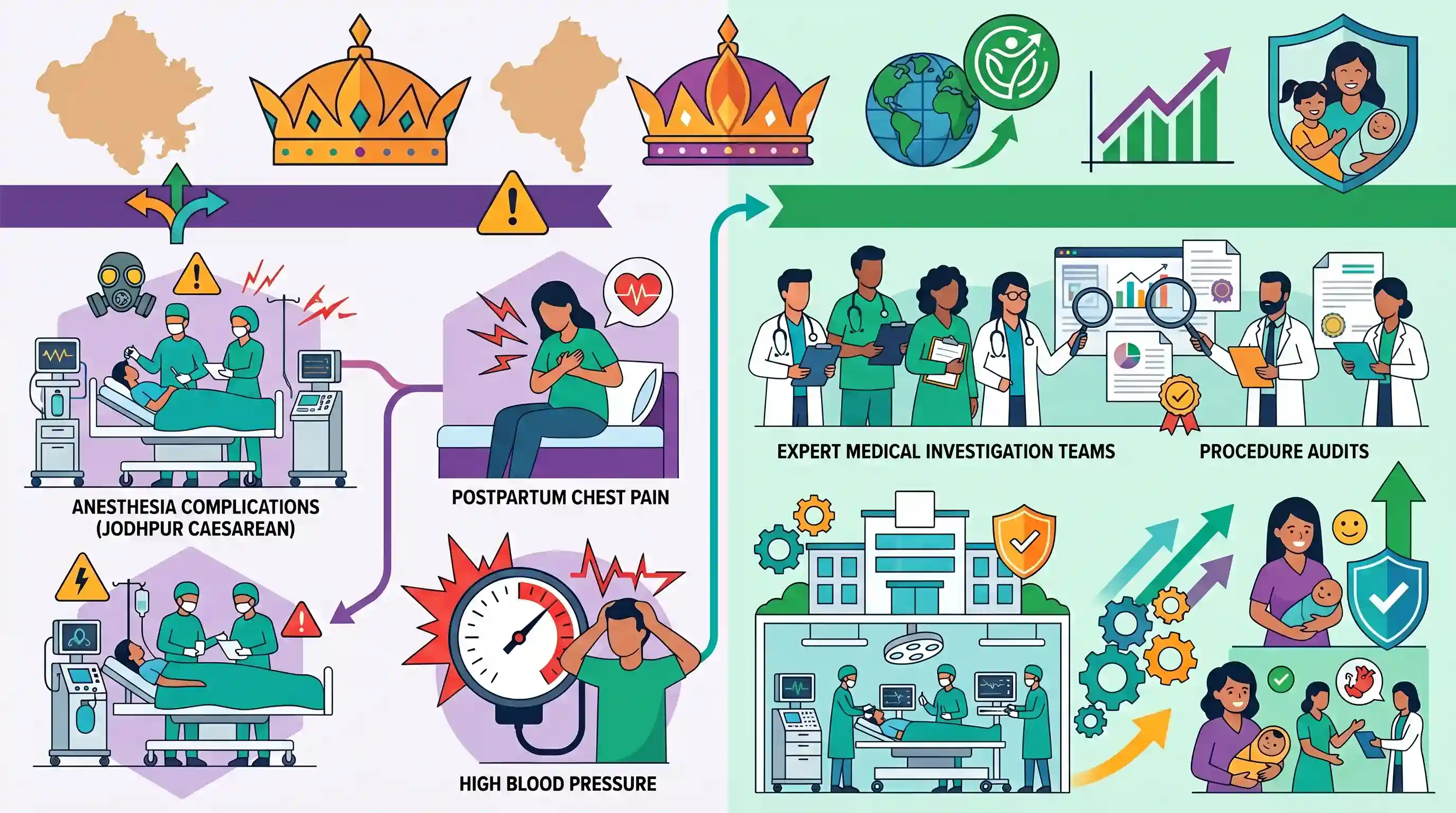
Rajasthan Health Minister Gajendra Singh Khimsar clarified that the recent cases of maternal deaths and health deterioration in government hospitals across Jodhpur, Nagaur, Didwana, Kota, and Bikaner are isolated, medically unrelated events. He outlined that different cases had distinct clinical complications, such as anaesthesia-related deterioration during Caesareans in Jodhpur, postpartum chest pain in Nagaur, and a sudden spike in blood pressure in Didwana. In response, the state health department has mobilized expert medical investigation teams to audit health procedures and improve critical care quality across state facilities.
Key Points
- Rajasthan Health Minister Gajendra Singh Khimsar stated that the maternal death and clinical deterioration cases across Kota, Bikaner, Nagaur, Didwana, and Jodhpur are separate, unrelated incidents.
- At Paota Hospital in Jodhpur, the condition of six to eight pregnant women deteriorated during Caesarean deliveries on June 20, 2026, prompting a high-level medical inquiry.
- The clinical causes varied significantly: a patient in Nagaur suffered a fatal post-delivery chest pain, whereas a patient in Didwana died before delivery due to a sudden and critical surge in blood pressure.
- The state government deployed specialist medical teams (including gynaecologists and anaesthetists) to inspect facilities, review protocols, and ensure stringent safety standards in public healthcare.
Important Terms
Janani Suraksha Yojana (JSY)

A centrally sponsored safe motherhood scheme under the National Health Mission providing cash incentives to encourage institutional deliveries among poor pregnant women.
UPSC context
GS Paper II: Social Justice & Health; tests maternal mortality reduction interventions and institutional delivery schemes.
Janani Shishu Suraksha Karyakram (JSSK)
A scheme launched in 2011 providing completely free, cashless deliveries, C-sections, drugs, diagnostics, and transport for pregnant women and sick infants in public facilities.
UPSC context
GS Paper II: Social Justice and Health; tests knowledge of mechanisms to eliminate out-of-pocket healthcare expenses.
Pradhan Mantri Matru Vandana Yojana (PMMVY)
A direct benefit transfer scheme under the National Food Security Act, 2013, offering maternity cash benefits to pregnant and lactating women for nutritional support and wage compensation.
UPSC context
GS Paper II: Welfare Schemes; evaluates understanding of social security, nutritional assistance, and maternity benefits.
Rajasthan Medical and Health Department
The state government administrative body responsible for healthcare delivery, state public health policy, medical colleges, and monitoring clinical procedures in public hospitals.
UPSC context
GS Paper II: State Health Administration; tests governance issues in regional public health implementation and quality assurance.
Paota Hospital Jodhpur
A district-level government hospital in Rajasthan that became the focus of high-level medical investigations after several postpartum C-section clinical complications occurred.
UPSC context
GS Paper II: Healthcare infrastructure; highlights standard operating procedure enforcement and clinical safety audits in public hospitals.
Prelims Trap
The Department of Health is the nodal agency for implementing and monitoring SDGs at the state level.
For states like Rajasthan, the Planning Department (via Economics & Statistics) is the overarching nodal agency for overall SDG coordination, not Health.
Static Concepts Connected
What is the difference between Maternal Mortality Ratio and Maternal Mortality Rate?
- Ratio Definition: MMR ratio measures maternal deaths per 100,000 live births, representing obstetric risk during pregnancy and childbirth.
- Rate Definition: Maternal Mortality Rate measures maternal deaths per 100,000 women of reproductive age (15–49) per year.
- Key Difference: The ratio uses live births as the denominator, while the rate uses the total reproductive-age female population.
How do JSY and JSSK differ in maternal care?
- JSY Mechanism: Acts as a conditional cash transfer scheme under the National Health Mission to incentivize institutional deliveries.
- JSSK Mechanism: An entitlement-based initiative assuring completely free, zero-cost deliveries and neonatal treatments in public facilities.
- Coverage Gap: While JSY focuses on financial incentives for mothers, JSSK eliminates out-of-pocket expenditure for both mother and sick infants.
Cross-Topic Patterns
Cooperative Federalism + State Health Indices
State-level MMR disparities highlight the role of cooperative federalism, where performance-linked central funds drive localized healthcare interventions.
Gender Budgeting + Direct Benefit Transfers
Maternity benefits like IGMPY demonstrate how targeted DBT under gender budgeting directly addresses structural malnutrition and economic vulnerability.

State-level SDG tracking and differences between cash-transfer (JSY) and entitlement-based (JSSK) maternal schemes are likely 2026 targets.
Linked PYQs · 3
Linked PYQs · 3
- 2023RPSC_PRELIMSGS1
Which scheme aims to improve the health and nutritional status of pregnant women and lactating mothers and their infants (0 to 6 months) by promoting the use of appropriate practices, care, and services during pregnancy, safe delivery, and breastfeeding?
- 2021RPSC_PRELIMSGS1
Which department has been declared as the nodal department for the effective implementation of Sustainable Development Goals in Rajasthan?
- 2021RPSC_PRELIMSGS1
Under the Ayushman Bharat Mahatma Gandhi Rajasthan Health Insurance Scheme, the amount provided per family per year in the event of a critical illness health insurance is
