Rajasthan High Court Judgment On GST Sub Contracting Liability
Source:scc-online ↗
Why It Matters
This judgment clarifies the tax implications of PPP models in infrastructure projects. It establishes that sub-contracting does not absolve the main concessionaire of GST liability and sets a critical precedent on when toll-collection rights are treated as taxable barter/consideration rather than tax-exempt toll collection.
Summary
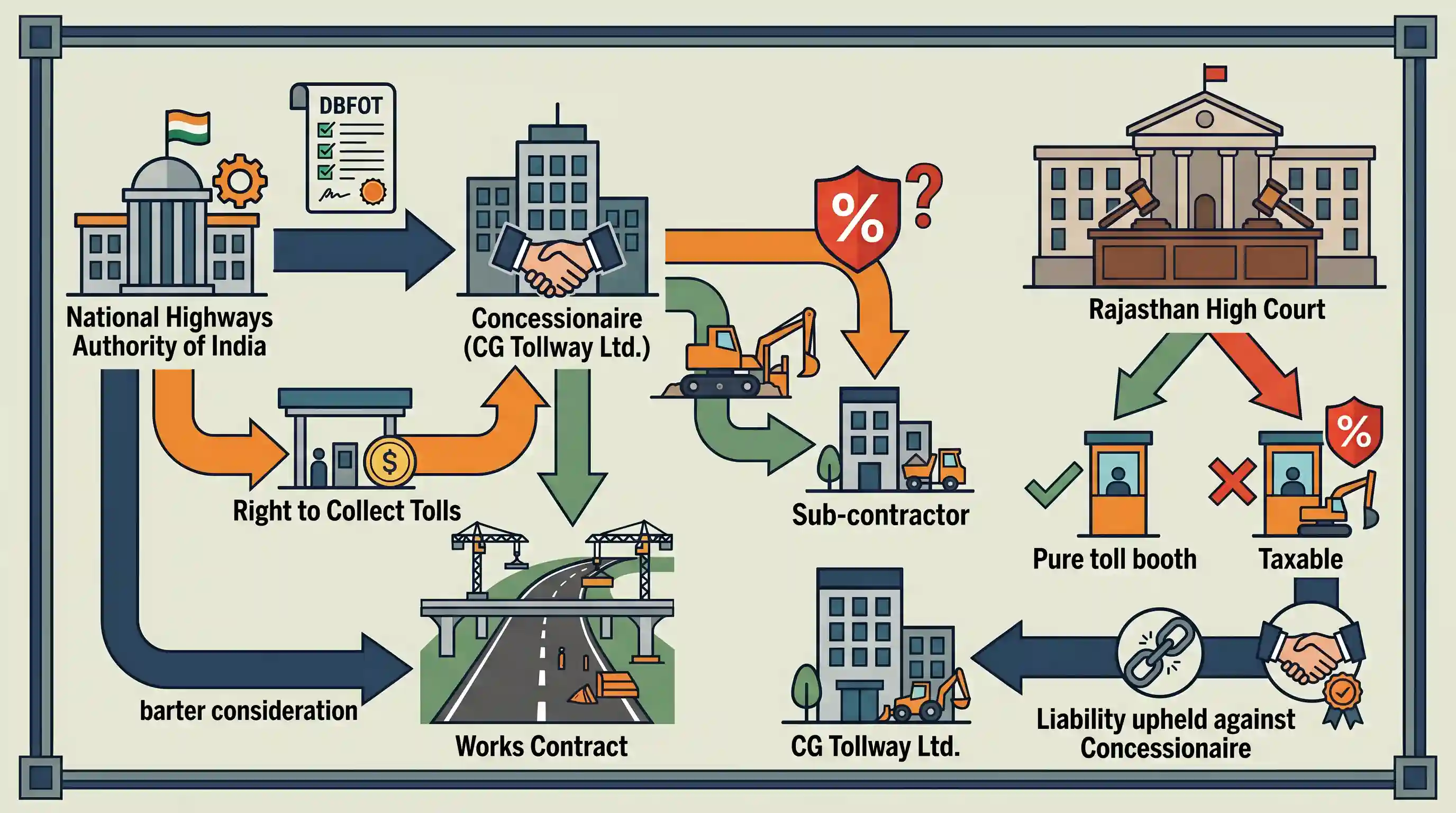
The Rajasthan High Court (Division Bench of Justice Sandeep Shah and Justice Arun Monga) upheld a GST demand against CG Tollway Ltd., holding that sub-contracting construction work under a DBFOT agreement with NHAI does not extinguish the principal concessionaire's tax liability. The court clarified that the right to collect tolls acts as barter consideration for the road construction works contract, rendering it a taxable supply under Section 7 of the CGST/RGST Acts. While independent toll collection is exempt, tolls collected as consideration for constructing infrastructure are taxable, and sub-contracting does not erase the privity of contract or the primary concessionaire's liability.
Key Points
- The Division Bench of the Rajasthan High Court ruled that sub-contracting road construction works does not extinguish the principal contractor's GST liability.
- The case arose from a DBFOT (Design, Build, Finance, Operate, and Transfer) concession agreement between NHAI and CG Tollway Ltd. for a section of NH-79.
- The petitioner sub-contracted the entire physical construction to a third party but retained the right to collect toll as consideration, claiming exemption from GST.
- The Court held that two distinct transactions and contracts existed: one between NHAI and the concessionaire, and another between the concessionaire and the sub-contractor, with no privity of contract between NHAI and the sub-contractor.
- Toll collection simpliciter is exempt from GST under Entry 23-A of Notification No. 12/2017; however, toll collected as barter/consideration for constructing roads under a works contract is a taxable supply under Section 7 of the CGST Act.
- The court rejected the petitioner's argument on 'negative equality' regarding dropped tax objections in Karnataka and Gujarat.
Important Terms
Central Goods and Services Tax (CGST) Act, 2017

Indian legislation governing the levy and collection of Goods and Services Tax (GST) by the Central Government on the intra-state supply of goods and services.
UPSC context
GS Paper III (Economy). Tests knowledge of fiscal federalism, indirect taxation reforms, and tax mobilization.
Notification No. 12/2017-Central Tax (Rate)
A vital notification under the CGST Act that specifies a comprehensive list of service activities exempted from Goods and Services Tax, often including public services and infrastructure.
UPSC context
GS Paper III (Economy). Tests analytical understanding of tax exemptions, service categorization, and their direct impact on economic sectors.
National Highways Authority of India (NHAI)
An autonomous government body established under the NHAI Act, 1988, responsible for the development, maintenance, and management of the national highways network in India.
UPSC context
GS Paper III (Infrastructure: Roads). Tests understanding of institutional mechanisms driving infrastructure development, connectivity, and public-private partnership models.
Rajasthan Goods and Services Tax (RGST) Act, 2017
State-level legislation enacted by the Rajasthan Government to levy and collect Goods and Services Tax (GST) on intra-state transactions of goods and services within Rajasthan.
UPSC context
GS Paper III (Economy). Tests comprehension of state tax structures under the concurrent dual GST framework in India.
Prelims Trap
All forms of toll collection and toll-retention rights under DBFOT/BOT models are entirely exempt from GST in India.
While toll collection simpliciter (charging users to access a road) is exempt under GST, toll collection rights granted as barter consideration for constructing the road are treated as taxable works contracts.
Static Concepts Connected
What is the DBFOT model of Public-Private Partnership (PPP)?
- Core Definition: A model where a private concessionaire designs, builds, finances, operates, and maintains an infrastructure asset for a specific concession period.
- Cost Recovery: The private player recovers its investment and operational costs by collecting user fees or tolls directly from the public during the concession period.
- Ownership Transfer: At the end of the concession period, the ownership and operational control of the facility revert completely to the public authority.
How does GST treat 'Works Contracts' and 'Barter' transactions?
- Works Contract Classification: Under the CGST Act, 2017, works contracts involving immovable property construction are legally classified as a "supply of services."
- Barter as Consideration: Supply includes barter transactions; receiving non-monetary consideration (such as the right to collect toll) in exchange for road construction constitutes a taxable supply.
- Privity of Contract: As per contract law, sub-contracting does not create a direct relationship between the client (e.g., NHAI) and the subcontractor, leaving the principal concessionaire's tax liability intact.
Cross-Topic Patterns
PPP Models + Indirect Tax Liability
Ambiguities in the tax treatment of non-monetary consideration (like toll rights) directly impact the financial viability and bidding strategies of long-term PPP infrastructure projects.
Contract Law + Infrastructure Governance
The doctrine of privity insulates public authorities like NHAI from subcontractor disputes, ensuring tax and execution liability remains strictly with the primary concessionaire.

Prelims 2026 may test how non-monetary barter (like toll rights) in DBFOT models is treated as a taxable works contract under GST.
Linked PYQs · 2
Linked PYQs · 2
- 2018RPSC_PRELIMSGS1
What has been included in the scope of GST (Goods and Services Tax)?
- 2025RPSC_PRELIMSGS1
Which of the following statements is correct regarding the benefit of the 'Input Tax Credit Mechanism' in GST?
