Rajasthan High Court Directs Separation of Police Investigation Wings
Source:scc-online ↗
Why It Matters
This judgment represents a significant shift in Rajasthan's state police administration and criminal justice system. Understanding the separation of police wings, the pilot projects, and the judicial mandate for forensic laboratory infrastructure is highly relevant for both Rajasthan state-specific polity questions and GS Paper-II (Governance and Judiciary).
Summary
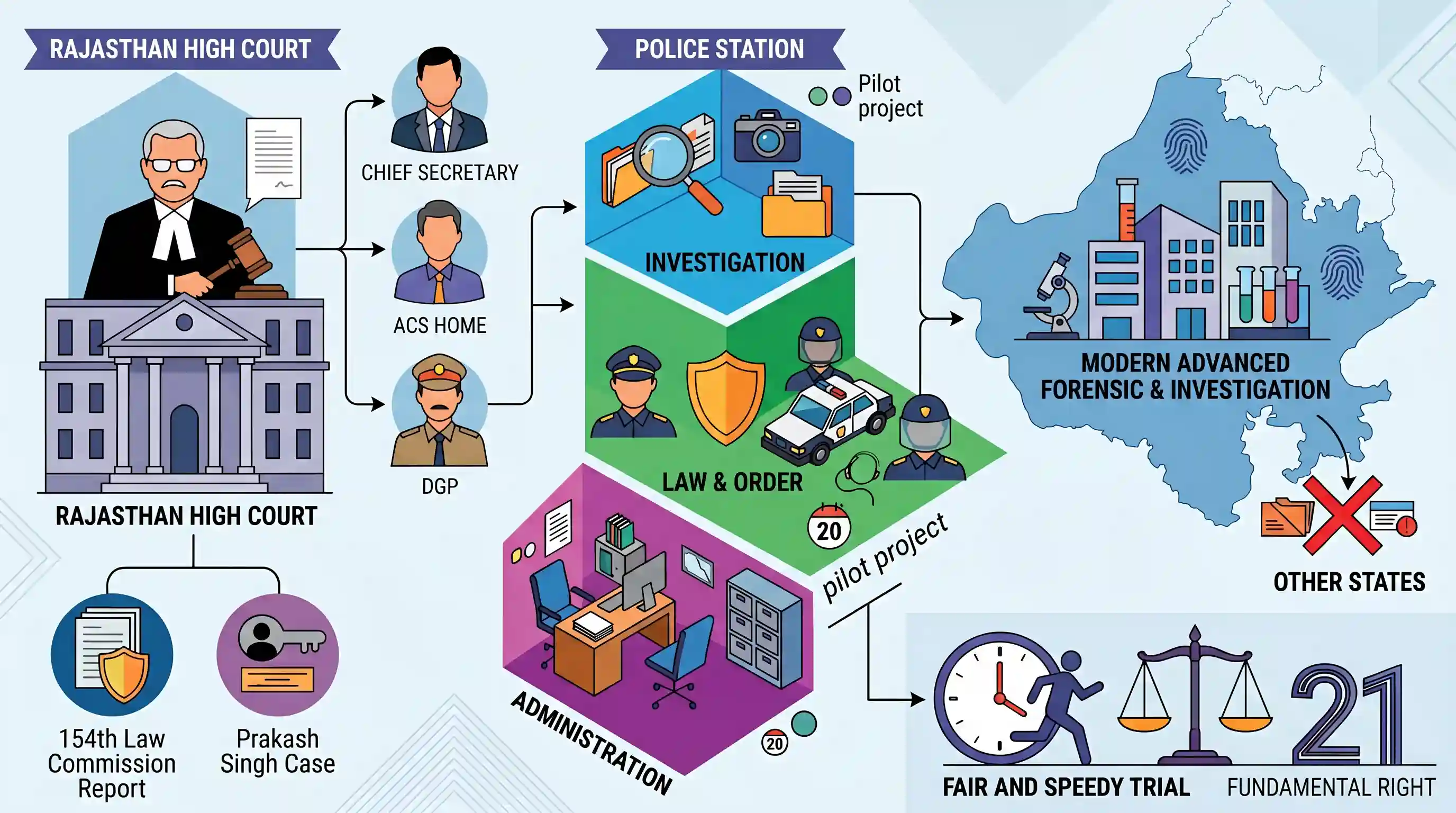
In a landmark directive for police reforms, the Rajasthan High Court (Justice Anoop Kumar Dhand) ordered the state administration (Chief Secretary, ACS Home, and DGP) to separate the investigative and law-and-order wings of the Rajasthan Police. Citing the 154th Law Commission Report and the landmark Prakash Singh (2006) judgment, the Court approved recommendations to organize police stations into three distinct units: Law & Order, Investigation, and Administration, starting with a 20-station pilot project. Furthermore, the Court directed the establishment of advanced forensic and investigation labs within Rajasthan to prevent the delays caused by sending evidence to other states, declaring that delayed investigations violate the fundamental right to a fair and speedy trial under Article 21.
Key Points
- The Single Bench of the Rajasthan High Court (Justice Anoop Kumar Dhand), in 'Prem Prakash Bidyasar v. State of Rajasthan', directed the state government to separate the police's investigative wing from the law and order wing.
- The High Court cited key legal precedents, including the 154th Report of the Law Commission of India and the landmark Supreme Court ruling in Prakash Singh v. Union of India (2006), to support the structural separation of policing duties.
- Following previous court orders, a committee constituted by the DGP of Rajasthan studied policing models in Kerala, Punjab, Delhi, and Bihar, recommending a three-unit operational structure for police stations: Law and Order, Investigation, and Administrative units.
- A pilot project incorporating this three-unit model is scheduled to be rolled out in 20 selected police stations across Rajasthan.
- The Court highlighted that the current 'undifferentiated model' (where the same officers handle FIRs, patrols, VIP duties, and investigations) compromises the intellectual rigor of casework, leading to low conviction rates and high pendency.
- The Court mandated the creation of advanced investigation and forensic labs in Rajasthan, noting that reliance on other states' labs causes delays that violate the fundamental right to a fair investigation and speedy trial under Article 21 of the Indian Constitution.
- Directions were issued specifically to the Chief Secretary, Additional Chief Secretary (ACS) of the Home Department, and the Director General of Police (DGP) of Rajasthan to implement these changes and increase police cadre strength.
Important Terms
Law Commission of India

An executive, non-statutory body constituted periodically by the Government of India to research and advise on legal reforms, ensuring the modernization of the justice delivery system.
UPSC context
GS Paper II (Polity & Governance); tests understanding of law reform mechanisms, executive bodies, and judicial administration.
Constitution of India (Article 21)
A fundamental right guaranteeing that no person shall be deprived of their life or personal liberty except according to procedure established by law, interpreted to include fair and speedy trials.
UPSC context
GS Paper II (Polity & Constitution); tests fundamental rights, judicial activism, and judicial interpretations expanding individual liberty.
Rajasthan Police Act
A state-specific legislation enacted in 2007 to consolidate and amend the law relating to the police force, ensuring professional organization, human rights protection, and accountability.
UPSC context
GS Paper II (State Administration); tests police administration, local security, and state-level compliance with police reform directives.
Rajasthan High Court
The highest judicial body in Rajasthan, established in 1949 under Article 214, responsible for administering justice, interpreting laws, and protecting citizens' fundamental rights.
UPSC context
GS Paper II (Judiciary); tests judicial system structure, powers of High Courts, and judicial interventions in state administration.
Department of Home (Government of Rajasthan)
The administrative department of the state government responsible for maintaining internal security, public order, and police administration across Rajasthan.
UPSC context
GS Paper II (State Administration); tests executive structures, police accountability, and state-level governance of internal security.
Prelims Trap
The structural separation of investigative and law-and-order police duties was first conceptualized and recommended by the Supreme Court in 2006.
The structural separation was recommended much earlier, including in the 154th Law Commission Report (1996) and the National Police Commission (1977-81). The Supreme Court in 2006 judicialized and mandated it.
Static Concepts Connected
What are the key directives issued by the Supreme Court in the Prakash Singh case (2006)?
- Separation of wings: Separate the investigative police from the law and order cadre to ensure specialized, uncompromised, and speedy crime investigation.
- Tenure security: Provide a minimum tenure of two years for the Director General of Police (DGP), SPs, and station house officers to insulate them from political interference.
- Independent oversight: Establish a State Security Commission, Police Establishment Board, and Police Complaints Authorities to oversee policy, postings, and public grievances respectively.
Cross-Topic Patterns
Article 21 + Forensic Infrastructure
Linking the lack of localized forensic laboratories to violations of Article 21 establishes that state capacity and scientific infrastructure are essential for upholding fundamental constitutional rights.
Police Reforms + Federalism Friction
While 'Police' is a State List subject, national push for uniform criminal justice procedures (like BNSS) requires states to implement long-delayed judicial directives on structural administrative reform.

BNSS mandate for forensic evidence makes judicial directives on separating investigation from law & order a highly probable 2026 Mains topic.
Linked PYQs · 2
Linked PYQs · 2
- 2023RPSC_PRELIMSGS1
According to Article 217 (1) of the Constitution, the President shall make the appointment of a judge of the Rajasthan High Court (other than the Chief Justice) after consultation with whom?
- 2023RPSC_PRELIMSGS1
According to Article 217(1) of the Constitution, who does the President appoint on the advice of whom, other than the Chief Justice of the Rajasthan High Court?
