Rajasthan HC Seeks Action Plan on Criminal Cases Against Lawmakers
Source:freepressjournal ↗
Why It Matters
The fast-tracking of criminal cases against lawmakers is crucial to check the criminalization of politics and ensure political accountability. The judiciary's proactive role (suo motu cognizance) in enforcing timely trials underscores the ongoing institutional efforts to maintain the sanctity of democratic representation.
Summary
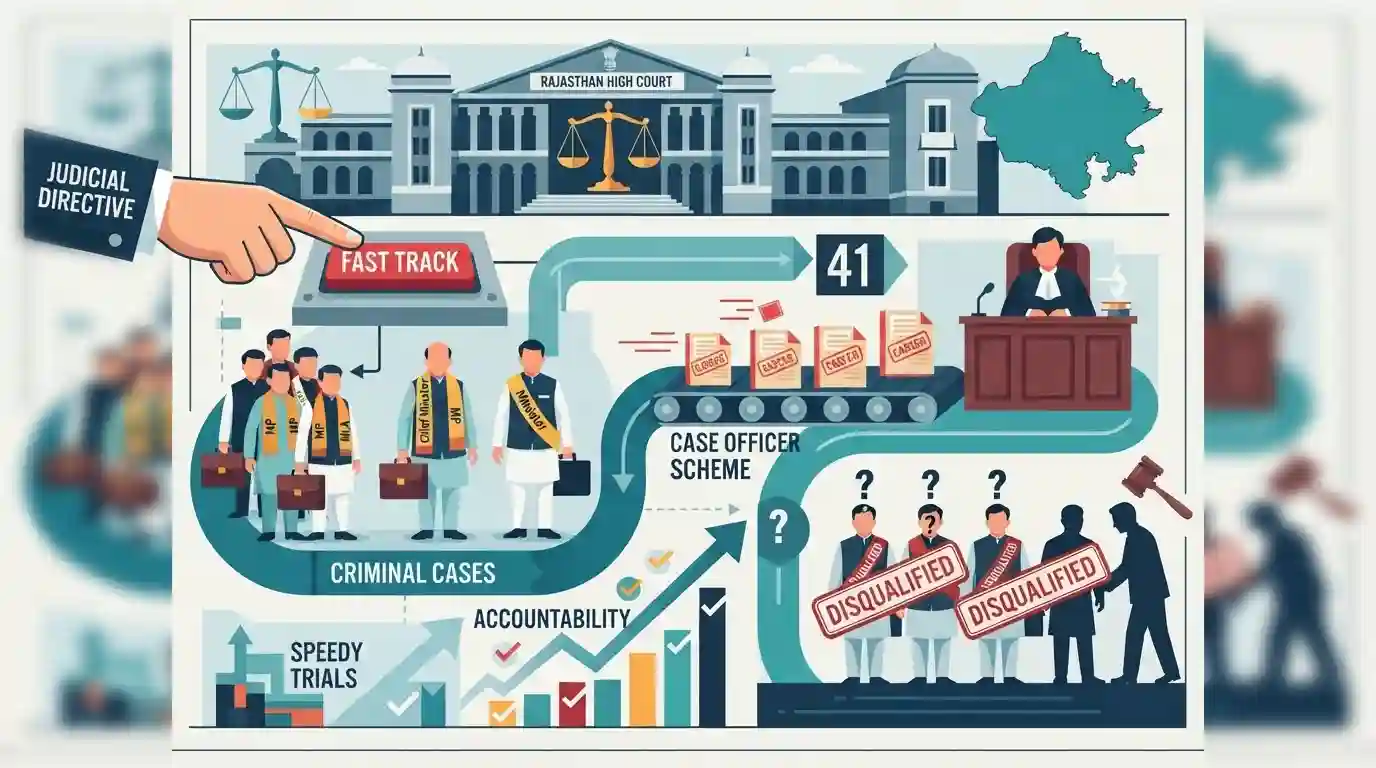
The Rajasthan High Court has directed the state government and the High Court administration to submit a comprehensive action plan to fast-track criminal cases pending against current and former Members of Parliament (MPs) and Members of the Legislative Assembly (MLAs). This order was issued in compliance with a Supreme Court directive aimed at curbing the criminalization of politics by ensuring speedy trials for lawmakers. The state government informed the court that 41 such cases are pending and are being managed under the 'Case Officer Scheme' for quicker resolution. Prominent political figures, including the Chief Minister and several ministers, are among those facing pending charges.
Key Points
- The Rajasthan High Court has demanded an action plan from the state government and HC administration to expedite trials in criminal cases against current and former MPs and MLAs.
- The directive was issued by a division bench comprising Acting Chief Justice SP Sharma and Justice Bhuvan Goel, following a mandate from the Supreme Court of India.
- The Supreme Court had directed High Courts to register suo motu cases to actively monitor the progress of cases against lawmakers.
- The state government stated that police-investigated cases are being handled under the "Case Officer Scheme" to ensure faster disposal.
- There are 41 pending cases against prominent politicians in Rajasthan, including the Chief Minister and a Union Minister, involving charges like corruption, defamation, and unlawful assembly.
Important Terms
Case Officer Scheme

A policing initiative where a designated nodal officer rigorously monitors the trial of specific criminal cases to ensure witness safety, prevent trial delays, and secure successful convictions.
UPSC context
GS Paper 2 (Governance). Illustrates state-level police and criminal justice reforms aimed at expediting judicial processes and ensuring accountability.
Criminalisation of Politics
The infiltration of individuals facing criminal charges into electoral politics and public office, creating a corrosive nexus between criminals, politicians, and the state machinery.
UPSC context
GS Paper 2 (Polity). Highly relevant for questions on electoral reforms, the Representation of the People Act, and democratic integrity.
Special Courts for MPs and MLAs
Dedicated judicial bodies set up following Supreme Court directives to exclusively and rapidly try long-pending criminal cases against sitting and former lawmakers, reducing political interference.
UPSC context
GS Paper 2 (Judiciary). Critical for analyzing judicial interventions in electoral reforms and addressing the immense pendency of criminal cases.
Disqualification of Legislators
The statutory process, notably under the Representation of the People Act (RPA) 1951, where lawmakers lose their seats—such as upon conviction for a crime with a sentence of two or more years.
UPSC context
GS Paper 2 (Polity). Tests the constitutional and statutory provisions for maintaining legislative integrity and cleaning up Indian politics.
Prelims Trap
State governments have absolute power to withdraw criminal cases against MLAs under CrPC.
The Supreme Court ruled that states cannot withdraw criminal cases against sitting or former MPs/MLAs without prior permission from the respective High Court, limiting executive discretion.
Static Concepts Connected
What triggers the immediate disqualification of a legislator?
- RPA 1951: Section 8 of the Representation of the People Act (RPA) 1951 mandates immediate disqualification upon conviction for a criminal offense with a sentence of two years or more.
- Lily Thomas Case: In the 2013 Lily Thomas case, the SC struck down Section 8(4) of the RPA, which previously gave convicted lawmakers a 3-month window to appeal before disqualification.
- Presidential Role: Under Article 103, the President decides on disqualifications (other than defection) but is bound by the Election Commission's opinion.
How does the withdrawal of prosecution apply to lawmakers?
- General Rule: Generally, a Public Prosecutor can withdraw from prosecution with the consent of the trial court before the judgment is pronounced.
- Lawmaker Exception: To curb political shielding, the SC ruled that state governments cannot withdraw cases against MPs/MLAs without explicit prior permission from the state's High Court.
Cross-Topic Patterns
Judicial activism in electoral reforms
The SC's mandate for suo motu HC monitoring and fast-track courts highlights the judiciary filling the legislative vacuum left by Parliament's reluctance to aggressively tackle political criminalization.
"Case Officer Scheme" & police reforms
Rajasthan's scheme assigns a dedicated officer from investigation to trial to prevent witness hostility. This mirrors the Malimath Committee's recommendations on separating investigation from law and order duties.

Expect a Prelims question mixing RPA disqualification criteria (Lily Thomas) with the SC's constraints on states withdrawing lawmaker cases.
Linked PYQs · 3
Linked PYQs · 3
- 2021RPSC_PRELIMSGS1
Under Article 103 of the Constitution of India, before giving any decision on any question relating to the disqualifications of members of the Lok Sabha, the President will take the opinion of whom?
- 2025RPSC_PRELIMSGS1
Under Section 7 of the Rajasthan Lokayukta and Upa-Lokayukta Act, 1973, the Lokayukta has the power to investigate charges against ministers and public servants in certain cases. Which of the following is not part of those investigations?
- 2024RPSC_PRELIMSGS1
According to the Rajasthan Lokayukta and Deputy Lokayukta Act, 1973, the Lokayukta in Rajasthan can investigate allegations against ministers and public servants in certain cases. Which of the following subject is included in such cases? (i) Involves grievance/any suffering caused by public servant. (ii) Used his position as a public servant to obtain, for himself or for any other person, any valuable thing or financial benefit. (iii) Sexual harassment of woman, cause injury to any person. (iv) Can be related to being guilty of corruption of the trust reposed in him as a public servant.
