Rajasthan High Court Quashes Unreasoned GST Registration Cancellation
Source:taxguru ↗
Why It Matters
It demonstrates the constitutional supremacy of Article 226 writ jurisdiction over statutory alternative remedies in cases where administrative authorities commit procedural illegalities and violate the fundamental principles of natural justice (audi alteram partem).
Summary
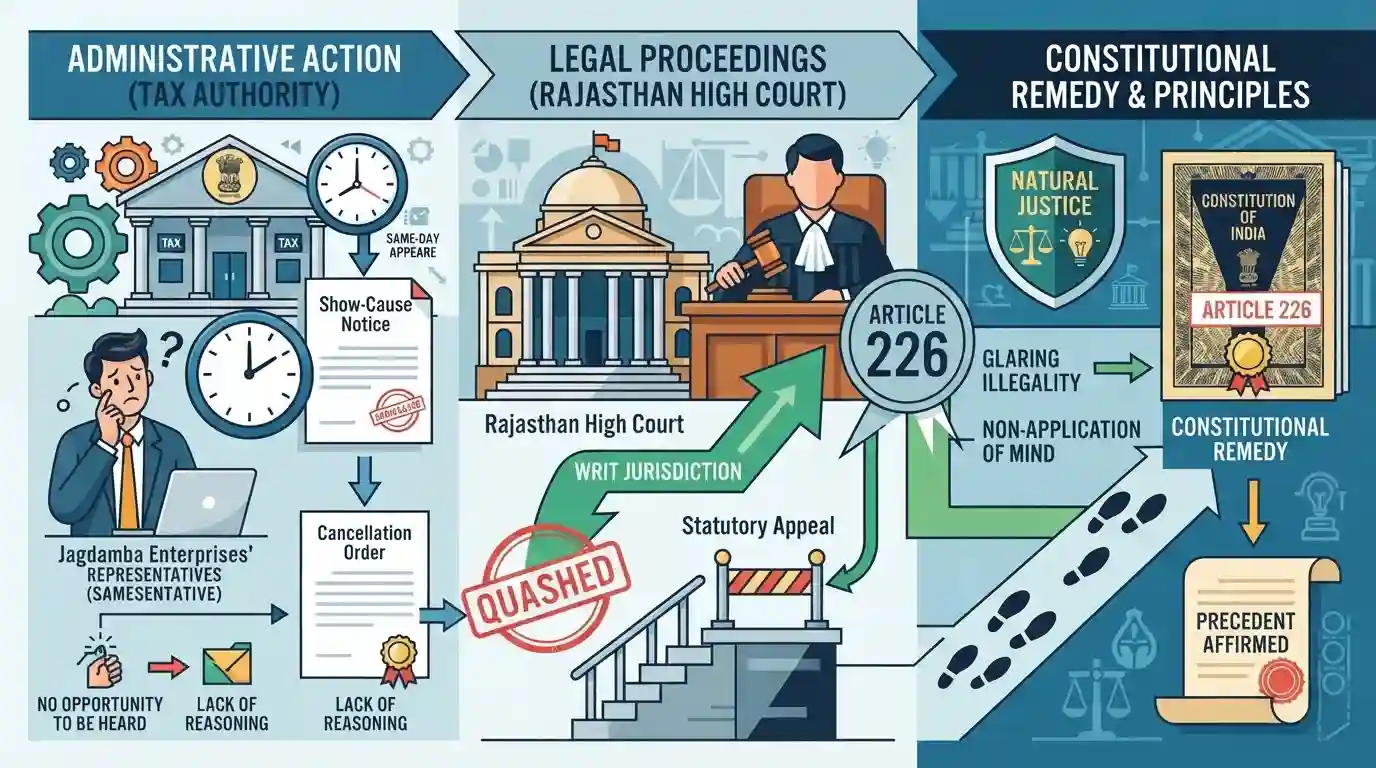
The Rajasthan High Court has struck down a Goods and Services Tax (GST) registration cancellation order and its underlying show-cause notice, citing a blatant violation of the principles of natural justice. In the case involving Jagdamba Enterprises, the tax authorities issued a show-cause notice demanding an appearance on the exact same day, depriving the petitioner of a fair opportunity to respond. Furthermore, the final cancellation order lacked any reasoning or specific grounds. Reaffirming established legal precedents, the High Court held that while the CGST Act provides an alternative statutory remedy via appeal (Section 107), the presence of such a remedy is not an absolute bar to invoking the High Court's extraordinary writ jurisdiction under Article 226 of the Constitution when an administrative action suffers from glaring illegality and non-application of mind.
Key Points
- The Rajasthan High Court quashed a GST cancellation order and show-cause notice issued to Jagdamba Enterprises for being vague, unreasoned, and violating principles of natural justice.
- The show-cause notice was issued on the exact same date the petitioner was instructed to appear, failing to provide a reasonable opportunity to be heard (audi alteram partem).
- The final cancellation order failed to specify any grounds for the revocation of the GST registration, indicating a complete lack of application of mind by the tax authority.
- Despite the existence of a statutory appellate remedy under Section 107 of the CGST Act, the High Court intervened via writ jurisdiction under Article 226, noting that glaring administrative illegalities bypass the alternative remedy bar.
Important Terms
Principles of Natural Justice

The doctrine requiring fairness in legal proceedings, famously encompassing 'audi alteram partem' (hear the other side). It demands affected parties receive adequate notice and a fair opportunity to respond before any adverse administrative action is taken.
UPSC context
Tests knowledge of Administrative Law and safeguards against arbitrary state action in constitutional and public law.
Audi Alteram Partem
A fundamental principle of natural justice meaning "hear the other side." It prevents anyone from being condemned unheard and necessitates valid show-cause notices in taxation or disciplinary actions.
UPSC context
Crucial for RPSC exams covering legal maxims, constitutional rights (Article 14), and judicial review in Rajasthan.
Article 226
A constitutional provision empowering High Courts to issue writs (like mandamus and certiorari) to protect Fundamental Rights or for "any other purpose," acting as a check on administrative arbitrariness.
UPSC context
Highly relevant for Polity papers; compares High Court writ powers with the Supreme Court's Article 32 powers.
Rajasthan High Court
Established in 1949 with its principal seat in Jodhpur and a bench in Jaipur, it is the highest judicial authority in Rajasthan, exercising writ jurisdiction over state administrative actions.
UPSC context
Essential for Rajasthan State Polity; tests knowledge of the state's judicial structure, history (1949 Ordinance), and seats.
Central Goods and Services Tax (CGST) Act
The 2017 Central Act regulating the levy and collection of intra-state goods and services tax. Section 29 governs registration cancellation, mandating an opportunity of being heard before revocation.
UPSC context
Important for Indian Economy and Taxation topics, testing regulatory procedures and taxpayers' rights against the Revenue Department.
Prelims Trap
Article 226 writ jurisdiction cannot be invoked under any circumstances if an alternative statutory remedy exists.
The alternative remedy rule is one of judicial discretion, not a constitutional bar. High Courts can intervene if natural justice is violated or glaring illegality exists.
Static Concepts Connected
How does Article 226 compare to Article 32 regarding scope and alternative remedies?
- Writ Scope: Art 226 covers fundamental rights and any other legal rights, while Art 32 is strictly restricted to the enforcement of fundamental rights.
- Discretionary nature: Art 226 is discretionary. High Courts can refuse a writ if an alternative remedy exists, whereas invoking Art 32 is a guaranteed fundamental right itself.
What are the core principles of Natural Justice applicable to administrative authorities?
- Fair hearing: Audi alteram partem ensures that no individual or business is penalized without being given a reasonable opportunity to be heard or defend themselves.
- Speaking orders: Administrative authorities must provide reasons for their decisions. Unreasoned orders reflect non-application of mind and are deemed arbitrary in law.
Cross-Topic Patterns
Tax Admin & Natural Justice
The exam often bridges basic constitutional protections with taxation, emphasizing that tax authorities act as quasi-judicial bodies bound to issue reasoned, speaking orders.
Judicial Review of Executive Discretion
RPSC frequently tests the limits of executive power, linking 'vague administrative orders' and non-application of mind to the violation of the Right to Equality under Article 14.

Statements comparing the discretionary nature of Art 226 despite alternative statutory remedies against Art 32 are highly probable.
Linked PYQs · 3
Linked PYQs · 3
- 2013RPSC_PRELIMSGS1
List-1 is matched with List-2 and the correct answer is selected using the codes given below - List-1 – List-2 Constitutional Article – Provision A. 215 1. Transfer of a judge from one High Court to another High Court B. 222 2. Power of superintendence over all courts C. 226 3. Power of the High Court to issue certain writs D. 227 4. The High Court as a court of record Code:
- 2012RPSC_PRELIMSGS1
What is the full form of GST?
- 2023RPSC_PRELIMSGS1
Identify the incorrect statement regarding the Menaka Gandhi case, 1978, concerning the judicial interpretation of Article 21.
