Udaipur Hills Hill Policy And Illegal Construction Judicial Scrutiny
Source:Rediff ↗
Why It Matters
Highlights the critical tension between urban development and ecological conservation in Rajasthan, specifically concerning the Aravalli range and Udaipur's lake system. It is highly relevant for RPSC RAS Prelims given the focus on Rajasthan's geography, environmental policies, and judicial interventions.
Summary
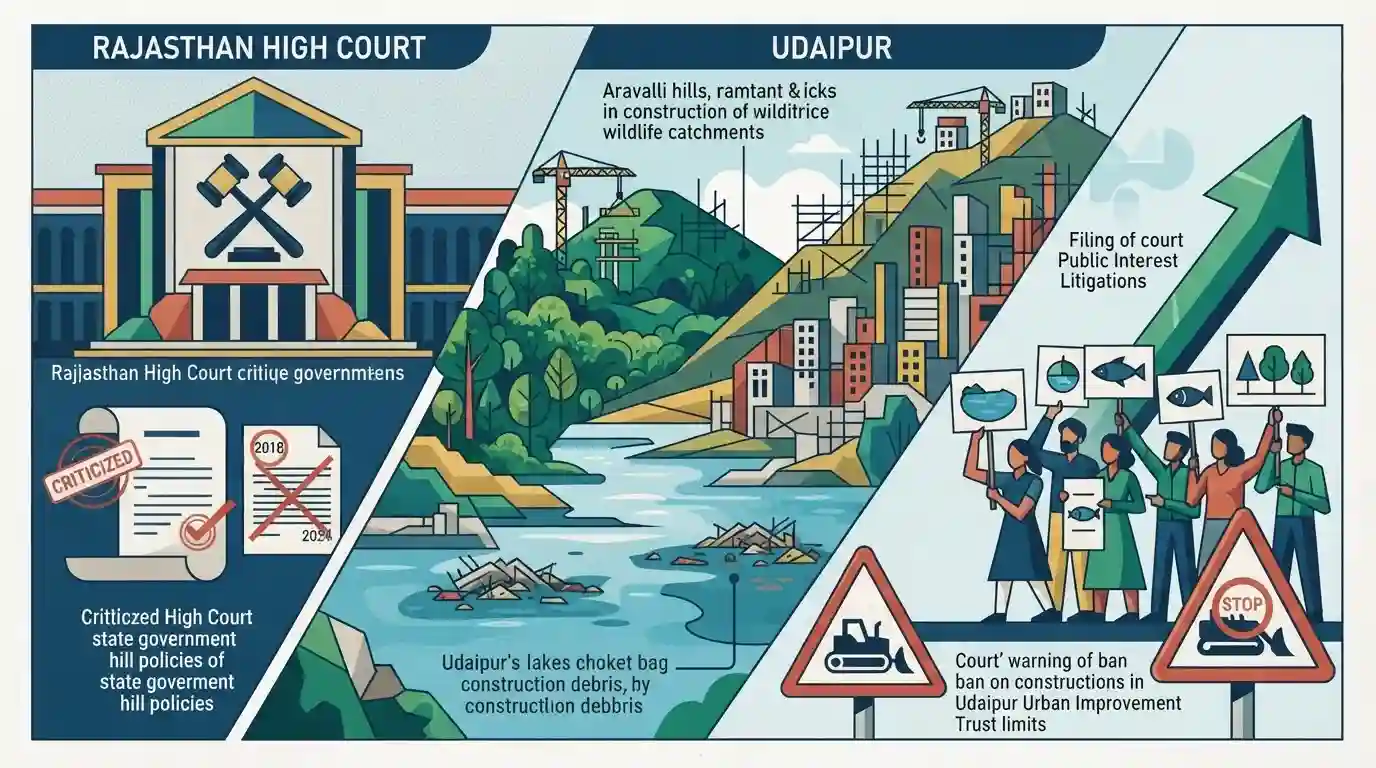
The Rajasthan High Court has taken a strict stance against rampant and unchecked construction activities on the ecologically sensitive hills of Udaipur. A division bench heavily criticized the state government's hill policies from 2018 and 2024, noting they were prepared by private agencies without proper consultation with environmental experts. Warning of a potential ban on new constructions within the Udaipur Urban Improvement Trust limits, the court linked the issue to the broader degradation of Udaipur's lakes and wildlife catchments. The case has been tagged with ongoing Public Interest Litigations filed by environmental groups like the Jheel Sanrakshan Samiti.
Key Points
- The Rajasthan High Court expressed grave concern over unchecked and indiscriminate construction on Udaipur's ecologically sensitive hills, threatening lakes and wildlife.
- The court strongly criticized the Rajasthan Hill Policies of 2018 and 2024 for being drafted by private agencies without consulting environmental authorities or adhering to ecological guidelines.
- Justices Pushpendra Singh Bhati and Munnuri Laxman warned that the court might halt all new constructions on hills within the Udaipur Urban Improvement Trust (UIT) boundaries.
- The matter was merged with pending Public Interest Litigations (PILs), including one by the Jheel Sanrakshan Samiti concerning the pollution of Udaipur lakes and catchment destruction.
Important Terms
Rajasthan Hill Policy 2024

An updated state framework classifying terrain by slope gradients to regulate hill construction. It was criticized by the Rajasthan High Court for being drafted by private agencies without adequate environmental expert consultation.
UPSC context
Important for GS-3 (Environment) and GS-2 (Governance), focusing on sustainable urban development and the importance of expert consultation in policy-making.
Rajasthan Hill Policy 2018
A previous state policy that created a slope-based sensitivity zonation for hill areas. Technical loopholes in the policy allowed widespread illegal hill cutting and flattening, leading to judicial scrutiny.
UPSC context
Relevant for GS-3 (Environmental Degradation). Tests evaluation of past state regulations, ecological impacts on sensitive geographies, and policy loopholes.
Udaipur Urban Improvement Trust (UIT)
A statutory body established under the Rajasthan Urban Improvement Act, 1959, responsible for city planning, expansion schemes, and providing essential urban amenities and infrastructure in Udaipur.
UPSC context
Relevant to GS-2 (Local Governance) and GS-3 (Urbanization), highlighting the role and accountability of statutory municipal bodies in managing ecological challenges.
Jheel Sanrakshan Samiti
A citizen-led NGO in Udaipur established to protect and conserve the city's lakes. It utilizes judicial interventions, like Public Interest Litigations (PILs), to push for sustainable water management and fight pollution.
UPSC context
Highly relevant for GS-2 (Role of Civil Society) and GS-3 (Water Conservation), demonstrating the impact of NGOs on environmental governance.
Prelims Trap
"Udaipur's lakes like Pichola and Fateh Sagar are natural tectonic lakes formed due to the geological upliftment of the Aravalli Range."
Udaipur's prominent lakes are actually interconnected artificial freshwater lakes created historically by constructing dams across streams (like the Ahar river) for water security.
Static Concepts Connected
What is the geographical and ecological significance of the Aravalli Range?
- Desertification Barrier: It acts as a critical ecological shield preventing the eastward expansion of the Thar Desert into the fertile Indo-Gangetic plains.
- Major Water Divide: It separates the drainage system of the Bay of Bengal (e.g., Banas river) from that of the Arabian Sea (e.g., Luni, Sabarmati).
- Monsoon Alignment: It runs parallel to the Arabian Sea branch of the southwest monsoon, providing no barrier, which contributes to the arid climate of western Rajasthan.
How does PIL relax the traditional legal rule of locus standi?
- Locus Standi Relaxation: Traditional law requires the aggrieved person to sue. PIL allows any public-spirited individual or NGO to file cases on behalf of those unable to approach courts.
- Constitutional Backing: It aligns with Article 39A (equal justice and free legal aid) and expands Article 21 to include the right to a healthy environment.
- Non-adversarial Nature: PIL is viewed as a collaborative effort between the court, government, and petitioners to secure public interest, rather than a traditional adversarial dispute.
Cross-Topic Patterns
Aravalli Mining & Eco-Sensitive Zones
The Udaipur catchment destruction parallels the broader illegal mining crisis in the Aravallis, frequently linking to Supreme Court rulings on Eco-Sensitive Zones and the Environment Protection Act.
Urbanization vs. Lake Catchments
Unchecked hill construction in Udaipur mirrors patterns seen in Bengaluru and Chennai, where the concrete sealing of natural wetlands and catchments leads directly to urban flooding.

Expect a geography mapping question in 2026 linking Aravalli's drainage systems (Banas, Luni) to artificial lakes and desertification.
Linked PYQs · 4
Linked PYQs · 4
- 2021RPSC_PRELIMSGS1
In which of the following districts are subtropical mountainous forests found?
- 2023RPSC_PRELIMSGS1
Match the following list – P (Directive Principles) with list – R (Article): List – P List – R A. Equal justice and free legal aid I. Article 48 A B. Protection of the environment II. Article 39 A C. Right to work III. Article 41 D. Preservation of monuments IV. Article 49 Choose the correct option: . A B C D
- 2013RPSC_PRELIMSGS1
Read the list of environmental concerns and the years in which the relevant laws were passed: List-1 – List-2 Environmental Concern – Year of enactment of law A. Wildlife Protection – 1. 1986 B. Environmental Protection – 2. 2013 C. Recognition of rights of tribals and other traditional forest dwellers – 3. 1972 D. Forest Conservation – 4. 1988 Which of the following is the correct match?
- 2025RPSC_PRELIMSGS1
Choose the incorrect statement with respect to the Rajasthan Forestry and Biodiversity Project (Phase-2).
