Rajasthan High Court Principal Bench Virtual Operation And Conference
Source:The Hans India ↗
Why It Matters
This event highlights the administrative flexibility of the state judiciary and the seamless integration of technology (video conferencing) to prevent judicial delays. Furthermore, the questions being heard by the larger benches—including open-jail eligibility for POCSO convicts and constitutional-cultural representations in court premises—carry high socio-legal significance in Indian polity and state administration.
Summary
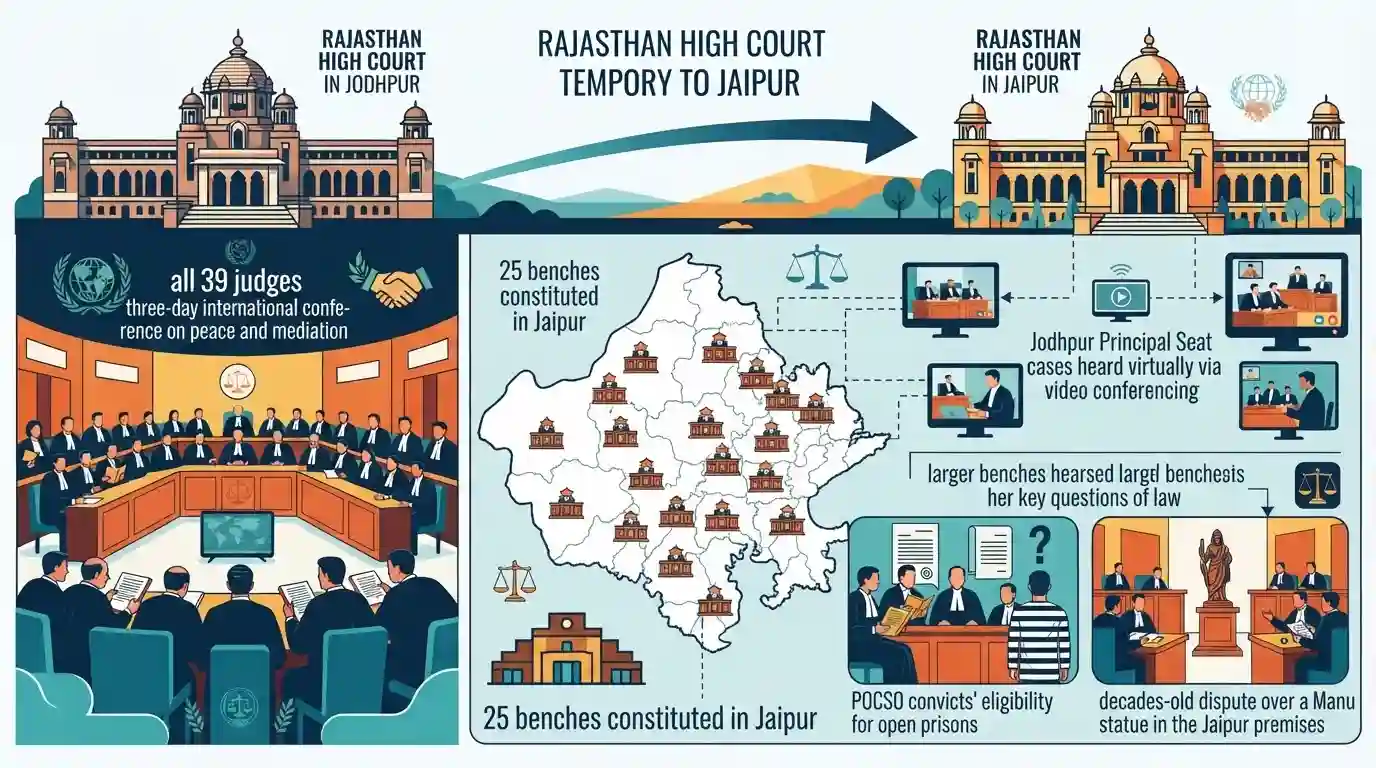
In a unique administrative and technological feat, all 39 judges of the Rajasthan High Court (from the Jodhpur Principal Seat and Jaipur Bench) temporarily shifted to Jaipur for a three-day international conference on peace and mediation. To ensure uninterrupted judicial operations, 25 benches were constituted in Jaipur, with Jodhpur Principal Seat cases being heard virtually via video conferencing. Larger benches also took up key questions of law, including POCSO convicts' eligibility for open prisons and the decades-old dispute over a Manu statue in the Jaipur premises.
Key Points
- All 39 judges of the Rajasthan High Court relocated to Jaipur to attend a three-day international conference on peace, mediation, and the rule of law, organized by the Rajasthan State Legal Services Authority (RSLSA).
- To avoid any disruption in judicial work, the High Court established 25 benches (4 larger benches, 6 division benches, and 15 single benches) functioning entirely from Jaipur.
- For the Principal Seat at Jodhpur, cases were heard via video conferencing (VC) through a dedicated set of 8 benches (1 larger, 3 division, 4 single).
- The Jaipur Bench handled local cases through the remaining 17 benches (3 larger, 3 division, 11 single).
- The larger benches were convened to hear major legal questions: whether priority should be granted to cases of senior citizens, women, children, and PwDs; the long-standing petition (since 1989) regarding the Manu statue at the Jaipur Bench; and whether POCSO/rape convicts are eligible for open prisons.
Important Terms
Protection of Children from Sexual Offences (POCSO) Act

A gender-neutral 2012 Indian law designed to protect minors from sexual assault, harassment, and pornography, ensuring child-friendly trial procedures and stringent punishments.
UPSC context
Crucial for GS-II (Vulnerable Sections). Tests knowledge of child rights and judicial approaches to sentencing, as debated in the Rajasthan High Court.
Open Prisons
Minimum-security correctional facilities without high walls, where selected convicts with good conduct can live with their families and earn a livelihood, promoting social rehabilitation.
UPSC context
Relevant for GS-II (Criminal Justice Reform). Highlights progressive, cost-effective rehabilitation models and human rights in governance.
Rajasthan State Legal Services Authority (RSLSA)
A statutory body under the Legal Services Authorities Act, 1987, tasked with providing free legal aid, organizing Lok Adalats, and promoting alternative dispute resolution across Rajasthan.
UPSC context
Tests GS-II (Statutory Bodies, Access to Justice). Illustrates state-level implementation of legal aid and alternative dispute resolution mechanisms.
Alternative Dispute Resolution (ADR)
Mechanisms like mediation, arbitration, and conciliation used to resolve legal disputes outside of traditional court litigation, reducing judicial pendency and fostering amicable settlements.
UPSC context
Core GS-II topic (Judicial Reforms). Frequently tested on strategies to reduce court backlogs and improve ease of doing business.
Larger Bench
A judicial bench of three or more judges in a High Court or the Supreme Court, constituted to resolve complex legal questions or conflicting rulings by smaller benches.
UPSC context
Important for GS-II (Indian Constitution). Tests understanding of judicial precedent, constitutional interpretation, and the internal hierarchy of courts.
Prelims Trap
High Courts are constitutionally restricted to hearing cases exclusively at their designated principal seat.
The Chief Justice of a High Court can authorize sittings at other places within the State, subject to the prior approval of the Governor.
Static Concepts Connected
What is the statutory framework governing State Legal Services Authorities (SLSAs)?
- Governing Act: Constituted under the Legal Services Authorities Act, 1987, to give effect to Article 39A.
- Patron-in-Chief: The Chief Justice of the respective High Court serves as the Patron-in-Chief of the SLSA.
- Executive Chairman: A serving or retired High Court judge, nominated by the Governor in consultation with the CJ.
How are Open Prisons regulated within the Indian criminal justice system?
- State Subject: Prisons and their administration are purely a State subject under Entry 4 of the State List (Schedule VII).
- Reformative Justice: They operate on trust and rehabilitation rather than deterrence, allowing well-behaved inmates to live without traditional high-security walls.
- Eligibility Criteria: Governed by state-specific jail manuals; usually strictly excludes heinous crimes, anti-national activities, or repeat offenders.
Cross-Topic Patterns
e-Courts Mission & ICT Integration
The seamless shift to virtual conferencing highlights Phase III of the e-Courts project, emphasizing cloud infrastructure and interoperable criminal justice systems (ICJS).
Open Prisons vs. Retributive Justice
The judicial debate on POCSO convicts in open jails connects penology (reformative vs. retributive justice) with statutory child protection frameworks.

Expect a multi-statement prelims question on the legal framework for open prisons and SLSA mandates under the Legal Services Act.
Linked PYQs · 2
Linked PYQs · 2
- 2023RPSC_PRELIMSGS1
According to Article 217 (1) of the Constitution, the President shall make the appointment of a judge of the Rajasthan High Court (other than the Chief Justice) after consultation with whom?
- 2023RPSC_PRELIMSGS1
According to Article 217(1) of the Constitution, who does the President appoint on the advice of whom, other than the Chief Justice of the Rajasthan High Court?
