Rajasthan High Court Condoned GST Appeal Delay on Online Upload
Source:taxguru ↗
Why It Matters
This ruling is significant for understanding the intersection of e-governance (digital tax portals) and administrative law. It underscores the continued relevance of the principles of natural justice and the High Court's writ jurisdiction (Article 226) in protecting citizens from arbitrary executive actions.
Summary
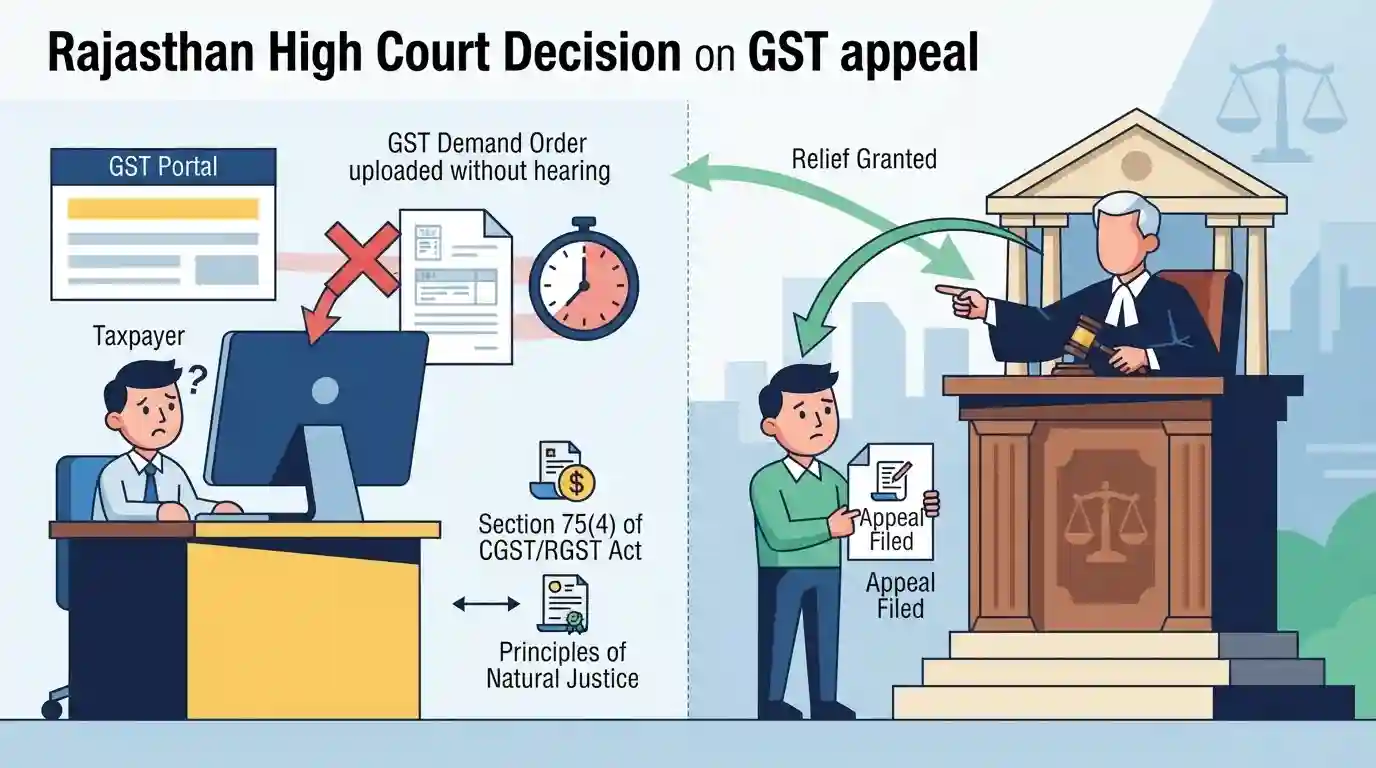
The Rajasthan High Court granted relief to a taxpayer by condoning a delay in filing an appeal against a GST demand order. The court observed that the order was merely uploaded on the GST portal and no personal hearing was granted, which prima facie violates Section 75(4) of the CGST/RGST Act and the principles of natural justice. The decision highlights the judiciary's role under Article 226 in ensuring that digital administrative procedures do not override a citizen's fundamental right to be heard and to seek appellate remedies.
Key Points
- The Rajasthan High Court condoned a delay in filing an appeal against a GST demand order, allowing the case to be heard on merits.
- The petitioner contended that the GST order was only uploaded on the GST portal without effective communication, violating the principles of natural justice.
- The court noted the alleged non-compliance with Section 75(4) of the CGST/RGST Act, 2017, which mandates an opportunity for a personal hearing before adverse orders are passed.
- The ruling reinforces that substantive justice and the right to appeal should not be thwarted by digital communication gaps or procedural technicalities.
Important Terms
Central Goods and Services Tax Act, 2017

The primary parliamentary legislation governing the levy and collection of tax on the intra-state supply of goods and services by the Central Government.
UPSC context
Crucial for GS Paper 3 (Economy), testing indirect tax architecture, economic reforms, and cooperative federalism.
GST Council
A constitutional body established under Article 279A, chaired by the Union Finance Minister, responsible for making recommendations to the Union and States on GST-related issues.
UPSC context
Highly relevant for GS Paper 2 (Polity), focusing on constitutional bodies, inter-state relations, and cooperative federalism.
Section 75(4) of the CGST Act
A statutory safeguard mandating that a personal hearing must be granted to a taxpayer if requested, or if any adverse decision is contemplated against them.
UPSC context
Relevant for GS Paper 2 and 3, illustrating procedural fairness, e-governance limitations, and statutory codification of natural justice.
Principles of Natural Justice
Fundamental legal tenets ensuring fairness in administrative or judicial actions, primarily encompassing the right to a fair hearing (audi alteram partem) and the rule against bias.
UPSC context
Key for GS Paper 2 (Polity), testing administrative law, fundamental rights, and the prevention of arbitrary executive action.
Article 226
A constitutional provision empowering High Courts to issue writs for the enforcement of Fundamental Rights and for other legal rights, ensuring judicial review over administrative actions.
UPSC context
Essential for GS Paper 2 (Polity), testing constitutional remedies, High Court powers, and judicial intervention in governance.
Rajasthan High Court
The highest judicial authority in Rajasthan, empowered with appellate and writ jurisdiction to ensure that administrative actions—like digital tax procedures—do not override citizens' rights.
UPSC context
Relevant to GS Paper 2 (Polity), illustrating the State Judiciary's role in upholding natural justice and checking executive overreach.
Prelims Trap
Writ jurisdiction under Article 226 cannot be invoked in tax disputes if an alternative statutory appellate mechanism exists.
High Courts can invoke Article 226 despite statutory appellate mechanisms if fundamental rights or natural justice (like the right to a hearing) are violated.
Static Concepts Connected
What are the core components of Natural Justice in Indian administrative law?
- Audi alteram partem: No person should be condemned unheard; it mandates fair notice and an opportunity for a personal hearing before adverse action.
- Rule against bias: The rule against bias, ensuring that no authority or adjudicator acts as a judge in their own cause.
- Reasoned decisions: Authorities must provide clear, written reasons for adverse decisions, preventing arbitrary administrative actions.
How does the writ jurisdiction of High Courts compare to the Supreme Court?
- Wider subject scope: Article 226 covers both Fundamental Rights and ordinary legal rights, making it wider in scope than Article 32.
- Discretionary nature: Article 32 is a Fundamental Right itself, whereas Article 226 is discretionary, meaning HCs can refuse to exercise it.
- Territorial limits: HCs can issue writs only within their territorial jurisdiction or if the cause of action arises within their territory.
Cross-Topic Patterns
E-Governance vs. Natural Justice
The shift to faceless assessments and portal-based administration risks excluding citizens, creating a direct clash between digital efficiency (e-governance) and fundamental administrative justice (right to be heard).
Tribunal Vacancies and Writ Burdens
Delayed operationalization of GST Appellate Tribunals (GSTAT) has forced taxpayers to bypass statutory appeals and heavily rely on High Courts' writ jurisdiction, overburdening constitutional courts.

Expect a 2026 Mains question on how 'faceless' e-governance initiatives and portal-based administration challenge natural justice principles.
Linked PYQs · 2
Linked PYQs · 2
- 2018RPSC_PRELIMSGS1
What has been included in the scope of GST (Goods and Services Tax)?
- 2013RPSC_PRELIMSGS1
List-1 is matched with List-2 and the correct answer is selected using the codes given below - List-1 – List-2 Constitutional Article – Provision A. 215 1. Transfer of a judge from one High Court to another High Court B. 222 2. Power of superintendence over all courts C. 226 3. Power of the High Court to issue certain writs D. 227 4. The High Court as a court of record Code:
