Rajasthan High Court Directs Local Body Election Schedule
Source:the-statesman ↗
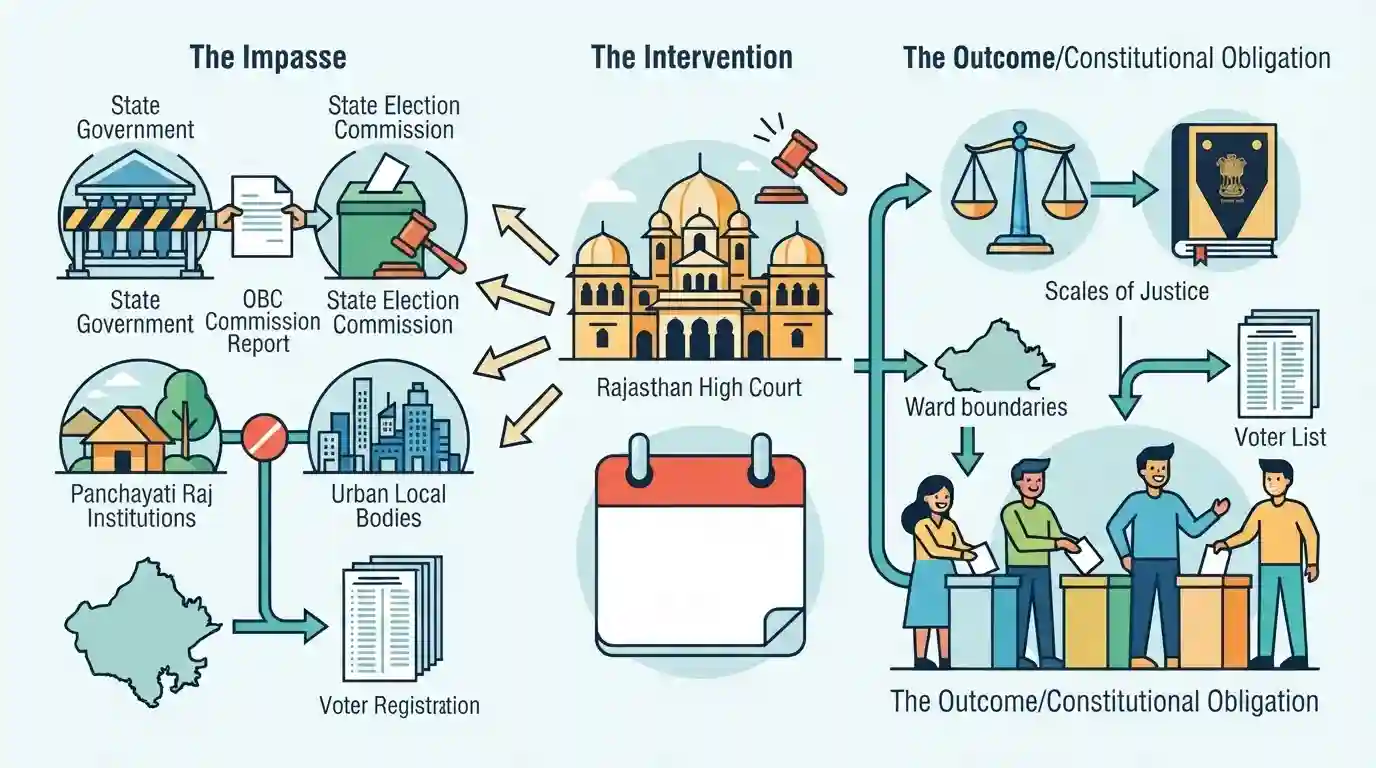
Why It Matters
Timely conduct of elections for Panchayati Raj Institutions and Urban Local Bodies is a strict constitutional mandate under Articles 243E and 243U. Delays caused by the finalization of reservation quotas (such as OBC limits) highlight the tension between ensuring social justice through political representation and adhering to democratic electoral timelines, a highly relevant theme for RPSC RAS examinations.
Summary
The Rajasthan High Court has issued a directive to the State Government and the State Election Commission (SEC) to submit a detailed election schedule for overdue Panchayats and Urban Civic Bodies by July 20, 2026. During hearings on contempt petitions related to delayed polls, the SEC argued that the delay stems from the state government's failure to provide the State OBC Commission's report on political reservation quotas. This missing data prevents the finalization of ward boundaries and voter lists. The High Court stressed the constitutional obligation to conduct regular local body elections, prompting swift administrative action to resolve the impasse.
Key Points
- The Rajasthan High Court ordered the state government and the State Election Commission (SEC) to submit an election schedule for pending Panchayats and Urban Civic Bodies by July 20, 2026.
- The SEC attributed the delay to the absence of crucial data from the state government, primarily the report from the State OBC Commission required to determine reservation quotas.
- Without the OBC quota report, finalized ward boundaries and reservation categories cannot be completed, stalling the finalization of voter lists.
- The High Court intervened on contempt of court petitions regarding missed election deadlines, emphasizing the constitutional mandate for holding regular, timely local body elections.
- The SEC assured the court that it is prepared with polling booths and EVMs, waiting only for the administrative data to proceed.
Important Terms
Part IX and IXA of the Constitution

Constitutional provisions added by the 73rd and 74th Amendments in 1992. They grant constitutional status to Panchayats and Municipalities, thereby establishing a formal framework for grassroots democratic local self-governance in India.
UPSC context
GS Paper 2 (Polity): Fundamental to understanding India's three-tier governance structure, democratic decentralization, and local bodies.
State Election Commission (SEC)
A constitutional body established under Articles 243K and 243ZA to superintend, direct, and control the preparation of electoral rolls and the conduct of all free and fair elections to Panchayats and Municipalities.
UPSC context
GS Paper 2 (Polity): Important for topics covering constitutional bodies, local self-government elections, and independent electoral machinery.
State OBC Commission
A state-level body responsible for identifying Backward Classes. For local elections, it must provide empirical data on political backwardness to fulfill the Supreme Court's "triple test" for determining OBC reservation quotas.
UPSC context
GS Paper 2 (Polity, Social Justice): Crucial for understanding affirmative action, political reservations in local governance, and judicial precedents.
Prelims Trap
The Constitution mandates proportional reservation for Other Backward Classes (OBCs) in Panchayati Raj Institutions.
Articles 243D and 243T strictly mandate reservation for SCs, STs, and women, but explicitly leave OBC reservations to the discretion of the State Legislature.
Static Concepts Connected
What is the Supreme Court's 'Triple Test' for OBC reservation in local bodies?
- Empirical Commission: The state must establish a dedicated commission to collect empirical data on local backwardness.
- Body-wise Quota: The state must specify the exact proportion of reservation required for local bodies based on the commission's data.
- 50% Ceiling: Aggregate reservations (SC + ST + OBC) must not breach the overall 50% limit.
What is the constitutional status of the State Election Commission (SEC)?
- Constitutional Basis: Created under Articles 243K (Panchayats) and 243ZA (Municipalities), it operates entirely independent of the Election Commission of India.
- Security of Tenure: Though appointed by the Governor, the SEC can only be removed in the same manner and on the same grounds as a High Court judge.
- Core Mandate: Vested with superintending, directing, and controlling electoral rolls and the conduct of all local body elections.
Cross-Topic Patterns
Art 243-O Bar vs. Writ Jurisdiction
While Art 243-O bars courts from electoral delimitation issues, High Courts routinely invoke writ jurisdiction to enforce the strict five-year constitutional mandate for holding local elections when states delay them.
Data deficits stalling electoral democracy
Just as the delayed Census postponed the Women's Reservation Act implementation, missing state-level empirical data (OBC reports) frequently stalls grassroots elections across various Indian states due to quota impasses.

The 'Triple Test' criteria for OBC quotas paired with the SEC's removal process is highly likely as a multi-statement question in 2026.
Linked PYQs · 3
Linked PYQs · 3
- 2016RPSC_PRELIMSGS1
The State Election Commission of Rajasthan is
- 2016RPSC_PRELIMSGS1
How many times have elections been held for the Panchayati Raj institutions in Rajasthan until 2015?
- 2021RPSC_PRELIMSGS1
According to the provisions of the Rajasthan Municipal Act, 2009, what is the maximum number of persons that the State Government can nominate in a Municipal Council?
