Rajasthan and Haryana Finalize Yamuna Water Sharing Agreement
Source:socialnews.xyz ↗
Why It Matters
Inter-state water sharing, specific canal/irrigation networks, and beneficiary districts are highly tested areas in RPSC RAS Prelims. The Yamuna Water Project represents a major geographical and administrative development directly benefiting Rajasthan's water-stressed Shekhawati region.
Summary
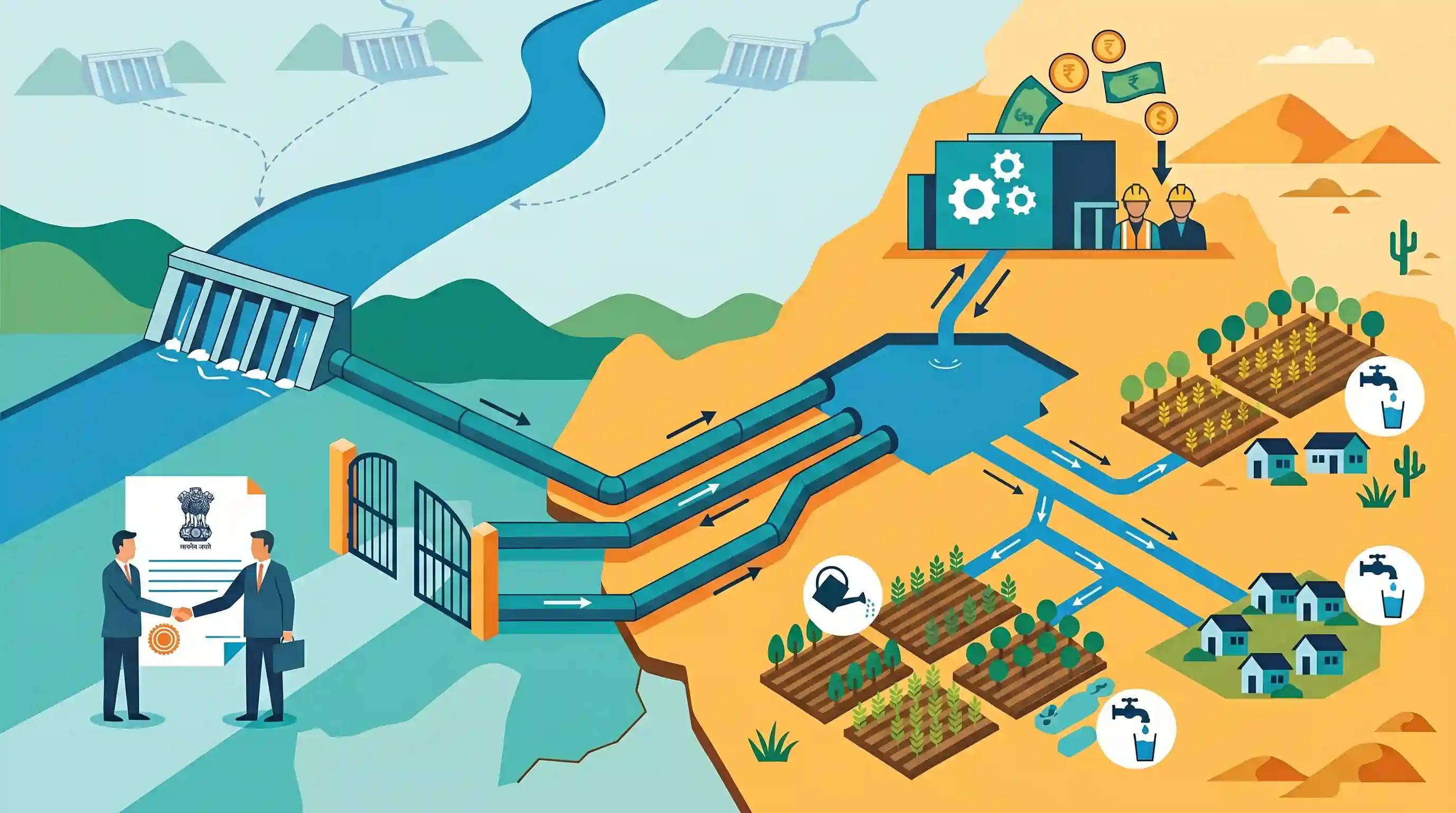
Rajasthan and Haryana signed a historic Memorandum of Agreement (MoA) in New Delhi to implement the 1994 Yamuna water-sharing pact, ending a three-decade dispute. Under this agreement, Rajasthan will receive its allocated 1,917 cusecs of water via three 3.6-meter diameter pipelines stretching from Hathnikund Barrage in Haryana to the Hashyawas reservoir in Churu district. The project, which utilizes gravity flow, will supply critical drinking and irrigation water to the Shekhawati region (Sikar, Churu, and Jhunjhunu). It will be managed by a dedicated Special Purpose Vehicle (SPV) and funded by Rajasthan, with future plans to use the infrastructure for Kishau, Lakhwar, and Renukaji project allocations.
Key Points
- Rajasthan and Haryana have agreed to implement the 1994 Yamuna Water-Sharing Agreement, ending a 30-year deadlock over water allocation and transport [1.1].
- Under the agreement, Rajasthan is allocated 1,917 cusecs of Yamuna water to provide drinking and irrigation water to the Shekhawati region (Sikar, Churu, and Jhunjhunu districts) [1.1].
- The Yamuna Water Project involves laying three parallel pipelines of 3.6-meter diameter from the Hathnikund Barrage in Haryana to the Hashyawas reservoir in Churu, Rajasthan [1.1].
- The pipeline corridor will run through five districts of Haryana: Yamunanagar, Kurukshetra, Kaithal, Jind, and Hisar [1.1].
- Because Rajgarh in Churu is nearly 110 meters lower than Hathnikund, water will flow naturally via gravity along most of the route, with pumping stations installed to maintain flow during dry periods [1.1].
- Instead of a joint management board, a Special Purpose Vehicle (SPV) will be established to construct, operate, and maintain the project, with Rajasthan bearing the primary financial burden [1.1].
- The pipeline network will be future-proofed to eventually transport Rajasthan's water share from the upcoming Kishau, Lakhwar, and Renukaji projects [1.1].
Important Terms
1994 Yamuna Water-Sharing Agreement

An interstate pact allocating Yamuna River waters among five basin states—Haryana, Uttar Pradesh, Rajasthan, Delhi, and Himachal Pradesh—governed by the Upper Yamuna River Board.
UPSC context
GS-II: Inter-State Water Disputes and Federalism; tests understanding of river water dispute resolution and sharing frameworks.
Lakhwar Multipurpose Project
A 300 MW national hydroelectric and water storage project on the Yamuna River in Uttarakhand, designed to supply drinking and irrigation water to six northern states.
UPSC context
GS-I & GS-III: Geography and Infrastructure; tests knowledge of key river valley projects and regional water security.
Kishau Multipurpose Project
A proposed inter-state hydropower and water-storage dam project on the Tons River (a Yamuna tributary) along the Himachal Pradesh-Uttarakhand border, benefiting six states.
UPSC context
GS-I & GS-III: River basins and infrastructure; tests familiarity with Yamuna basin development and inter-state project coordination.
Renukaji Dam Project
A 148-meter-high rock-fill storage dam project on the Giri River (a Yamuna tributary) in Himachal Pradesh, aimed primarily at securing Delhi's lean-season drinking water.
UPSC context
GS-I & GS-III: Water resource management; tests awareness of critical reservoir projects and cooperative federalism in basin sharing.
Ministry of Jal Shakti
The apex Union ministry in India overseeing the integrated development, management, conservation, and administration of the country's water resources, river basins, and drinking water.
UPSC context
GS-II: Government policies and institutional frameworks; tests knowledge of water governance, conservation missions, and interstate river management.
Special Purpose Vehicle (SPV)
A distinct, legally structured entity created by an organization to isolate financial risk and focus exclusively on executing a specific project or objective.
UPSC context
GS-III: Investment models and infrastructure; tests conceptual understanding of specialized corporate and financing structures used in public projects.
Prelims Trap
Uttarakhand was one of the original 1994 signatory states to the Upper Yamuna Water Sharing Agreement.
Uttarakhand was only created in 2000; it became a party to the 1994 agreement post-bifurcation. Original signatories were Haryana, UP, Rajasthan, HP, and Delhi.
Static Concepts Connected
What are the constitutional provisions for managing inter-state water disputes?
- Article 262: Empowers Parliament to legislate on adjudication of disputes relating to inter-state river waters, explicitly excluding Supreme Court jurisdiction.
- Union List Entry 56: Gives the Union power to regulate and develop inter-state rivers and river valleys to the extent declared by Parliament.
- State List Entry 17: Governs water supply, irrigation, canals, drainage, and water power, but is subject to Entry 56 of the Union List.
What are the key features of the Upper Yamuna Basin?
- Geographical Extent: Defined geographically as the stretch of the Yamuna River from its origin at Yamunotri down to the Okhla Barrage in Delhi.
- Upper Yamuna River Board: Established in 1995 as a subordinate office under the Ministry of Jal Shakti to regulate water allocation among the basin states.
- Key Storage Projects: Includes Kishau (on Tons river), Lakhwar (on Yamuna), and Renukaji (on Giri river) to store and regulate seasonal monsoon flows.
Cross-Topic Patterns
Water federalism and bilateral SPVs
Shows a structural shift from adversarial Article 262 tribunals to collaborative, state-funded Special Purpose Vehicles (SPVs) to bypass political deadlocks.
Gravity-led design & climate adaptation
Utilizing a 110-meter natural elevation drop for gravity flow minimizes the massive energy footprint typically required for dryland canal irrigation.

The distinction between Article 262 statutory tribunals and bilateral executive SPVs for water sharing is a prime target for GS-2 federalism.
Linked PYQs · 3
Linked PYQs · 3
- 2023RPSC_PRELIMSGS1
The Mahi Bajaj Sagar project is a joint venture of:
- 2021RPSC_PRELIMSGS1
The 'Parwan' multipurpose irrigation project of Rajasthan will provide irrigation facilities to which districts?
- 2018RPSC_PRELIMSGS1
In Rajasthan, for the first time, which of the following projects has made sprinkler irrigation mandatory?
