Caste Based Pressure Groups Challenge State Administration
Source:Indian Express ↗
Why It Matters
This development is highly relevant for GS Paper 2 (Polity and Governance), illustrating the practical mechanics of pressure groups and caste-based political mobilization in India. It also touches upon the complexities of the reservation system (affirmative action), constitutional provisions concerning backward classes, and the administrative challenges of balancing community demands with judicial caps and social harmony.
Summary
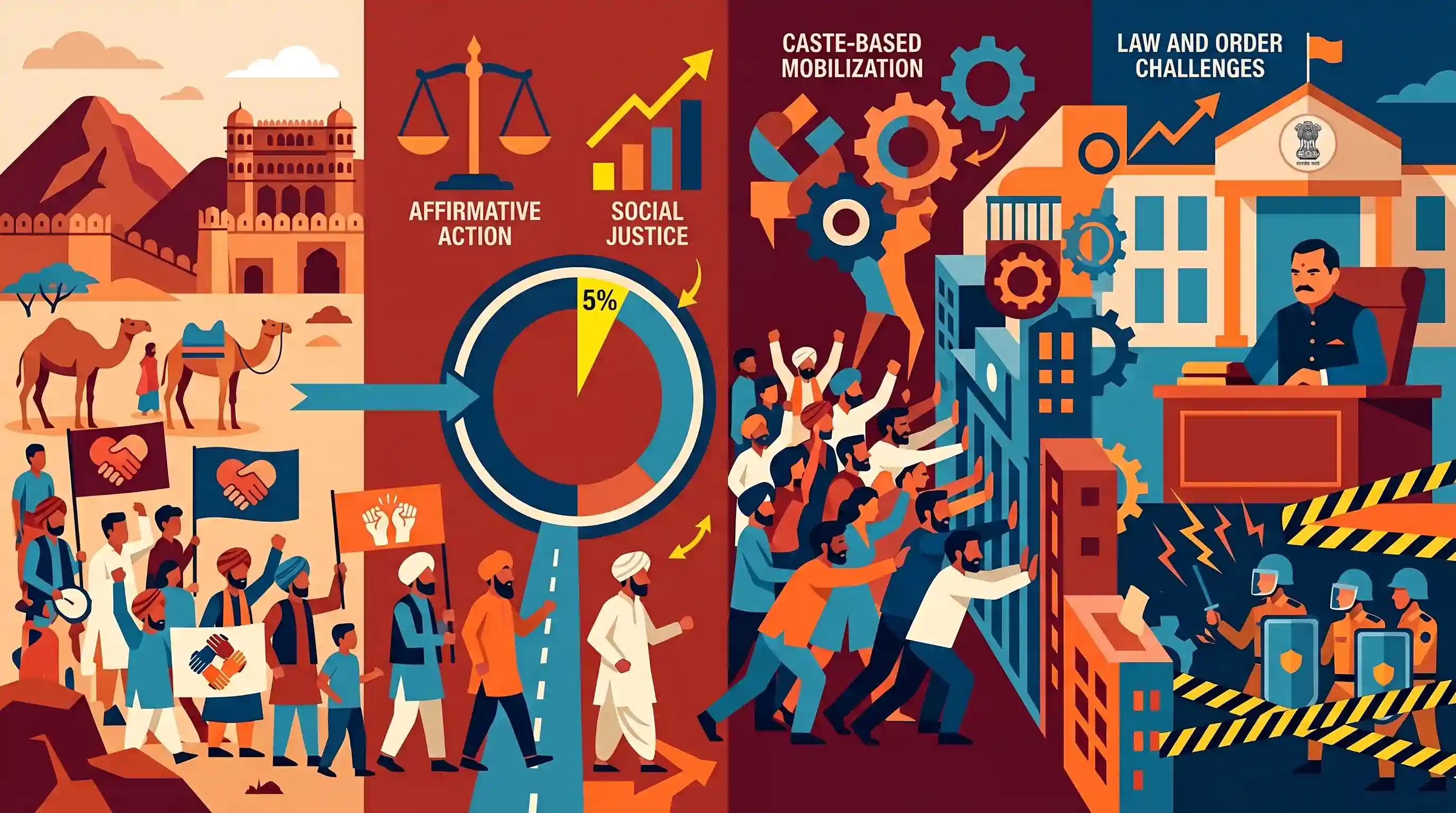
In Rajasthan, the Gujjar community is gearing up for a fresh round of protests against the BJP government led by Chief Minister Bhajan Lal Sharma, claiming their long-standing demands remain unfulfilled. Historically, the community has spearheaded massive agitations demanding enhanced reservation benefits, transitioning from demands for Scheduled Tribe (ST) status to securing a 5% Most Backward Classes (MBC) quota. This impending stir underscores the persistent influence of caste-based mobilization and pressure group tactics in regional politics, which often present significant law-and-order and governance challenges for the state machinery.
Key Points
- The Gujjar community in Rajasthan is preparing for renewed agitations against the BJP government led by CM Bhajan Lal Sharma, citing that their demands remain unmet.
- Historically, Rajasthan's Gujjars have led intense protests demanding inclusion in the Scheduled Tribes (ST) category, which eventually led to the creation of a 5% Most Backward Classes (MBC) quota for them and other communities.
- The potential for a new stir highlights the ongoing role of caste-based mobilization and informal pressure groups in Indian state politics to negotiate policy concessions.
- Such agitations typically pose significant governance, economic, and law-and-order challenges for the state administration due to tactics like blockades and protests.
Important Terms
Most Backward Classes (MBC) Quota

A specific sub-category within the Other Backward Classes (OBC) in Rajasthan, providing 5% reservation to communities like Gujjars and Banjaras deemed extremely marginalized compared to the broader OBC pool.
UPSC context
GS II (Social Justice); critical for understanding sub-categorization of OBCs and the 50% reservation ceiling set by the Indra Sawhney judgment.
Scheduled Tribe (ST) Status
A constitutional designation under Article 342 for communities exhibiting primitive traits, geographical isolation, and social backwardness, entitling them to dedicated political representation and affirmative action benefits.
UPSC context
GS II (Governance/Tribal Welfare); tests knowledge of the Lokur Committee criteria and the legal process for community inclusion in the ST list.
Gujjar Aarakshan Sangharsh Samiti
A caste-based pressure group that mobilizes the Gujjar community in Rajasthan to demand enhanced reservation benefits, representing the influence of interest groups on state-level policy and governance.
UPSC context
GS II (Pressure Groups); serves as a case study for how informal associations use agitation to influence legislative and executive decisions.
Pressure Groups
Organized interest groups that attempt to influence public policy and government decisions through lobbying or protest without directly contesting elections or seeking to capture formal political power.
UPSC context
GS II (Polity/Governance); a major syllabus theme regarding the role of civil society and associations in a democratic framework.
Caste-based Mobilization
The political strategy of organizing individuals based on their caste identity to secure socio-economic benefits, reservation, or electoral influence from the state.
UPSC context
GS I & II (Indian Society/Polity); explores the persistence of caste as a factor in modern Indian democratic and developmental processes.
Prelims Trap
"Laws placed in the Ninth Schedule are completely immune from judicial review and cannot be struck down for breaching the 50% limit."
Post the I.R. Coelho judgment (2007), laws added to the 9th Schedule after April 24, 1973, are open to judicial review if they violate the Constitution's Basic Structure.
Static Concepts Connected
What is the constitutional status of the Ninth Schedule regarding judicial review?
- Article 31B Origin: Inserted via the 1st Amendment (1951) under Article 31B, it was originally designed to protect land reform laws from fundamental rights challenges.
- I.R. Coelho Case: The Supreme Court ruled that blanket immunity does not exist for laws added to the 9th Schedule after the Kesavananda Bharati verdict (April 24, 1973).
- Basic Structure Test: Even 9th Schedule laws can be struck down if they abrogate fundamental rights forming part of the basic structure (e.g., Articles 14, 15, 19, 21).
How does a community secure Scheduled Tribe (ST) status under the Indian Constitution?
- Presidential Notification: Under Article 342, the President, after consulting the state's Governor, issues a public notification specifying the tribes or tribal communities for that state.
- Parliamentary Amendment: Once notified, any subsequent inclusion in or exclusion from this ST list can only be made by Parliament through a specific law.
- State Limitation: State governments can only recommend inclusion based on criteria like primitive traits, distinct culture, and geographical isolation; they cannot independently grant ST status.
Cross-Topic Patterns
Sub-categorization of quotas across states
The Gujjar demand for MBC status parallels the recent landmark Supreme Court ruling permitting the sub-classification of SCs and STs by state governments to ensure equitable quota distribution.
Pressure groups & economic blockades
Caste-based non-associational pressure groups using extra-parliamentary tactics (rail/highway blockades) test the boundary between democratic grievance redressal and state internal security/law-and-order management.

Expect a 2026 question linking Article 342 (ST notification), the 9th Schedule's judicial review limits, and state quota sub-categories.
Linked PYQs · 3
Linked PYQs · 3
- 2017MainsGS2
How do pressure groups influence Indian political process? Do you agree with this view that informal pressure groups have emerged as more powerful than formal pressure groups in recent years?
- 2022MainsGS2
Discuss the role of the National Commission for Backward Classes in the wake of its transformation from a statutory body to a constitutional body.
- 2023PrelimsGS1
Consider the following statements: Statement-I: The Supreme Court of India has held in some judgements that the reservation policies made under Article 16(4) of the Constitution of India would be limited by Article 335 for maintenance of efficiency of administration. Statement-II: Article 335 of the Constitution of India defines the term 'efficiency of administration'. Which one of the following is correct in respect of the above statements?
